ACT Science Essentials
Master the ACT Science section with proven strategies for data analysis, experiments, and viewpoints to boost your score efficiently.
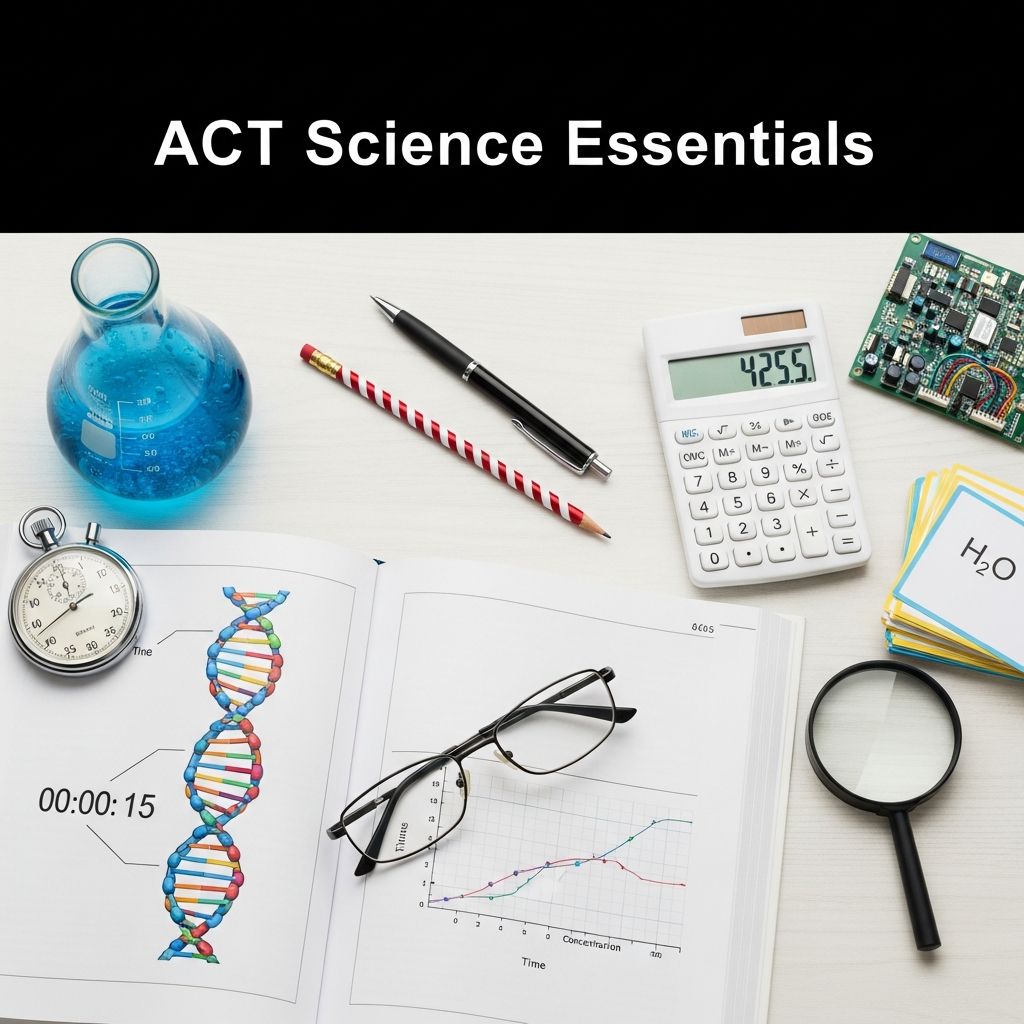
ACT Science Essentials: Your Roadmap to a Top Score
The ACT Science section challenges students to demonstrate critical thinking in scientific contexts without requiring advanced subject knowledge. Spanning 35 minutes for 40 multiple-choice questions, it evaluates your ability to interpret data, understand experiments, and evaluate competing ideas.
Understanding the Test Blueprint
The section features six to seven passages, each paired with 5-7 questions, totaling 40 items. Unlike pure science exams, it mimics reading comprehension with scientific visuals and text, demanding quick analysis under time pressure—about 53 seconds per question.
Passages fall into three categories:
- Data Representation (30-40%): Focuses on graphs, tables, and figures. Questions test identifying trends, interpolating values, and comparing datasets.
- Research Summaries (45-60%): Describes 1-3 experiments. Emphasizes design elements like variables, controls, and result interpretation.
- Conflicting Viewpoints (15-20%): Presents two scientists’ hypotheses. Requires comparing arguments, evidence, and resolutions.
| Passage Type | Percentage | Key Skills | Example Content |
|---|---|---|---|
| Data Representation | 30-40% | Trend spotting, calculations from visuals | Line graphs of temperature vs. time |
| Research Summaries | 45-60% | Variable identification, hypothesis testing | Plant growth experiments |
| Conflicting Viewpoints | 15-20% | Argument comparison, evidence evaluation | Dinosaur extinction theories |
Scores scale from 1-36 based on raw correct answers, adjusted for test difficulty variations, not peer performance.
Core Competencies for Success
Excel by honing three reporting categories: Interpretation of Data (40%), Scientific Investigation (20-30%), and Evaluation of Models (30-40%).
Mastering Data Interpretation
This dominates with questions on visuals. Practice spotting patterns: direct relationships (rising together), inverse (one rises, other falls), or correlations. Calculate rates, like speed from distance-time graphs, using formulas such as slope = rise/run.
Tip: Scan questions first to target relevant data points, saving time.
Navigating Scientific Investigations
Understand experiment anatomy: independent variable (manipulated), dependent (measured), controls (held constant). Identify hypotheses, predict outcomes, and spot flaws like insufficient replicates.
Common scenarios include biology (enzyme activity), chemistry (reaction rates), physics (motion), and earth sciences (climate data).
Resolving Conflicting Perspectives
One passage, two views. Underline key claims, supporting evidence, and assumptions. Questions probe similarities, differences, and strongest support. Dual-passage strategy: Label questions by viewpoint, highlight conflicts, then align answers.
Strategic Approaches to Maximize Efficiency
Time is tight; prioritize. Spend 5 minutes per passage max.
- Preview Questions: Read all before the passage to focus reading.
- Target Passage Type: Data reps quickest; viewpoints slowest.
- Eliminate Extremes: Answers like ‘always’ or ‘never’ often wrong.
- Guess Smart: All answers in passage; no penalty for guessing.
- Pace Yourself: Flag and skip tough ones; return if time.
For dual passages, categorize questions as View 1, View 2, or Both for precision.
Building a Rock-Solid Study Plan
Start with diagnostics: Take full timed practice tests from official ACT resources to benchmark.
- Week 1-2: Review fundamentals via Khan Academy or ACT.org modules.
- Week 3-4: Passage drills: 10 data reps, 10 research, 5 viewpoints daily.
- Week 5+: Full sections, analyze errors by category.
Track progress: Aim for 80% accuracy in weak areas before test day. Simulate conditions: No calculator, quiet space, 35 minutes.
Typical Traps and How to Avoid Them
Trap 1: Over-Reading. Skim for structure, dive only as needed.
Trap 2: Math Phobia. Basic arithmetic only—no formulas provided, but practice graph math.
Trap 3: Ignoring Visuals. 75% questions reference figures; practice rapid decoding.
Trap 4: Viewpoint Mix-Up. Use shorthand notes: ‘Sci A: X causes Y; Sci B: Z instead.’
Sample Passage Breakdown
Imagine a Data Representation passage: Graph shows plant height vs. fertilizer amount. Questions: Which amount maxes growth? Predict at 10g? Trend between 5-15g?
Solution: Peak at 20g, extrapolate linearly, positive correlation.
Research Summary: Two trials test salt on ice melt. Question: Control variable? (Temperature). Which trial invalid? (No replicates).
Conflicting: Scientist 1 claims volcanoes caused extinction (ash evidence); Scientist 2 says asteroid (iridium layer). Strongest support for 1? Weakest for 2?
Boosting Speed and Stamina
Build endurance with back-to-back sections. Use timers for micro-drills: 1 minute per graph question. Read science news (Scientific American summaries) for vocab like ‘extrapolate,’ ‘hypothesis.’
FAQs: ACT Science Clarified
Q: Do I need AP Science? No—grade 11 science suffices; focus skills over facts.
Q: Calculator allowed? No, but simple math only.
Q: How to score 36? 37-40 raw; perfect data trends, experiment logic.
Q: Online vs. Paper? Format similar; practice both if possible.
Q: Improve from 20 to 30? Targeted practice: 20 hours on weaknesses yields 5-10 point gains.
Final Push to Test Day
Review errors nightly. Sleep well; eat light breakfast. In test center, bubble systematically. Post-test, scores in 2 weeks—use for college apps.
With disciplined prep, ACT Science becomes a score booster. Focus skills, practice relentlessly, conquer the section.
References
- A Guide to the Science Section of the ACT — CollegeVine Blog. 2023. https://blog.collegevine.com/a-guide-to-the-science-section-of-the-act
- 9 Tips To Get Ready for the ACT Science Test — Wyzant Blog. 2023. https://blog.wyzant.com/the-facts-about-act-science/
- What’s Actually Tested on the ACT Science Section? — PrepScholar Blog. 2023. https://blog.prepscholar.com/whats-actually-tested-on-act-science-skills-and-topics
- Format of the ACT — Manhattan Review. 2024-02-06. https://www.manhattanreview.com/act-format/
- Preparing for the ACT – Exam Sections & Structure — ACT.org. 2025. https://www.act.org/content/act/en/products-and-services/the-act/test-preparation/act-exam-sections-and-structure.html
- What’s on the ACT Science Section? — C2 Education. 2023. https://www.c2educate.com/whats-act-science-section/
- Description of Science Test — ACT.org. 2025. https://www.act.org/content/act/en/products-and-services/the-act/test-preparation/description-of-science-test.html
Similar Articles






Read full bio of medha deb