AP Biology: Your Guide to College-Level Science
Master AP Biology: Exam format, key topics, preparation strategies, and benefits for high school students aiming for college success.
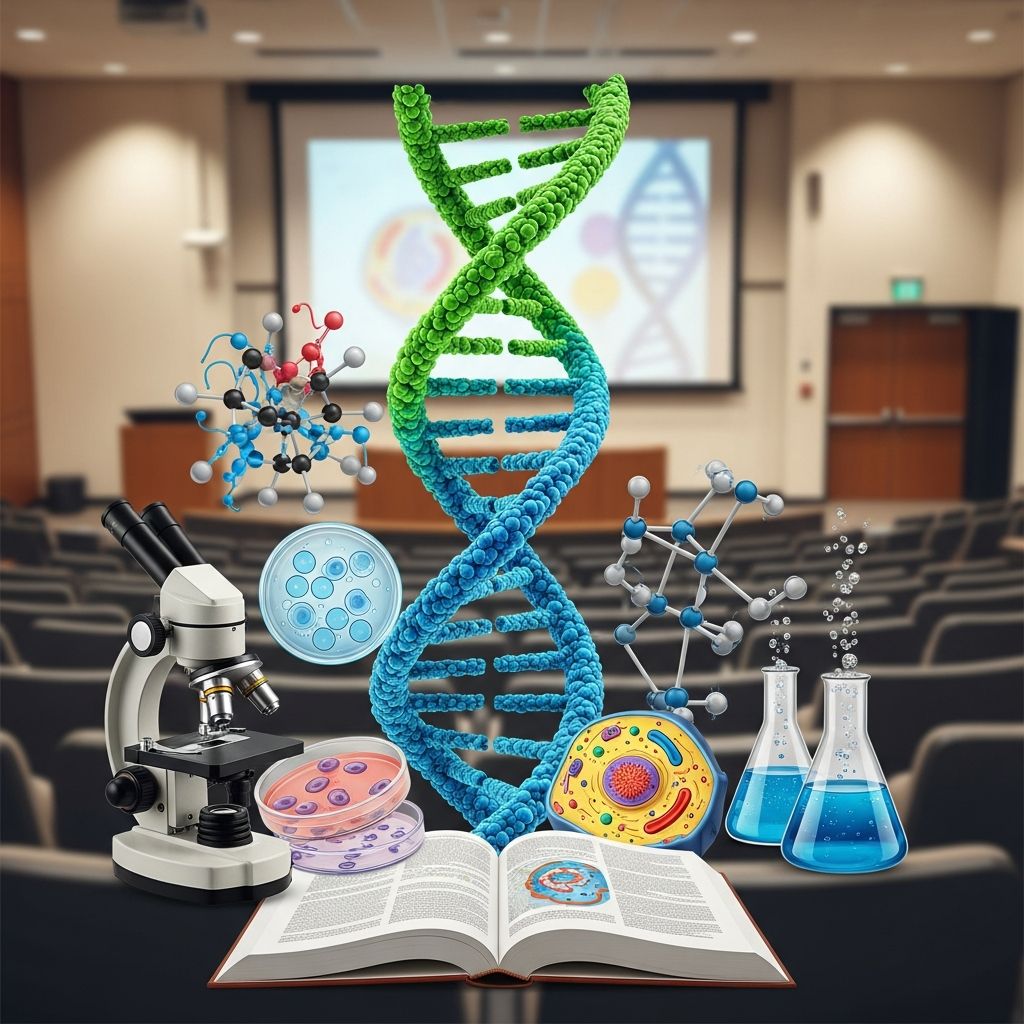
AP Biology offers high school students a challenging dive into college-level biological sciences, building skills in analysis, experimentation, and critical thinking essential for future scientists and health professionals.
Why Pursue AP Biology in High School?
Advanced Placement Biology stands out as one of the most popular AP courses, attracting students passionate about life sciences. This course mirrors a two-semester introductory biology program at universities, emphasizing not just facts but how living systems function through scientific inquiry. It equips learners with tools to dissect complex biological phenomena, from molecular interactions to ecosystem dynamics.
Enrolling in AP Biology signals academic rigor to college admissions officers. High scores can translate to college credits, potentially allowing freshmen to skip basic courses and dive into advanced studies. Beyond credits, the curriculum fosters enduring skills like data interpretation and evidence-based reasoning, valuable across STEM fields.
Core Themes and Learning Units
The AP Biology framework organizes content into eight interconnected units, promoting a big-picture understanding of biology’s foundational principles. These units span scales from atoms to biospheres, highlighting evolution, energy flow, information transfer, and system interactions.
- Unit 1: Chemistry of Life – Investigates water’s properties, macromolecules like proteins and nucleic acids, and enzyme catalysis, laying groundwork for cellular processes.
- Unit 2: Cell Structure and Function – Explores prokaryotic vs. eukaryotic cells, organelles, and membrane dynamics, explaining compartmentalization’s role in life.
- Unit 3: Cellular Energetics – Covers photosynthesis, respiration, and feedback mechanisms governing energy transformations in cells.
- Unit 4: Cell Communication and Cell Cycle – Details signal transduction, mitosis, meiosis, and regulatory checkpoints ensuring accurate cell division.
- Unit 5: Heredity – Examines Mendelian genetics, chromosome behavior, and non-Mendelian inheritance patterns.
- Unit 6: Gene Expression and Regulation – Analyzes DNA replication, transcription, translation, and epigenetic controls influencing gene activity.
- Unit 7: Natural Selection – Focuses on evolutionary mechanisms, speciation, and evidence supporting Darwinian theory.
- Unit 8: Ecology – Addresses population dynamics, community interactions, energy pyramids, and global biogeochemical cycles.
These units interconnect; for instance, genetic principles from Unit 5 underpin evolutionary changes in Unit 7, while ecological patterns in Unit 8 reflect cellular energetics from Unit 3. Mastery requires seeing biology as a web of interdependent processes[10].
Understanding the 2026 AP Biology Exam Structure
The AP Biology exam, lasting three hours, is a hybrid digital assessment delivered via the Bluebook app, split evenly between multiple-choice and free-response sections, each worth 50% of the score.
| Section | Questions | Time | % of Score |
|---|---|---|---|
| Multiple Choice | 60 | 90 minutes | 50% |
| Free Response | 6 (2 long, 4 short) | 90 minutes | 50% |
This format tests conceptual depth over rote recall, demanding application of knowledge to novel scenarios.
Multiple-Choice Section Breakdown
Featuring 60 questions—standalone or in sets linked to stimuli like graphs or experiments—this section evaluates core competencies. Expect to explain concepts, interpret visuals, apply the scientific method, perform calculations, and justify arguments with evidence. Questions might involve analyzing respirometer data to infer respiration rates or evaluating phylogenetic trees for evolutionary relationships. No penalty for guessing encourages thoughtful elimination of wrong answers.
Free-Response Section Insights
The six questions demand written explanations: two long-form (9 points each) often involve experimental design, data graphing, and result interpretation; four short-form (4 points each) probe investigations, models, and data analysis. Success hinges on precise terminology, logical structure, and evidence integration—e.g., predicting biodiversity impacts from habitat disruption.
Preparation Strategies for Success
Effective prep blends content review, practice, and lab simulations. Start by mapping the eight units to the exam’s science practices: concept explanation, visual representation, questioning/methods, data analysis, and argumentation[10].
Daily Study Routine:
- Review one unit weekly, using diagrams for structures like mitochondria or flowcharts for gene expression.
- Practice 20-30 multiple-choice questions daily, timing yourself to build speed.
- Write full free-responses bi-weekly, self-scoring against rubrics from official samples.
- Incorporate labs: simulate enzyme kinetics or population modeling with virtual tools.
Leverage resources like College Board practice exams and unit guides. Focus on weak areas via targeted drills—e.g., if ecology lags, model trophic levels with data sets. Group study sharpens explanation skills vital for free-responses.
Exam Day Essentials and Scoring
On test day, manage time rigorously: 1.5 minutes per multiple-choice, allotting more for complex sets. For free-responses, outline before writing to ensure completeness. Scores range 1-5; 3+ often earns credit, with 4-5 ideal for competitive programs.
Digital tools in Bluebook provide calculators and graphing utilities, but familiarity is key—practice in-app. Post-exam, scores release in July, influencing course placements.
College Credit and Career Advantages
A strong AP Biology score validates readiness for university-level work, freeing schedules for electives or majors like pre-med, environmental science, or biotech. Policies vary—check college sites—but many award credit for 3+, fulfilling gen-ed requirements.
Long-term, skills transfer to MCAT prep, research internships, or lab roles. Alumni report boosted GPAs and confidence in advanced courses.
Frequently Asked Questions (FAQs)
What prerequisites are recommended for AP Biology?
High school biology and chemistry provide essential foundations; algebra proficiency aids data analysis.
Is the AP Biology exam fully digital in 2026?
Yes, it’s a hybrid digital exam using Bluebook for multiple-choice and free-response viewing.
How much time should I dedicate to AP Biology prep?
4-6 months of consistent study, 5-10 hours weekly, intensifying near exam with full practice tests.
Can I use a calculator on the exam?
Digital tools include built-in calculators for free-response; no personal devices allowed.
What if I score a 3—does it help with college apps?
Absolutely; it demonstrates rigor, often qualifying for credit and strengthening STEM profiles.
Overcoming Common Challenges
Students often struggle with interconnections—e.g., linking cellular respiration to ecological energy flow. Combat this with concept maps. Free-response anxiety? Practice rubrics emphasize partial credit for structured attempts. Time management improves via timed sections.
For visual learners, animate processes like mitosis; quantitative types, crunch stats on Hardy-Weinberg equilibrium. Diverse practice mirrors exam variety.
References
- AP® Biology Exam Format Explained — UWorld College Prep. 2025. https://collegeprep.uworld.com/ap/ap-biology/exam-format-and-information/
- AP Biology Exam – AP Students — College Board. 2025. https://apstudents.collegeboard.org/courses/ap-biology/assessment
- The Complete AP Biology Review Guide for 2025 — PrepScholar. 2025. https://blog.prepscholar.com/ap-biology-review
- AP Biology Exam — College Board AP Central. 2025. https://apcentral.collegeboard.org/courses/ap-biology/exam
- AP Biology Exam Guide — The Princeton Review. 2025. https://www.princetonreview.com/college-advice/ap-biology-exam
- What’s Tested on AP Biology: 5 Things to Know — Kaplan Test Prep. 2025. https://www.kaptest.com/study/ap-biology/whats-tested-on-ap-biology-5-things-to-know/
Similar Articles







Read full bio of Sneha Tete