AP vs SAT Subject Tests: Key Differences
Discover how AP exams and SAT Subject Tests differ in purpose, format, scoring, and college impact to optimize your admissions strategy.
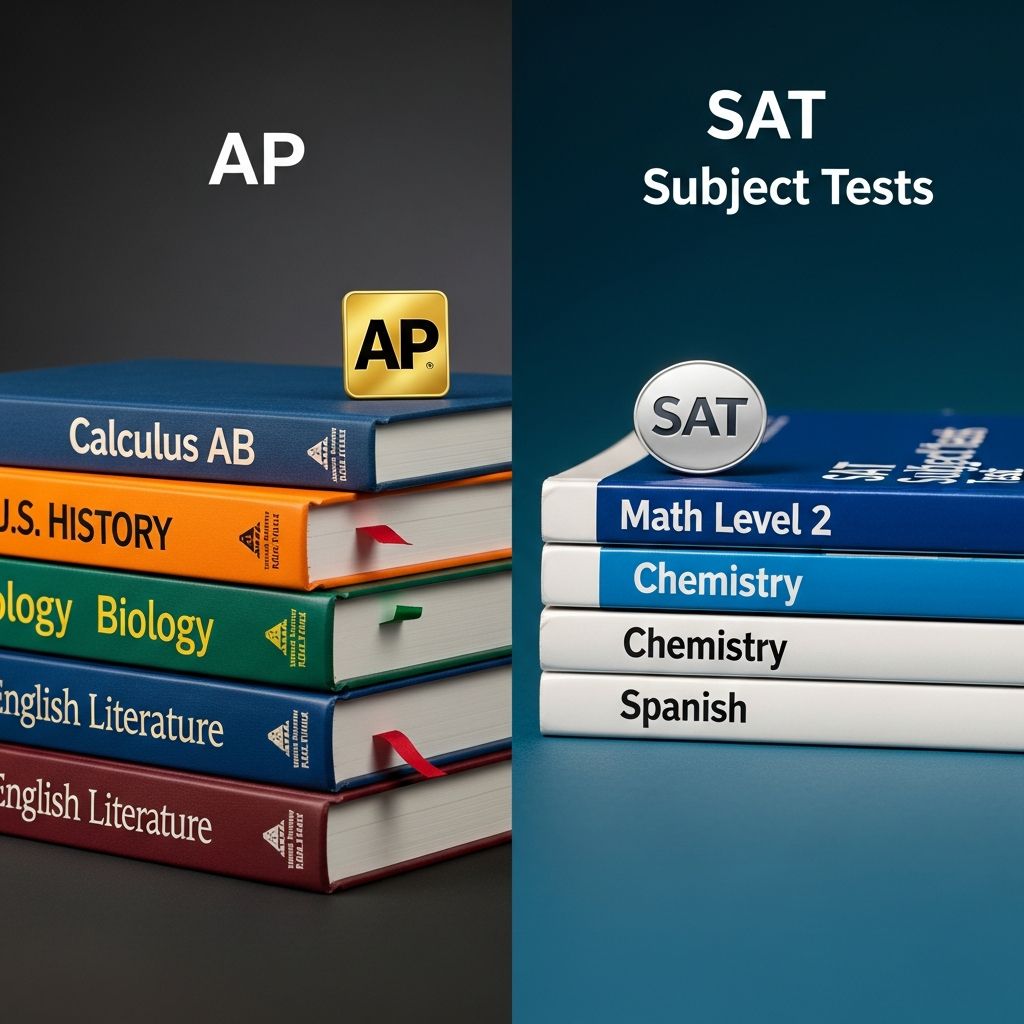
AP exams and SAT Subject Tests, both administered by the College Board, serve distinct purposes in showcasing student abilities, though SAT Subject Tests were discontinued in 2021. AP exams evaluate college-level mastery for potential credit, while SAT Subject Tests assessed high school proficiency to strengthen applications.
Understanding AP Exams: College-Level Challenges
Advanced Placement exams cap rigorous high school courses designed to mirror introductory college curricula. Students demonstrate deep comprehension through multifaceted assessments, often earning credits or advanced placement at universities for scores of 3 or higher.
- Subject Variety: Over 38 exams span humanities, sciences, arts, and more, allowing specialization in fields like calculus, biology, or U.S. history.
- Exam Structure: Typically 2-3 hours, blending multiple-choice questions with free-response sections requiring analysis, essays, and problem-solving.
- Timing and Access: Administered annually in May, requiring enrollment in corresponding AP classes for optimal preparation.
High scores signal readiness for university rigor, influencing admissions at selective institutions where course challenge matters.
SAT Subject Tests: High School Proficiency Checks
SAT Subject Tests gauged knowledge from standard high school curricula across 20 topics in math, science, languages, history, and English. They highlighted strengths without demanding college-level depth.
- Subject Options: Choices included Math Level 1/2, Biology, Chemistry, U.S. World History, and languages with listening components.
- Format Details: One-hour, multiple-choice only, with scaled scores from 200-800 and penalty for guessing.
- Scheduling Flexibility: Offered multiple times yearly, allowing up to three per date, switchable on test day.
Though discontinued, they once supplemented applications, especially for competitive programs requiring subject-specific proof.
Core Distinctions: A Side-by-Side Analysis
Key variances lie in depth, purpose, and outcomes. AP pushes analytical skills; SAT Subject Tests emphasized recall speed.
| Aspect | AP Exams | SAT Subject Tests |
|---|---|---|
| Content Depth | College-level, synthesis required | High school-level, factual recall |
| Duration | 2-3 hours | 1 hour each |
| Question Types | Multiple-choice + free-response | Multiple-choice only |
| Scoring | 1-5 scale | 200-800 scale |
| Frequency | Once yearly (May) | 6 times yearly |
| College Impact | Credit/advanced standing | Application strength/placement |
| Class Prerequisite | Recommended | Not required |
This comparison underscores AP’s emphasis on higher-order thinking versus SAT Subject Tests’ breadth testing.
Strategic Role in College Applications
AP performance showcases academic ambition, vital post-SAT Subject Test discontinuation, as colleges prioritize rigorous coursework. Strong AP scores (4-5) often yield credits, reducing college costs and time.
SAT Subject Tests previously aided international students or STEM applicants proving readiness, but AP now fills this gap. Admissions officers value 4-8 AP courses, balancing depth and breadth.
Preparation Tactics for Success
AP Exam Strategies
Enroll in AP classes for structured learning. Practice free-response with past exams from College Board resources. Focus on themes, not rote facts.
- Review syllabi alignment.
- Form study groups for essay practice.
- Simulate timed conditions monthly.
SAT Subject Test Approaches (Historical)
Leverage recent coursework. Use official practice tests for pacing, given negative marking. Target peak subjects post-relevant classes.
College Policies on Scores and Credits
Institutions like those in the Ivy League grant AP credit variably; check via College Board’s AP Credit Policy Search. SAT Subject scores influenced placement but rarely credit.
Post-discontinuation, AP dominates for validation. Some schools remain test-optional, elevating AP’s role.
Choosing the Right Path Forward
Assess goals: credit-seeking students prioritize AP; application boosters once used Subject Tests. Consult counselors for school-specific needs. Balance with GPA and extracurriculars.
Frequently Asked Questions (FAQs)
Are SAT Subject Tests still required?
No, discontinued by College Board in 2021; AP exams now emphasize subject mastery.
Can I get college credit from AP without the class?
Possible but challenging; self-study demands extensive preparation.
How many AP exams should I take?
4-8 recommended for competitive applicants, per major alignment.
Do AP scores expire for credit?
Typically valid if taken in high school; confirm per college.
What’s harder: AP or SAT Subject Tests?
AP requires deeper analysis; Subject Tests test speed and basics.
Navigating Changes in Testing Landscape
With test-optional trends, AP endures as proof of rigor. Stay updated via College Board announcements.
References
- AP vs. SAT Subject Tests: What is the difference? — Tutela Prep. 2023. https://www.tutelaprep.com/blog/difference-between-ap-vs-sat–tutela-blog/
- The Difference Between AP Exams and SAT Subject Tests — College Raptor. 2020. https://www.collegeraptor.com/getting-in/articles/act-sat/sat-subject-tests-whats-the-difference-between-st-ap-exams/
- AP vs IB vs SAT Subject Tests: What’s the Difference? — Moon Prep. 2022. https://moonprep.com/bsmd-admissions-consulting/ap-vs-ib-vs-sat-subject-tests-whats-the-difference-2/
- AP Exams and SAT Subject Tests: Similarities & Differences — Score at the Top. 2023. https://www.scoreatthetop.com/blog/ap-exams-and-sat-subject-tests-similarities-differences
- An Overview of AP Exams and SAT Subject Tests — Applerouth. 2021. https://www.applerouth.com/blog/an-overview-of-ap-exams-and-sat-subject-tests
Similar Articles






Read full bio of medha deb