Balkan Peninsula: Nations and Geopolitics
Discover the diverse countries, history, and strategic importance of the Balkan Peninsula in Southeast Europe.
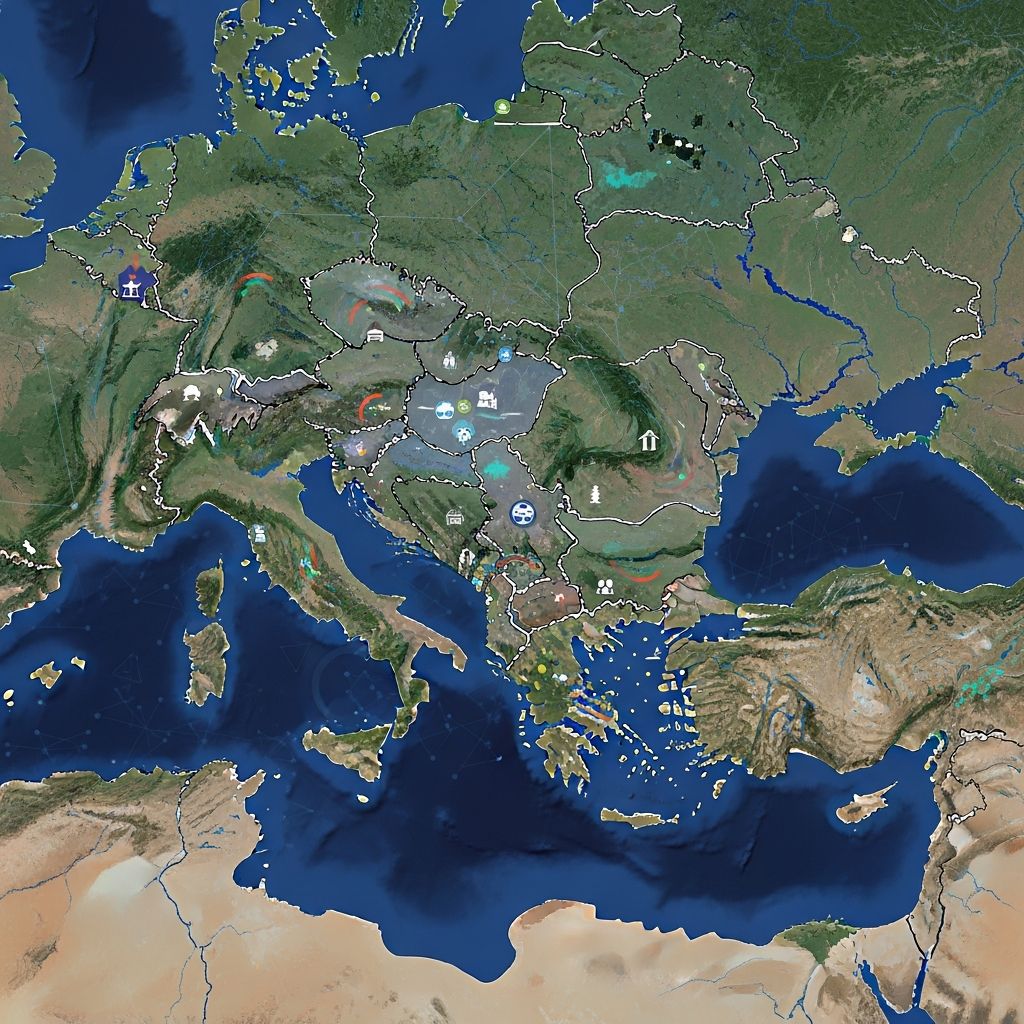
The Balkan Peninsula stands as a crossroads of Europe, blending rugged mountains, ancient histories, and vibrant cultures. This region in Southeast Europe features a complex mix of nations shaped by geography, empires, and modern politics. Understanding its scope requires navigating disputed borders and diverse identities.
Geographical Foundations of the Balkans
The Balkan Peninsula derives its name from the Balkan Mountains spanning Bulgaria, a key feature in its topography. It is bordered by the Adriatic Sea to the northwest, Ionian Sea to the southwest, Aegean Sea to the south, Turkish Straits to the east, and Black Sea to the northeast. The northern boundary remains debated, often drawn along the Danube, Sava, and Kupa rivers or the Dinaric Alps.
Covering approximately 470,000 square kilometers, the peninsula hosts diverse landscapes from coastal plains to high peaks like Musala at 2,925 meters in Bulgaria’s Rila range. These features influence climate, agriculture, and human settlement patterns, fostering isolated communities and distinct regional identities.
Core Countries and Their Territories
Defining Balkan states involves geographical, historical, and political lenses. Fully enclosed nations include Albania, Bosnia and Herzegovina, Bulgaria, Montenegro, and North Macedonia. Partial inclusions encompass Croatia (south of Sava and Kupa rivers), Greece (mainland), Kosovo, Serbia (south of the Danube), Romania (Northern Dobruja), and Turkey’s East Thrace.
| Country | Status in Balkans | Key Features |
|---|---|---|
| Albania | Full | Adriatic coast, mountainous interior |
| Bosnia and Herzegovina | Full | Diverse ethnic groups, Dinaric Alps |
| Bulgaria | Full | Balkan Mountains, Black Sea access |
| Croatia | Partial (southern) | EU/NATO member, Adriatic islands |
| Greece | Partial (mainland) | Aegean coast, ancient heritage |
| Kosovo | Full (disputed) | Youngest state, partial recognition |
| Montenegro | Full | Bay of Kotor, NATO member |
| North Macedonia | Full | EU candidate, NATO member |
| Serbia | Partial (southern) | Landlocked core, regional power |
This table highlights the primary states, noting Slovenia’s frequent exclusion despite former Yugoslav ties, as it lies mostly north of traditional boundaries.
Historical Layers Shaping the Region
The Balkans’ history reflects layers of influence from Roman, Byzantine, Ottoman, and Austro-Hungarian empires. Ottoman rule dominated for centuries, introducing Islam alongside Orthodox Christianity and Catholicism. The 19th century saw nationalist uprisings leading to independence movements.
Post-World War I, the Kingdom of Yugoslavia united South Slavs, but ethnic tensions persisted. World War II fragmentation gave way to Tito’s communist federation, suppressing divisions temporarily. The 1990s dissolution triggered brutal wars in Croatia, Bosnia, and Kosovo, resulting in new states amid ethnic cleansing and NATO interventions.
- Yugoslav Wars (1991-2001): Involved Slovenia, Croatia, Bosnia, and Kosovo conflicts, leading to over 140,000 deaths.
- Dayton Agreement (1995): Ended Bosnian War, creating a federal structure with Bosniak-Croat Federation and Serb Republika Srpska.
- Kosovo Independence (2008): Recognized by about half of UN members, remains contentious with Serbia.
The Western Balkans: A Modern Focus
The term “Western Balkans” refers to non-EU states: Albania, Bosnia and Herzegovina, Kosovo, Montenegro, North Macedonia, and Serbia. Croatia and Slovenia, as EU/NATO members, are excluded. This designation emerged post-Yugoslavia to denote integration aspirants.
Integration progress varies: Albania, Montenegro, and North Macedonia are NATO members; all pursue EU accession amid reforms. Bosnia’s tripartite presidency—representing Bosniaks, Serbs, Croats—complicates governance, with ongoing ethnic power-sharing.
Cultural and Ethnic Tapestry
Religious diversity defines the Balkans: Orthodox in Bulgaria, Serbia, Montenegro, North Macedonia; Catholic in Croatia, Slovenia; Muslim majorities or significant populations in Albania, Bosnia, Kosovo. Languages like Serbo-Croatian variants (Bosnian, Croatian, Serbian, Montenegrin) show mutual intelligibility despite political separations.
This mosaic fuels both richness and tension. Festivals, cuisine (cevapi, baklava), and traditions blend Mediterranean, Ottoman, and Central European elements, making the region a cultural hotspot.
Geopolitical Significance Today
Straddling Europe and Eurasia, the Balkans serve as a bridge or buffer in global strategies. Proximity to Russia, Turkey, and the EU heightens its role in energy routes, migration, and security. EU enlargement promises stability, but Russian influence and Chinese investments challenge Western dominance.
Recent developments include North Macedonia’s 2020 NATO entry and EU talks, Montenegro’s NATO accession in 2017, and Albania’s aspirations. Serbia balances EU ties with Russian partnerships, while Kosovo-Serbia normalization dialogues continue under EU mediation.
Economic Landscapes and Challenges
Economies range from tourism-driven Croatia and Montenegro to agriculture in Bulgaria and industry in Serbia. Unemployment, corruption, and brain drain plague Western Balkans, with GDP per capita lagging EU averages. EU funds drive infrastructure, but disputes like Bosnia’s entity divisions hinder progress.
- Tourism: Croatia’s Dalmatian coast attracts millions annually.
- Energy: Pipelines like TAP enhance connectivity.
- Trade: CEFTA facilitates regional commerce.
Future Prospects and Integration
EU membership remains the beacon for stability, promising economic growth and dispute resolution. Challenges include rule of law, minority rights, and border issues. NATO expansions bolster security against external threats.
Climate change impacts coastal areas, while youth migration underscores reform needs. Regional cooperation via Berlin Process fosters dialogue.
Frequently Asked Questions (FAQs)
What countries are considered part of the Balkans?
Core countries include Albania, Bosnia and Herzegovina, Bulgaria, Montenegro, North Macedonia, with partial inclusions of Croatia, Greece, Kosovo, Serbia, Romania, and Turkey.
Why is the northern border of the Balkan Peninsula disputed?
Definitions vary between rivers (Danube, Sava, Kupa) and mountain ranges (Dinaric Alps), leading to inclusions/exclusions of Slovenia, Romania.
What caused the breakup of Yugoslavia?
Ethnic nationalism, economic woes, and Tito’s death in 1980 fueled independence movements, escalating into 1990s wars.
Is Kosovo a recognized Balkan state?
Kosovo declared independence in 2008; recognized by over 100 countries but not Serbia or several UN members.
What is the Western Balkans?
It groups EU aspirants: Albania, Bosnia, Kosovo, Montenegro, North Macedonia, Serbia, excluding EU members Croatia/Slovenia.
References
- Balkans – Geopolitical Futures — Geopolitical Futures. 2023. https://geopoliticalfutures.com/balkans/
- Balkans – Wikipedia — Wikipedia. 2026-04-04. https://en.wikipedia.org/wiki/Balkans
- A Brief Intro to the Balkans — Where on Planet Earth. 2023. https://www.whereonplanetearth.com/p/a-brief-intro-to-the-balkans
- The BALKANS Explained (Geography Now!) — YouTube (Geography Now). 2014-11-13. https://www.youtube.com/watch?v=ED0b0E6xUL8
- A Brief History of the Balkans (Yugoslavia) — Sovereign Limits. 2023. https://sovereignlimits.com/blog/a-brief-history-of-the-balkans
- Balkan countries – The complete list — Ekorna. 2023. https://www.ekorna.com/list-of-balkan-countries/
- The Geopolitics Of South-East Europe — Eurasia Review. 2026-02-02. https://www.eurasiareview.com/02022026-the-geopolitics-of-south-east-europe-and-the-importance-of-the-regional-geostrategic-position-analysis/
Similar Articles







Read full bio of Sneha Tete