The Bellamy Salute: America’s Forgotten Flag Gesture
Discover how a patriotic hand gesture from 1892 became uncomfortably linked to fascism, leading to its swift replacement during World War II.
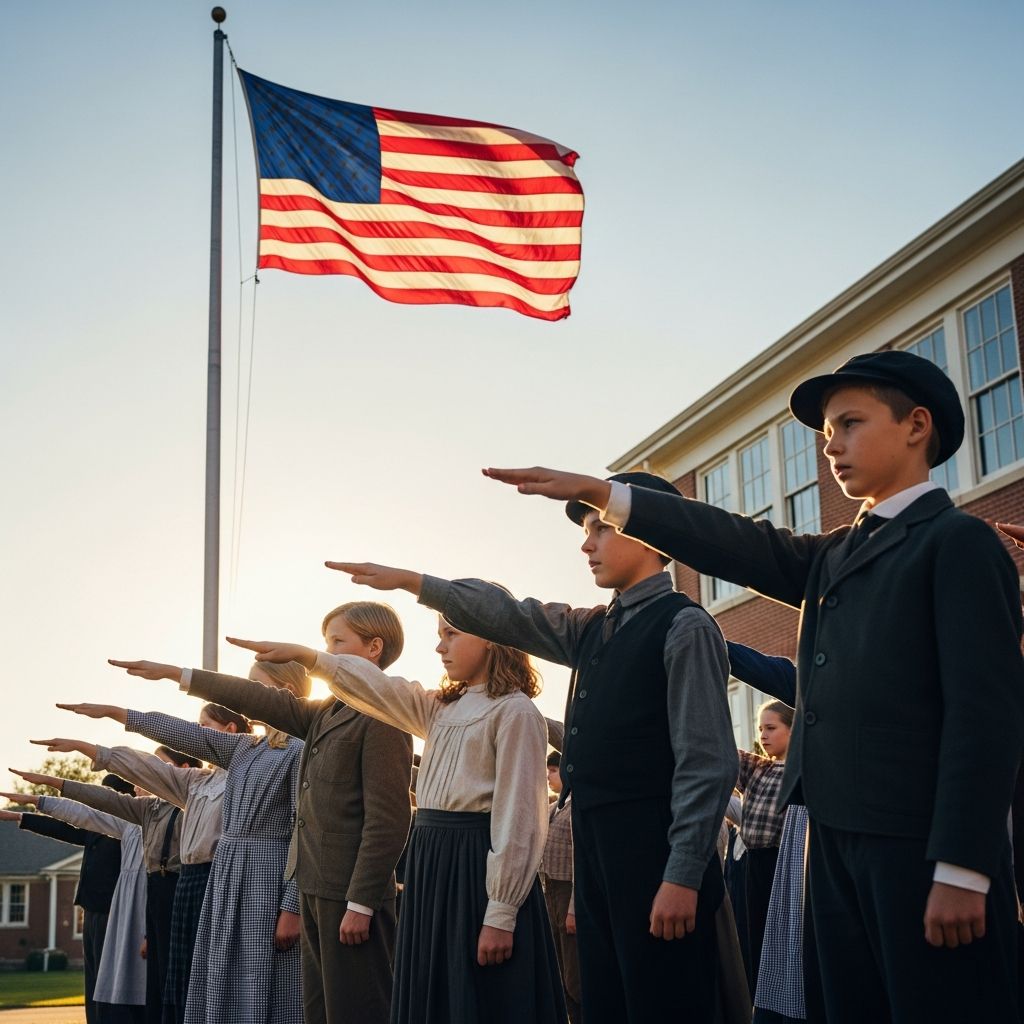
The Bellamy Salute, a once-standard gesture in American schools and public gatherings, involved extending the right arm toward the flag while reciting the Pledge of Allegiance. Introduced in 1892, it symbolized unwavering patriotism but was abandoned in 1942 amid World War II due to its striking similarity to fascist salutes in Europe.
Origins in a Patriotic Era
In the late 19th century, America sought ways to instill national unity amid rapid industrialization and immigration. Francis Bellamy, a former minister and magazine editor, crafted the Pledge of Allegiance for The Youth’s Companion, a popular children’s publication. The pledge debuted on September 8, 1892, timed for the 400th anniversary of Christopher Columbus’s arrival.
James B. Upham, Bellamy’s colleague and the magazine’s junior partner, devised the accompanying gesture. As described, participants began with a military-style salute at the right temple, then extended the arm forward, palm upward or downward, holding it through the pledge’s end before dropping it to the side. Bellamy endorsed this dramatic pose, believing it conveyed solemn commitment to the flag and republic.
Initially optional, the salute gained traction during nationwide celebrations on October 12, 1892, where millions of schoolchildren participated. This event marked the gesture’s entry into American ritual, blending education with civic pride.
Integration into Daily School Life
By the early 20th century, the Bellamy Salute became routine in U.S. classrooms. Photographs from the era show rows of students standing rigidly, arms outstretched toward the Stars and Stripes, eyes fixed ahead. Textbooks and school manuals codified it alongside the pledge’s text.
- Standard Procedure: Stand facing the flag, recite ‘I pledge allegiance to the flag,’ then extend the right arm straight out, palm facing up or down.
- Variations: Some instructions specified a graceful extension; others emphasized a rigid, heel-snapping stance mimicking military drill.
- Educational Impact: Teachers used it to teach respect for national symbols, fostering a sense of indivisible unity in diverse classrooms.
This practice persisted for decades, evolving into a symbol of American identity. During World War I, it reinforced loyalty amid anti-German sentiment, with schools emphasizing the pledge as a bulwark against foreign influences.
Global Echoes and Rising Concerns
The 1920s brought fascism to Europe. Benito Mussolini’s Italy popularized the Roman salute—an arm extended skyward, palm down—which echoed ancient imperial gestures. Adolf Hitler’s Nazis adopted a near-identical version, making it their iconic Sieg Heil.
Americans first noticed parallels in newsreels and photographs. By the 1930s, as Nazi aggression escalated, U.S. media highlighted the visual overlap. Critics worried that images of American children mimicking these motions could fuel enemy propaganda, portraying the U.S. as ideologically aligned with totalitarianism.
Domestic debates intensified. Some defended the salute as purely patriotic, predating fascist versions by decades. Others, including veterans’ groups, argued its optics undermined Allied resolve. The resemblance was uncanny: straight arm, forward thrust, palm orientation—all hallmarks shared across continents.
Legislative Shift During Wartime
Pearl Harbor’s attack on December 7, 1941, catalyzed change. With the U.S. at war against Axis powers, any association with Nazi imagery became untenable. Veterans organizations like the American Legion and Veterans of Foreign Wars lobbied Congress urgently.
On June 22, 1942, Public Law 77-623 established the U.S. Flag Code, initially retaining a modified Bellamy Salute: hand over heart, then extend palm upward toward the flag. However, this compromise lasted mere months. On December 22, 1942, Congress amended the code entirely, mandating the hand-over-heart position throughout the pledge.
| Era | Gesture Description | Key Event |
|---|---|---|
| 1892–1942 | Right arm extended toward flag, palm up/down | Columbus Day debut; school standard |
| June 1942 | Hand to heart, then extend palm up | Initial Flag Code |
| Dec 1942–Present | Right hand over heart | WWII amendment |
This pivot reflected wartime pragmatism, prioritizing moral clarity over tradition. No formal debate survives, but the speed suggests broad consensus.
Cultural Legacy and Modern Reflections
Post-1942, the Bellamy Salute faded into obscurity, surviving mainly in vintage photos that startle contemporary viewers. Its story underscores patriotism’s fluidity—gestures once revered can swiftly become liabilities.
Historians view it as a lens on 20th-century anxieties. The salute’s demise paralleled shifts in the pledge itself: ‘my flag’ became ‘the flag’ in 1923 for immigrant clarity; ‘under God’ added in 1954 amid Cold War.
Today, debates over pledge recitation persist—stand, kneel, or sit?—echoing past tensions. The Bellamy episode reminds us that symbols evolve with context, balancing reverence and relevance.
Visual Evidence from the Time
Archival images capture the salute’s ubiquity. A 1915 New York Tribune photo shows Chicago students in perfect formation. Another from Southington, Connecticut, depicts uniformed children mid-pledge, arms rigid. These stark visuals explain the 1940s alarm.
- 1917 Illustration: From Saluting the Flag, depicting precise arm angles.
- 1930s School Photos: Nationwide snapshots mirroring European rallies.
Frequently Asked Questions (FAQs)
Who created the Bellamy Salute?
James B. Upham invented it, with Francis Bellamy’s approval, to accompany the 1892 Pledge of Allegiance.
Why was it discontinued?
Its resemblance to Nazi and fascist salutes during World War II prompted Congress to replace it with the hand-over-heart gesture in 1942.
Was the salute ever law?
Not initially; it became formalized in the 1942 Flag Code before quick amendment.
Did the Pledge of Allegiance change too?
Yes, wording evolved separately, but the salute’s end was gesture-specific.
Can we see it today?
Only in historical photos and films; performing it now might confuse or offend.
Broader Implications for National Symbols
The Bellamy Salute’s arc reveals how gestures encode ideology. What starts as innocent patriotism can accrue unintended meanings via global events. In an interconnected world, America’s rituals must navigate such pitfalls.
Comparisons arise with other symbols: Confederate flags repurposed, or statue removals. Each case weighs heritage against harm. The salute teaches adaptability preserves unity.
Educators now emphasize intent over form. Modern pledges focus on words, allowing personal expression—standing silently, for instance. This flexibility honors Bellamy’s core aim: allegiance to democratic ideals.
References
- Bellamy salute – Wikipedia — Wikipedia contributors. 2023 (continuously updated). https://en.wikipedia.org/wiki/Bellamy_salute
- The Bellamy Salute to Old Glory — Sharon M. Kennedy. 2023-06-13. https://www.authorsharonkennedy.com/2023/06/13/the-bellamy-salute-to-old-glory/
- Bellamy Salute: How Americans Once Pledged Allegiance — All That’s Interesting. N/A. https://allthatsinteresting.com/bellamy-salute
- The Bellamy Salute — Futility Closet. 2013-11-01. https://www.futilitycloset.com/2013/11/01/the-bellamy-salute/
- Francis Bellamy Pledge Salute — Digital Chicago History. N/A. https://digitalchicagohistory.org/exhibits/show/autopsy-of-the-pledge-of-al/item/891
- School Children Pledging Their Allegiance — Visit the Capitol. N/A. https://www.visitthecapitol.gov/artifact/school-children-pledging-their-allegiance-flag-southington-connecticut-photograph-fenno
Similar Articles






Read full bio of medha deb