Calvin Cycle: Photosynthesis’ Sugar Factory
Unlock the secrets of the Calvin cycle, the light-independent powerhouse that transforms CO2 into life-sustaining sugars in plant cells.
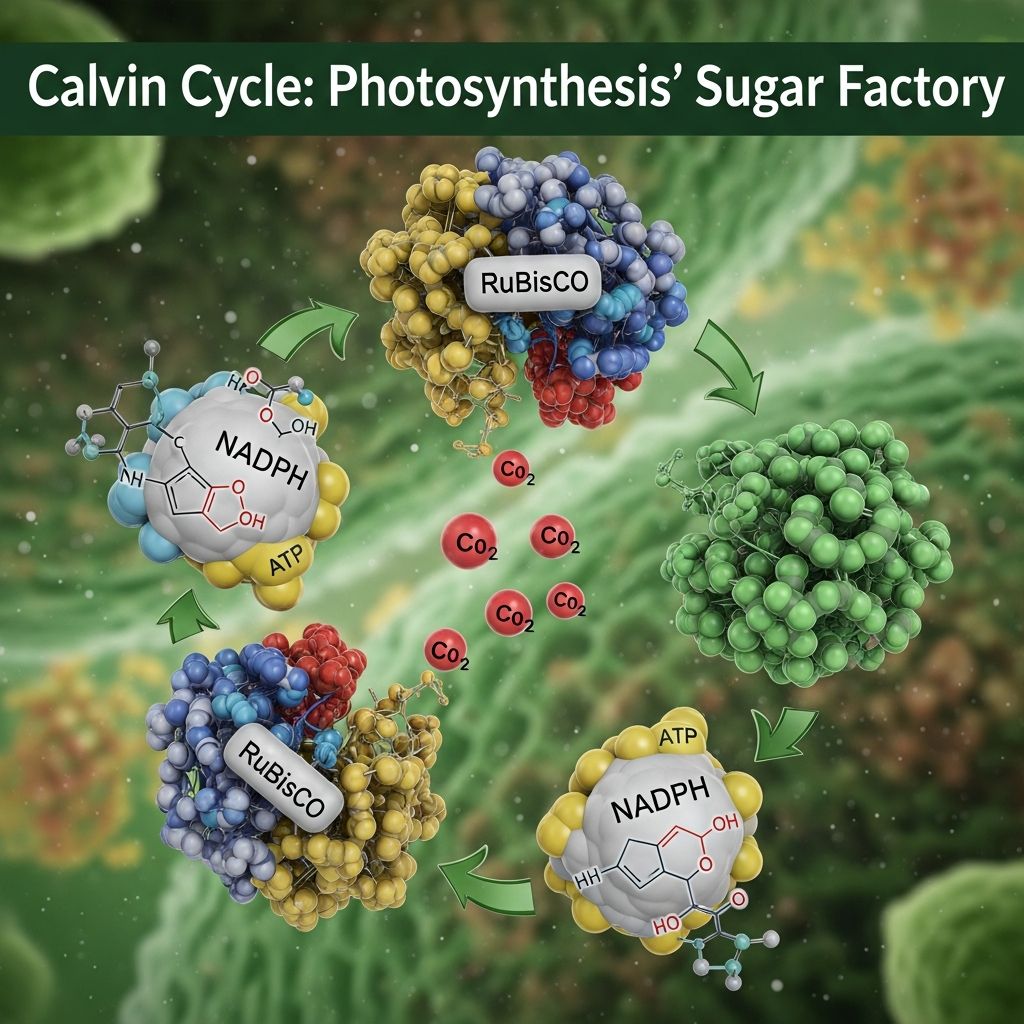
The Calvin cycle represents the core of photosynthesis’ dark reactions, where plants convert atmospheric carbon dioxide into organic sugars using energy from light-dependent processes. This essential biochemical pathway occurs in the stroma of chloroplasts and sustains nearly all life on Earth by producing glucose and other carbohydrates.
Photosynthesis: A Dual-Stage Marvel
Photosynthesis unfolds in two interconnected phases. The light-dependent reactions capture solar energy in the thylakoid membranes, generating ATP and NADPH. These high-energy molecules then fuel the Calvin cycle in the chloroplast stroma, independent of direct light.
Carbon dioxide enters leaves via stomata, diffuses through mesophyll cells, and reaches the stroma. Here, the cycle fixes CO2 into stable organic forms, countering atmospheric carbon buildup and forming the basis of food chains.
Core Components Driving the Cycle
- RuBP (Ribulose-1,5-bisphosphate): A five-carbon molecule that accepts CO2 to kickstart fixation.
- RuBisCO: The world’s most abundant enzyme, catalyzing the fixation step despite its dual carboxylase-oxygenase function.
- ATP and NADPH: Energy and reducing power from light reactions, consumed in reduction and regeneration.
- G3P (Glyceraldehyde-3-phosphate): The three-carbon output; one of every six becomes glucose precursors.
Stage 1: Carbon Fixation Unveiled
The cycle initiates when RuBisCO binds CO2 to RuBP, forming an unstable six-carbon intermediate that rapidly splits into two 3-phosphoglycerate (3-PGA) molecules. This fixation incorporates inorganic carbon into organic biochemistry, requiring one RuBisCO per reaction.
For every three CO2 molecules, three RuBP yield six 3-PGA. This step demands no ATP or NADPH yet sets the stage for sugar synthesis.
Stage 2: Reduction Powers Sugar Formation
Next, 3-PGA undergoes phosphorylation by ATP, forming 1,3-bisphosphoglycerate. NADPH then reduces this to G3P, releasing ADP, NADP+, and inorganic phosphate.
Of the six G3P from three CO2, one exits for carbohydrate production—like glucose (C6H12O6) after two such cycles—while five regenerate RuBP. This phase consumes nine ATP and six NADPH per three CO2.
Stage 3: Regeneration Keeps the Wheel Turning
The regeneration phase recycles five G3P into three RuBP through a series of rearrangements involving transketolase, transaldolase, and other enzymes. This consumes six more ATP, totaling 18 ATP and 12 NADPH for six CO2 to yield one glucose.
This cyclic renewal ensures continuous operation, highlighting the pathway’s efficiency.
Quantitative Breakdown of Inputs and Outputs
| Per Glucose Molecule (6 CO2) | Reactants | Products |
|---|---|---|
| Carbon Fixation | 6 CO2 + 6 RuBP | 12 3-PGA |
| Reduction | 12 ATP + 12 NADPH | 12 G3P (2 export, 10 recycle) |
| Regeneration | 6 ATP | 6 RuBP |
| Net | 18 ATP, 12 NADPH, 6 CO2 | C6H12O6 |
This table summarizes the stoichiometry: six cycle turns fix six carbons into one hexose sugar.
Environmental and Evolutionary Context
The Calvin cycle evolved in ancient cyanobacteria, enabling oxygenic photosynthesis that oxygenated Earth. Today, it fixes about 100 billion tons of carbon yearly, regulating climate via the biological carbon pump.
RuBisCO’s oxygenase activity causes photorespiration, reducing efficiency in hot, dry conditions—plants like C4 and CAM species mitigate this with spatial or temporal CO2 concentration.
Experimental Discovery and Legacy
Melvin Calvin’s 1940s algae experiments using 14C-labeled CO2 traced the pathway, earning a Nobel Prize. Andrew Benson and James Bassham contributed key insights, hence the Calvin-Benson cycle moniker.
Biotechnological Horizons
Engineering RuBisCO for higher specificity or introducing bacterial cycles into crops could boost yields amid climate challenges. Synthetic biology explores alien carbon fixation for biofuels.
Frequently Asked Questions
Where does the Calvin cycle occur in chloroplasts?
In the stroma, the fluid-filled space surrounding thylakoids, using ATP/NADPH from light reactions.
Is the Calvin cycle truly light-independent?
Yes, but indirectly reliant on light via ATP/NADPH; it runs in darkness if these are supplied.
What limits Calvin cycle efficiency?
RuBisCO’s affinity for O2 over CO2, causing photorespiration; high temperatures exacerbate this.
How many ATP/NADPH per glucose?
18 ATP and 12 NADPH for one C6H12O6 from six CO2.
Can animals perform the Calvin cycle?
No, it’s unique to photosynthetic autotrophs like plants, algae, and cyanobacteria.
Visualizing the Cycle: Key Intermediates
- CO2 + RuBP → [unstable C6] → 2 × 3-PGA (Fixation)
- 3-PGA + ATP → 1,3-BPG + ADP
- 1,3-BPG + NADPH → G3P + NADP+ + Pi (Reduction)
- 5 G3P + 3 ATP → 3 RuBP (Regeneration)
These steps form a balanced loop, exporting net G3P for starch, sucrose, and cellulose.
The Calvin cycle’s elegance lies in its self-sustaining nature, turning simple gases into complex life fuels. Its study informs agriculture, ecology, and biotechnology, underscoring photosynthesis’ foundational role.
References
- The Calvin Cycle | Biology I — Lumen Learning (SUNY). 2023. https://courses.lumenlearning.com/suny-biology1/chapter/the-calvin-cycle/
- The Calvin Cycle — ChemTalk. 2023-10-15. https://chemistrytalk.org/the-calvin-cycle/
- 5.12C: The Calvin Cycle — Biology LibreTexts. 2023-08-20. https://bio.libretexts.org/Bookshelves/Microbiology/Microbiology_(Boundless)/05:_Microbial_Metabolism/5.12:_Biosynthesis/5.12C:_The_Calvin_Cycle
- The Calvin Cycle — Khan Academy. 2024. https://www.khanacademy.org/science/ap-biology/cellular-energetics/photosynthesis/a/calvin-cycle
- Photosynthesis: Calvin cycle — Khan Academy. 2024. https://www.khanacademy.org/science/biology/photosynthesis-in-plants/the-calvin-cycle-reactions/v/photosynthesis-calvin-cycle
Similar Articles






Read full bio of Sneha Tete