Choosing Between Pre-Tax and Roth Retirement Deferrals
Learn how pre-tax and Roth deferrals work, how they’re taxed, and how to choose the right mix for your retirement strategy.
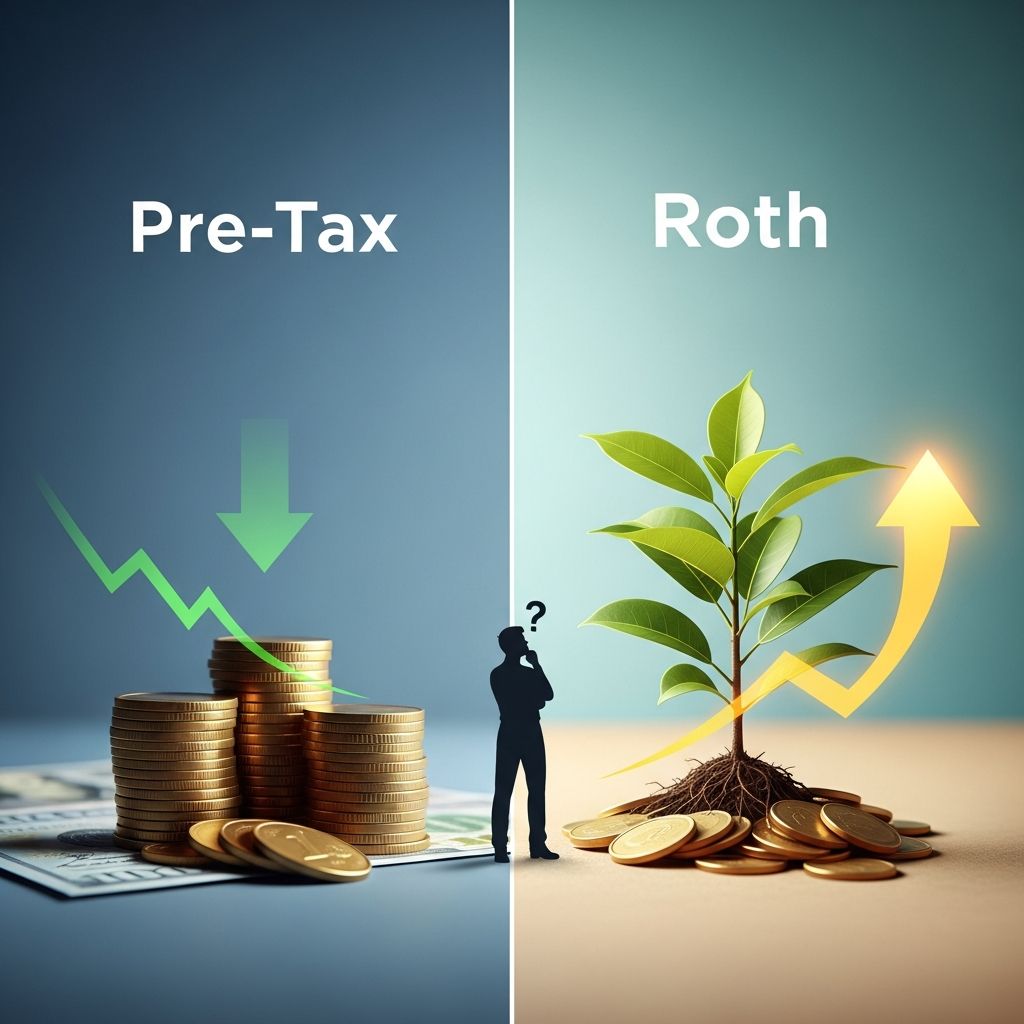
Pre-Tax vs Roth Deferrals: A Practical Guide to Retirement Contributions
When you enroll in a workplace retirement plan like a 401(k), you often have a choice between making
pre-tax (traditional) employee deferrals
andRoth deferrals
. Understanding how each option is taxed can significantly affect how much you keep in retirement.This guide explains how both contribution types work, compares their tax treatment, and offers simple frameworks to help you choose the right mix for your situation.
What Is a Pre-Tax (Traditional) Employee Deferral?
A pre-tax employee deferral is money you ask your employer to send directly from your paycheck into a qualified retirement plan—such as a 401(k), 403(b), or 457(b)—before income taxes are applied.
In IRS terms, these are called elective deferrals, because you elect to defer part of your compensation into a plan instead of taking it all as current pay.
Key features of pre-tax deferrals
- Made with before-tax dollars: Contributions are deducted from your pay before federal income tax is calculated, lowering your taxable income for the year.
- Tax-deferred growth: Investment earnings inside the account (interest, dividends, capital gains) are not taxed each year; instead, taxes are postponed until withdrawal.
- Taxed in retirement: Withdrawals from traditional 401(k) or similar accounts are generally taxed as ordinary income in the year you take them.
- Subject to annual limits: The IRS caps how much you can defer from your salary each year across traditional and Roth deferrals combined.
Advantages of pre-tax deferrals
- Immediate tax break: Reducing your current taxable income can lower your tax bill, especially if you are in a higher tax bracket today.
- Potentially larger current paycheck after tax: Because contributions are made before tax, your net take-home pay may be higher than if you contributed the same gross amount to a Roth option.
- Helpful for high-income years: If you are temporarily in a high-earning phase (for example, bonuses or peak-career income), pre-tax deferrals can help manage your tax burden.
Trade-offs of pre-tax deferrals
- Future tax uncertainty: You do not know what tax rates will be when you withdraw the money in retirement. If rates are higher later, your tax bill may be larger than expected.
- Required minimum distributions (RMDs): Traditional 401(k) and similar accounts are generally subject to mandatory withdrawals starting at a specified age (for most people, in their early 70s), which triggers taxable income.
What Is a Roth Deferral?
A Roth deferral is a contribution to a designated Roth account in an employer plan (Roth 401(k), Roth 403(b), or Roth 457(b)) using money that has already been taxed. Unlike pre-tax deferrals, you do not receive an immediate tax deduction for these contributions.
Key features of Roth deferrals
- Funded with after-tax dollars: The contribution amount is included in your taxable income for the year; there is no up-front tax reduction.
- Tax-free growth and qualified withdrawals: Earnings can be withdrawn tax-free in retirement if certain rules are met (for example, the account must meet a required holding period and distributions must be qualified).
- Same overall deferral limit: Roth and traditional deferrals share the same annual employee deferral limit; you can split your contributions between them, but the total cannot exceed IRS caps.
Advantages of Roth deferrals
- Tax-free income in retirement: Qualified withdrawals of both contributions and earnings are not subject to federal income tax.
- Protection against rising tax rates: Paying tax now can be attractive if you expect to be in a higher tax bracket later or if overall tax rates rise over time.
- Useful early in your career: When your income (and therefore tax rate) is relatively low, paying tax up front can be less costly, while giving you decades of potential tax-free growth.
Trade-offs of Roth deferrals
- No immediate deduction: Your current-year tax bill may be higher than if you had contributed the same amount pre-tax.
- Budget impact: Because contributions are made after tax, the same gross contribution will reduce your take-home pay more than a pre-tax contribution.
How the Tax Timing Differs
The core distinction between pre-tax and Roth deferrals is when you pay income tax.
| Feature | Pre-Tax (Traditional) Deferral | Roth Deferral |
|---|---|---|
| Tax on contributions | Not taxed when contributed; reduces taxable income today. | Taxed in the year contributed; no deduction. |
| Tax on investment growth | Tax-deferred while in the account. | Not taxed annually; may be tax-free if withdrawal is qualified. |
| Tax on withdrawals | Generally fully taxable as ordinary income. | Qualified distributions are tax-free. |
| Best fit (in general) | Those who expect a lower tax bracket in retirement. | Those who expect a similar or higher tax bracket later. |
IRS Contribution Limits and Rules
The Internal Revenue Service sets annual limits on how much employees can defer into workplace retirement plans. These limits apply to the combined total of your pre-tax and Roth deferrals across all applicable plans with the same employer.
Key points about limits
- Employee deferral cap: The IRS publishes an annual dollar limit on employee elective deferrals to 401(k), 403(b), and most 457(b) plans.
- Catch-up contributions: Workers aged 50 or older may be allowed an additional catch-up amount beyond the standard limit.
- Combined treatment: Roth and traditional deferrals are added together for limit purposes; you can choose the mix, but not exceed the total cap.
Employer matching contributions
Many employers match part of what you contribute. Under recent law changes, employers can sometimes allow matching contributions to be treated as Roth if the employee elects that treatment, though this match may then be taxed in the year it is made.
Whether pre-tax or Roth, not contributing enough to receive the full match is usually leaving compensation on the table.
How to Decide: Pre-Tax vs Roth Deferrals
There is no universal answer; the “better” choice depends on your income, tax outlook, and retirement plans. However, a few guiding questions can help.
1. What is your current tax bracket?
- Higher bracket now: If you face a relatively high marginal tax rate today, pre-tax deferrals can bring meaningful short-term savings.
- Lower bracket now: If you are early in your career or currently have modest income, Roth deferrals may be attractive because paying tax now is less costly.
2. What do you expect in retirement?
- Expect lower income later: Traditional pre-tax contributions may make sense, because you defer tax from a higher rate year to a lower rate year.
- Expect similar or higher income later: Roth contributions can help lock in today’s rates and secure tax-free withdrawals in the future.
3. Do you want tax diversification?
Many financial planners emphasize the benefit of building both pre-tax and Roth balances over time. Having money in accounts with different tax treatments can give you flexibility when creating retirement income.
- You can draw more from Roth accounts in years when your income is high, limiting how much additional taxable income you realize.
- You can lean on pre-tax accounts in lower-income years, spreading taxable income more evenly over retirement.
4. Cash-flow considerations
- Tight budget: If every dollar of take-home pay matters, pre-tax deferrals let you save more for the same impact on your paycheck.
- Room in your budget: If you can comfortably manage a slightly lower paycheck, Roth contributions may provide better long-term tax benefits.
Example: Same Gross Contribution, Different Tax Outcomes
To illustrate the difference in tax timing, imagine two workers each contributing the same amount to a 401(k):
- Alex chooses pre-tax deferrals.
- Jordan chooses Roth deferrals.
Both invest the same gross contribution and achieve the same investment performance. The pre-tax account is larger before tax because Alex never paid tax on contributions. Jordan’s Roth account may be smaller before tax, but withdrawals in retirement can be tax-free if the conditions for qualified distributions are satisfied.
The real question becomes: Are the tax rates at contribution time higher or lower than the rates at withdrawal time?
Strategic Approaches by Life Stage
While everyone’s situation is unique, some general patterns can be helpful when thinking about contribution strategy.
Early career
- Income often modest; tax bracket may be relatively low.
- Long time horizon allows many years of potential tax-free growth.
- Common approach: Emphasize Roth deferrals while still ensuring you capture any employer match.
Mid-career
- Earnings may be at or approaching peak levels.
- Tax bracket could be higher than you expect in retirement.
- Common approach: Use more pre-tax contributions to reduce current tax burden, possibly combining with some Roth for diversification.
Late career and pre-retirement
- Income and savings needs must be assessed alongside expected retirement expenses.
- Required minimum distributions from pre-tax accounts can create taxable income later.
- Common approach: Balance pre-tax contributions with Roth contributions (if available) to manage projected future RMDs and tax brackets.
Common Mistakes to Avoid
- Ignoring the employer match: Deciding between pre-tax and Roth matters, but getting the full match is often the first priority.
- Focusing only on this year’s refund: A pre-tax contribution that boosts your current refund might lead to higher taxable withdrawals later; consider your long-term picture.
- Assuming tax rates will not change: Tax laws and personal circumstances evolve; revisiting your mix of deferrals every few years can be valuable.
- Not coordinating with other accounts: Workplace plans, individual retirement accounts, and taxable investment accounts all interact in your overall strategy.
Quick Decision Checklist
Use this brief checklist to reflect on which type of deferral may currently fit you:
- Is my tax bracket today lower than I expect it to be in retirement?
- Can my budget handle slightly lower take-home pay for potential future tax-free withdrawals?
- Am I already saving in other pre-tax or Roth accounts?
- How significant is my employer match, and am I capturing all of it?
- Would having both pre-tax and Roth accounts give me more flexibility later?
Frequently Asked Questions (FAQs)
Q: Can I contribute to both pre-tax and Roth in the same year?
Yes. Many employer plans allow you to split your contributions between pre-tax and Roth. The IRS limit applies to your total employee deferrals, regardless of how you divide them.
Q: Does the employer match go into pre-tax or Roth?
Traditionally, employer matches have gone into pre-tax accounts, even when employees contribute to a Roth option. Recent law changes now allow some plans to offer Roth treatment for employer contributions if the employee elects it; however, these Roth-treated matches are taxable when made.
Q: Are Roth 401(k) rules the same as Roth IRA rules?
They share the same basic idea—after-tax contributions and potentially tax-free withdrawals—but differ in several technical ways, including income limits for Roth IRA contributions and required minimum distribution rules. Employer plan Roth accounts and Roth IRAs are governed by different parts of the tax code.
Q: How do required minimum distributions work?
Traditional pre-tax 401(k) and similar accounts generally require minimum withdrawals starting at a specified age, which count as taxable income. RMD rules for Roth accounts depend on the type of account and current law at the time you retire, so reviewing up-to-date IRS guidance is important.
Q: Should I switch from pre-tax to Roth if I think tax rates will rise?
If you expect higher tax rates later, increasing your Roth contributions can be one way to manage that risk. Many people choose a blended approach, continuing some pre-tax saving while steadily building Roth balances for flexibility.
References
- Roth comparison chart — Internal Revenue Service. 2024-01-01. https://www.irs.gov/retirement-plans/roth-comparison-chart
- Roth vs. Traditional 401(k) Deferrals: Key Differences & Examples — Human Interest. 2023-06-15. https://humaninterest.com/learn/articles/roth-401k-vs-traditional-401k/
- What Is A Roth Deferral? (How It Works, Limits & Benefits) — Carry. 2024-02-20. https://carry.com/learn/roth-deferral-benefits
- Roth vs. Traditional 401(k) Contributions – How to Choose — Employee Fiduciary. 2023-03-10. https://www.employeefiduciary.com/blog/roth-vs-traditional-401k-contributions
- Retirement Topics — 401(k) and Profit-Sharing Plan Contribution Limits — Internal Revenue Service. 2024-01-01. https://www.irs.gov/retirement-plans/plan-participant-employee/retirement-topics-401k-and-profit-sharing-plan-contribution-limits
Similar Articles







Read full bio of medha deb