From Skills to Strength: How Coaching Accelerates Talent Growth
Discover how strategic coaching turns isolated skills into sustained performance, potential, and organizational impact.
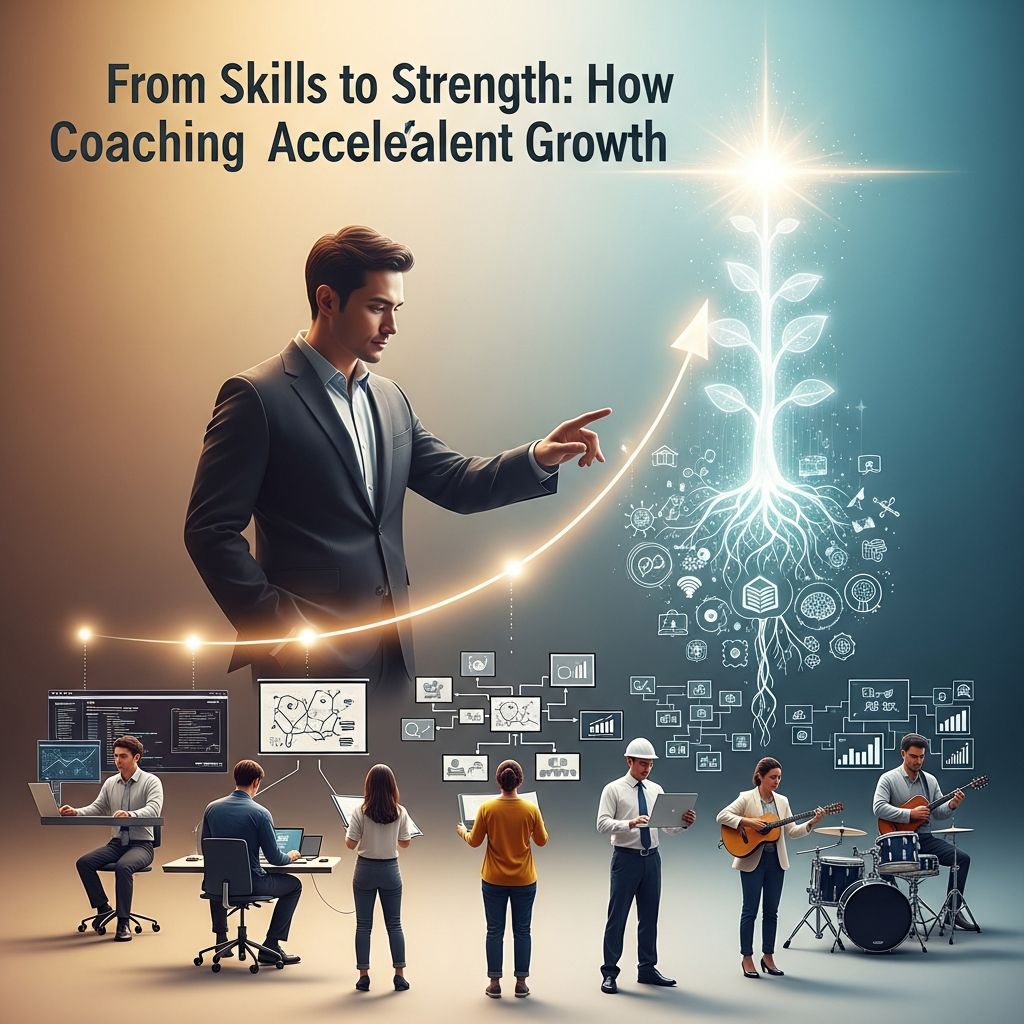
Organizations invest heavily in training, yet many still struggle to see consistent performance improvements, stronger leadership pipelines, or higher engagement. Coaching bridges this gap by transforming isolated skills into lasting behavior change and business impact.
Unlike one-off workshops, coaching offers a personalized, ongoing partnership that helps people apply what they learn, build confidence, and grow into their future roles.
Why Skills Alone Are Not Enough
Traditional training often focuses on transferring knowledge: concepts, tools, and techniques. But knowing what to do is very different from consistently doing it under pressure, in complex, real-world conditions.
Research from leadership and coaching organizations shows that coaching plays a central role in moving from awareness to action:
- Many companies report a clearly positive return on investment from coaching, with gains in performance, engagement, and retention.
- Coaching improves self-awareness, confidence, and communication, which are core to applying any technical or leadership skill effectively.
- Coached leaders often develop stronger strategic thinking and problem-solving capabilities, enabling them to use their skills in more complex contexts.
In talent development, the challenge is not the lack of skills content but the lack of structured support to internalize and use those skills consistently. Coaching fills exactly this gap.
The Strategic Role of Coaching in Talent Development
Coaching is no longer reserved for a few executives. Progressive organizations are integrating coaching into broader talent strategies to support employees at multiple career stages.
| Talent Level | Primary Development Need | How Coaching Helps |
|---|---|---|
| Early-career / Emerging talent | Build core skills, confidence, and role clarity | Guides goal setting, feedback use, and navigating early challenges |
| First-time & mid-level managers | Lead teams, manage conflict, deliver results through others | Strengthens communication, coaching skills, and decision-making |
| Senior leaders & executives | Strategic thinking, change leadership, influence across the organization | Provides a confidential space to reflect, refine strategy, and align behavior with impact |
Core Ways Coaching Supports Talent Development
- Individualized growth paths: Coaching focuses on each person’s context, strengths, and goals instead of generic content.
- Application to real work: Sessions center on current projects and decisions, ensuring that learning is tied to tangible outcomes.
- Accountability and follow-through: Regular check-ins build momentum and keep development commitments visible and active.
- Stronger leadership pipeline: Potential leaders receive support earlier, reducing derailment risk in new roles.
Coaching as a Catalyst for Behavior Change
Lasting talent development depends on behavior, not just knowledge. Coaching is uniquely suited to shift habits and mindsets over time.
From Insight to New Habits
Effective coaching typically moves through three broad phases:
- Awareness: Exploring current strengths, patterns, and blind spots, often with assessments or 360° feedback.
- Experimentation: Trying new behaviors in real situations, reflecting on what worked and what did not.
- Integration: Turning successful experiments into repeatable routines and leadership practices.
Because this process unfolds over weeks or months, it gives people time to practice, adjust, and embed new ways of working.
Key Capabilities Strengthened Through Coaching
While coaching goals are personalized, several recurring capabilities have outsized impact on talent success:
- Self-awareness: Understanding one’s impact, triggers, and strengths is foundational for any leadership role.
- Emotional intelligence: Coaches frequently focus on empathy, self-regulation, and relationship skills, all of which support team performance and collaboration.
- Decision-making: Coaching encourages structured reflection on complex choices, clarifying assumptions and risks.
- Communication: Leaders refine how they listen, give feedback, and adapt their style to different stakeholders.
- Resilience and adaptability: Coached individuals typically build better coping strategies for change, ambiguity, and setbacks.
Designing Coaching that Aligns with Business Strategy
For coaching to truly accelerate talent development, it must be more than a perk or isolated program. The most effective organizations deliberately align coaching with their strategic priorities and talent needs.
Key Design Principles
- Start from business outcomes: Define what success looks like in terms of performance, culture, or capability (for example, stronger succession bench, improved cross-functional collaboration, or faster change adoption).
- Clarify target populations: Identify which groups will benefit most—emerging leaders, critical roles, project leads, or executive successors.
- Connect with existing programs: Link coaching to leadership curricula, onboarding, or high-potential programs so it amplifies other initiatives rather than operating in isolation.
- Use clear agreements: Set expectations upfront between the organization, coach, and coachee around goals, confidentiality, and measures of progress.
Blending Coaching with Other Learning Methods
Coaching works best as part of a broader learning ecosystem, not as a replacement for training, mentoring, or stretch assignments. An integrated approach often includes:
- Formal learning (courses, workshops) to introduce frameworks and knowledge.
- On-the-job projects that provide real challenges and opportunities to practice.
- Mentoring to share organizational wisdom and networks.
- Coaching to personalize development, address barriers, and sustain behavior change over time.
Benefits for Individuals, Teams, and the Organization
When coaching is thoughtfully embedded in talent development, the benefits cascade across different levels of the organization.
For Individual Employees
- Greater clarity and focus: Employees learn to prioritize, set meaningful goals, and align their work with organizational priorities.
- Stronger confidence: Regular reflection and small wins through coaching boost self-belief and willingness to take on stretch assignments.
- Enhanced career ownership: Coachees shift from passive recipients of development to active designers of their own growth.
- Better well-being: Constructive conversations about stress, boundaries, and values support healthier, more sustainable performance.
For Managers and Teams
- Improved team leadership: Coached managers become better at delegating, developing others, and resolving conflict.
- Higher engagement: Studies link effective coaching behaviors from leaders with increased employee engagement and discretionary effort.
- Clearer communication: Teams benefit from leaders who can articulate expectations and listen actively to concerns.
- Stronger collaboration: Coaching often targets relationship-building, which supports cross-functional work.
For the Organization
- More robust leadership pipeline: Potential future leaders are identified and supported earlier, reducing risks in succession and growth.
- Better change outcomes: Coached leaders are more capable of guiding their teams through transformation, mergers, or restructuring.
- Return on investment: Studies cited by major leadership organizations report substantial ROI from coaching, from increased productivity to improved retention.
- Culture of development: Visible investment in coaching signals that learning and growth are valued, which attracts and retains top talent.
Making Coaching Scalable and Inclusive
Historically, coaching was reserved for a handful of senior executives. Today, advances in digital platforms and internal coaching capability make it possible to extend coaching to broader talent segments.
Pathways to Scale
- Blended coaching models: Combining virtual sessions, in-person meetings, and asynchronous check-ins allows more people to participate without heavy travel or time costs.
- Internal coach pools: Some organizations develop internal managers or HR professionals as certified coaches, increasing access while maintaining quality.
- Digital tools: Coaching platforms can match coachees with suitable coaches, support scheduling, and track goals and progress at scale.
Promoting Fair Access
To ensure coaching truly drives inclusive talent development:
- Use transparent criteria for who receives coaching, tied to role requirements or potential, not just visibility or seniority.
- Offer coaching to diverse pools of emerging leaders, not only those already in the spotlight.
- Encourage leaders who receive coaching to adopt a coaching mindset with their own teams, cascading developmental conversations throughout the organization.
Measuring the Impact of Coaching on Talent Development
Because coaching often focuses on qualitative changes—mindsets, relationships, confidence—measuring impact can be challenging but is achievable with the right approach.
What to Track
- Goal progress: Degree to which coachees achieve clearly defined objectives set at the start of the coaching engagement.
- Behavioral change: Feedback from managers, peers, or 360° tools about visible improvements in leadership behaviors.
- Talent metrics: Promotion rates, internal mobility, readiness for key roles, and reduced derailment in new positions.
- Business indicators: Changes in team productivity, engagement scores, or retention in groups where coaching is widely deployed.
Combining Quantitative and Qualitative Data
Organizations often gain the clearest picture when they combine metrics with narrative insights:
- Surveys capturing coachee satisfaction, perceived usefulness, and confidence levels.
- Manager observations about changes in performance, initiative, or collaboration.
- Case examples showing how coaching contributed to resolving a critical issue or delivering a major project.
Practical Tips for Launching or Strengthening Coaching Programs
Whether your organization is just beginning with coaching or refining an existing approach, the following practices can increase impact on talent development:
- Anchor every engagement in a clear development plan that aligns with both individual aspirations and business needs.
- Choose qualified, experienced coaches with relevant business understanding and recognized credentials from reputable bodies.
- Engage the coachee’s manager at the beginning and end of the process to align goals and discuss observed progress, while maintaining coaching confidentiality.
- Communicate the purpose of coaching as developmental and future-focused, not remedial or punitive.
- Review outcomes periodically to refine target groups, coach selection, and integration with other talent initiatives.
Frequently Asked Questions (FAQs)
Q1: How is coaching different from mentoring or training?
Training typically transfers knowledge to a group, and mentoring shares personal experience and advice. Coaching, by contrast, is a structured, one-on-one process focused on helping individuals clarify their own goals, reflect on their behavior, and design their own solutions. The coach asks powerful questions, challenges assumptions, and supports accountability rather than providing all the answers.
Q2: Who benefits most from coaching in a talent development context?
Coaching can help at many levels, but it is especially powerful for employees in transition or stretch roles: new managers, high-potential talent preparing for broader responsibility, and leaders navigating major change. In these situations, people must quickly transform skills and experience into new behaviors, mindsets, and ways of leading—exactly where coaching adds value.
Q3: How long should a coaching engagement last to see meaningful results?
While there is no universal standard, many organizations find that engagements lasting between six and twelve months—with regular sessions—provide enough time to build trust, experiment with new behaviors, and consolidate change. Shorter, focused coaching sprints can also be useful for specific, time-bound challenges, but deeper shifts usually require sustained work.
Q4: Is coaching only suitable for performance issues?
No. When positioned only as a remedy for problems, coaching can carry stigma and limit uptake. The strongest talent strategies use coaching primarily as a proactive development tool—to accelerate growth, prepare people for future roles, and support high-performing individuals facing new complexity—while sometimes also using it to help address specific performance gaps.
Q5: How can small or resource-constrained organizations use coaching effectively?
Smaller organizations can start by focusing coaching on critical roles or moments, such as first-time managers or leaders driving strategic initiatives. They can also train managers in core coaching skills, enabling more developmental conversations day to day, and selectively partner with external coaches for high-impact needs rather than trying to offer coaching to everyone immediately.
References
- Navigating the benefits and challenges of executive coaching — IMD Business School. 2023-09-07. https://www.imd.org/blog/leadership/executive-coaching/
- The Power of Executive Coaching: A Strategic Advantage for Leadership Growth — Ivey Business School. 2025-08-01. https://www.ivey.uwo.ca/executive-education/insights/2025/08/the-power-of-executive-coaching-a-strategic-advantage-for-leadership-growth/
- How Executive Coaching Benefits Your Organization’s Leaders — IMPACT Group. 2023-04-18. https://impactgrouphr.com/blog/executive-coaching-benefits/
- The Importance of Executive Coaching in Leadership Development — Institute of Organization Development. 2022-11-15. https://instituteod.com/the-importance-of-executive-coaching-in-leadership-development-meeting-the-growing-demand-for-od-leaders/
- What Is Executive Coaching? Key Benefits & Process — FranklinCovey. 2024-02-10. https://www.franklincovey.com/blog/what-is-executive-coaching/
- The Benefits of Coaching for Leadership Development — American Public University (APUS). 2023-06-12. https://www.apu.apus.edu/area-of-study/business-and-management/resources/the-benefits-of-coaching-for-leadership-development/
- Coaching for Talent Development — Center for Creative Leadership. 2021-05-20. https://www.ccl.org/articles/guides/coaching-for-talent-development/
Similar Articles







Read full bio of medha deb