Essential Strong Acids in Chemistry
Master the key strong acids: their complete ionization, properties, applications, and safe handling in chemical science.
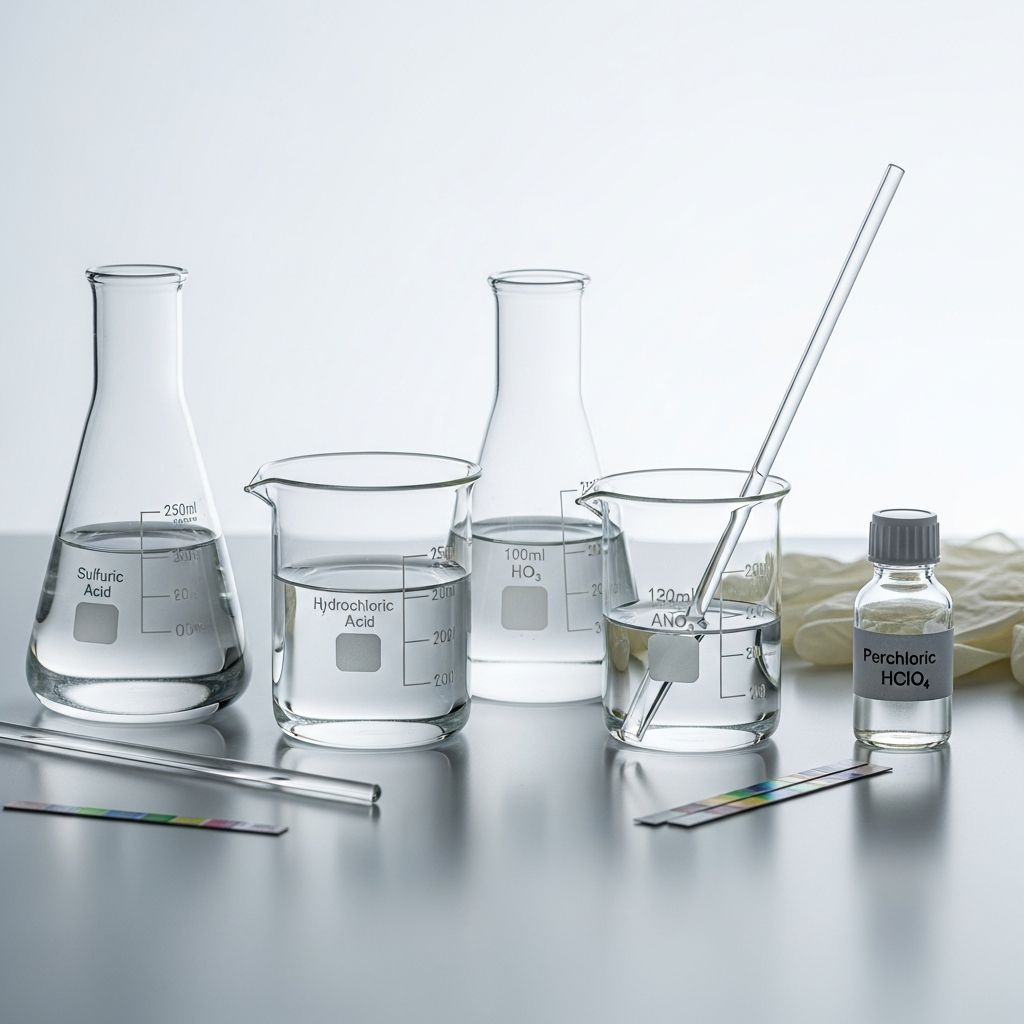
Strong acids represent a cornerstone of acid-base chemistry, distinguished by their complete dissociation in aqueous solutions. These compounds fully ionize to release hydrogen ions (H+), driving reactions in laboratories, industries, and natural processes. Understanding their behavior is crucial for students, researchers, and professionals working with chemical equilibria, pH calculations, and industrial applications.
Defining Strength in Acids: Complete Ionization Explained
The strength of an acid is measured by its tendency to donate protons (H+) in water, not its corrosiveness. Strong acids dissociate nearly 100%, producing hydronium ions (H3O+) and their conjugate bases. For instance, the reaction for a generic strong acid HA is: HA + H2O → H3O+ + A–. This full ionization results in high acid dissociation constants (Ka), often greater than 1, and very low pKa values (typically < -2).
In contrast, weak acids like acetic acid (CH3COOH) only partially dissociate, with Ka values much less than 1. This distinction affects pH: a 0.1 M solution of HCl (strong) has pH ≈ 1, while the same concentration of acetic acid has pH ≈ 2.9. Strong acids conduct electricity well due to free ions and catalyze reactions efficiently.
The Seven Core Strong Acids: Formulas and Characteristics
Chemistry curricula emphasize seven primary strong acids, essential for memorization in exams like the MCAT. These are binary acids of halogens (except fluorine) and key oxyacids.
| Acid Name | Formula | Conjugate Base | pKa (approx.) |
|---|---|---|---|
| Hydrochloric Acid | HCl | Cl– | -6.3 |
| Hydrobromic Acid | HBr | Br– | -8.7 |
| Hydroiodic Acid | HI | I– | -9.3 |
| Nitric Acid | HNO3 | NO3– | -1.4 |
| Sulfuric Acid | H2SO4 | HSO4– (1st), SO42- (2nd weak) | -3.0 (1st) |
| Chloric Acid | HClO3 | ClO3– | -2.7 |
| Perchloric Acid | HClO4 | ClO4– | -10 |
This table highlights their structures: hydrohalic acids (HCl, HBr, HI) feature H-X bonds where bond strength decreases down Group 17, enhancing acidity (HI > HBr > HCl >> HF weak). Oxyacids like HNO3 and HClO4 gain strength from electronegative oxygen atoms stabilizing conjugate bases. Sulfuric acid is diprotic, but only the first proton fully dissociates.
Why These Acids Dominate: Bond Strength and Stability Factors
Acidity correlates inversely with H-A bond strength and conjugate base stability. In hydrohalic acids, larger halogens (I > Br > Cl) form weaker bonds due to poor orbital overlap, facilitating proton release. For oxyacids, more oxygen atoms delocalize negative charge on the anion, as in perchlorate (ClO4–) versus hypochlorite (ClO–, weak acid HClO).
Electronegativity plays a role: chlorine in HClO4 pulls electron density, weakening the O-H bond. These factors ensure complete ionization in dilute solutions (<1 M); concentrated forms may deviate slightly.
Practical Applications Across Industries
- Hydrochloric Acid (HCl): Used in steel pickling to remove rust, food processing (gelatin production), and pH adjustment in pools.
- Sulfuric Acid (H2SO4): The ‘king of chemicals’ for fertilizers (superphosphate), batteries, petroleum refining, and dyes. Global production exceeds 200 million tons annually.
- Nitric Acid (HNO3): Essential for explosives (TNT), fertilizers (ammonium nitrate), and nylon production.
- Hydrobromic and Hydroiodic Acids: Catalysts in organic synthesis; HI reduces certain compounds.
- Chloric and Perchloric Acids: Oxidizers in labs; perchloric acid for trace metal analysis due to non-complexing anion.
These acids enable processes from wastewater treatment to rocket fuels, underscoring their economic importance.
Safety Protocols: Handling Powerful Proton Donors
Despite misconceptions, strength ≠ corrosiveness, yet strong acids demand caution. HCl corrodes steel; H2SO4 dehydrates tissues violently; HF (weak) uniquely penetrates skin to dissolve bones.
Key guidelines:
- Wear PPE: gloves, goggles, acid-resistant aprons.
- Work in fume hoods for vapors.
- Neutralize spills with bases like NaHCO3; water dilutes but generates heat.
- Store in glass or compatible plastics; label clearly.
Perchloric acid risks explosions with organics—use specially designed digestors.
Strong Acids in Calculations: pH, Titrations, and Equilibria
For strong acids, [H+] = initial concentration (dilute solutions), so pH = -log[H+]. In titrations with strong bases, equivalence pH = 7.
Conjugate bases (e.g., Cl–, NO3–) are negligible bases, forming neutral salts like NaCl (pH ≈7). This simplifies stoichiometry in buffers or equilibria problems.
Beyond the Basics: Superacids and Exceptions
Superacids like fluorantimonic acid (HSbF6) surpass HClO4, protonating weak bases like alkanes. They require Teflon storage due to extreme reactivity. Note: HF is weak (pKa 3.17) despite being hydrofluoric, due to strong F-H bond.
Frequently Asked Questions (FAQs)
Is sulfuric acid fully strong?
Yes for the first proton (H2SO4 → H+ + HSO4–); second is weak (pKa ≈2).
How to memorize strong acids?
Use mnemonic: “Hi! Brother Classmate, perchloric, chloric, nitric, sulfuric“.
Why is HF not strong?
Strong F-H bond and poor charge delocalization on small F– make dissociation partial.
Are strong acids always dangerous?
Strength defines ionization, not danger; handle per safety data sheets regardless.
Strong acid vs. concentrated weak acid?
Strong always fully ionizes; concentrated acetic (weak) can match HCl pH but behaves differently in reactions.
Conclusion: Mastering Strong Acids for Chemical Proficiency
Grasping strong acids unlocks acid-base mastery, from lab work to industrial scales. Their complete ionization powers countless applications while demanding respect for safety.
References
- Strong Acids And Bases – Acid Base Equilibria – MCAT Content — Jack Westin. 2023. https://jackwestin.com/resources/mcat-content/acid-base-equilibria/strong-acids-and-bases
- The 7 Strong Acids — PrepScholar Blog. 2022-10-15. https://blog.prepscholar.com/list-of-strong-acids
- Learn All About The Strong Acids and Bases — PraxiLabs. 2022-12-04. https://praxilabs.com/en/blog/2022/12/04/strong-acids-and-bases-2/
- Strong Acids and Bases — Chemistry LibreTexts (Petrucci et al.). 2023-08-12. https://chem.libretexts.org/Bookshelves/General_Chemistry/Map:_General_Chemistry_(Petrucci_et_al.)/16:_Acids_and_Bases/16.4:_Strong_Acids_and_Strong_Bases
- How To Memorize The Strong Acids and Strong Bases — The Organic Chemistry Tutor (YouTube). 2020. https://www.youtube.com/watch?v=AaYQ_ZiE7AY
Similar Articles







Read full bio of Sneha Tete