Exploring Career Pathways in Skilled Trades
Discover how skilled trades offer students practical alternatives to traditional education
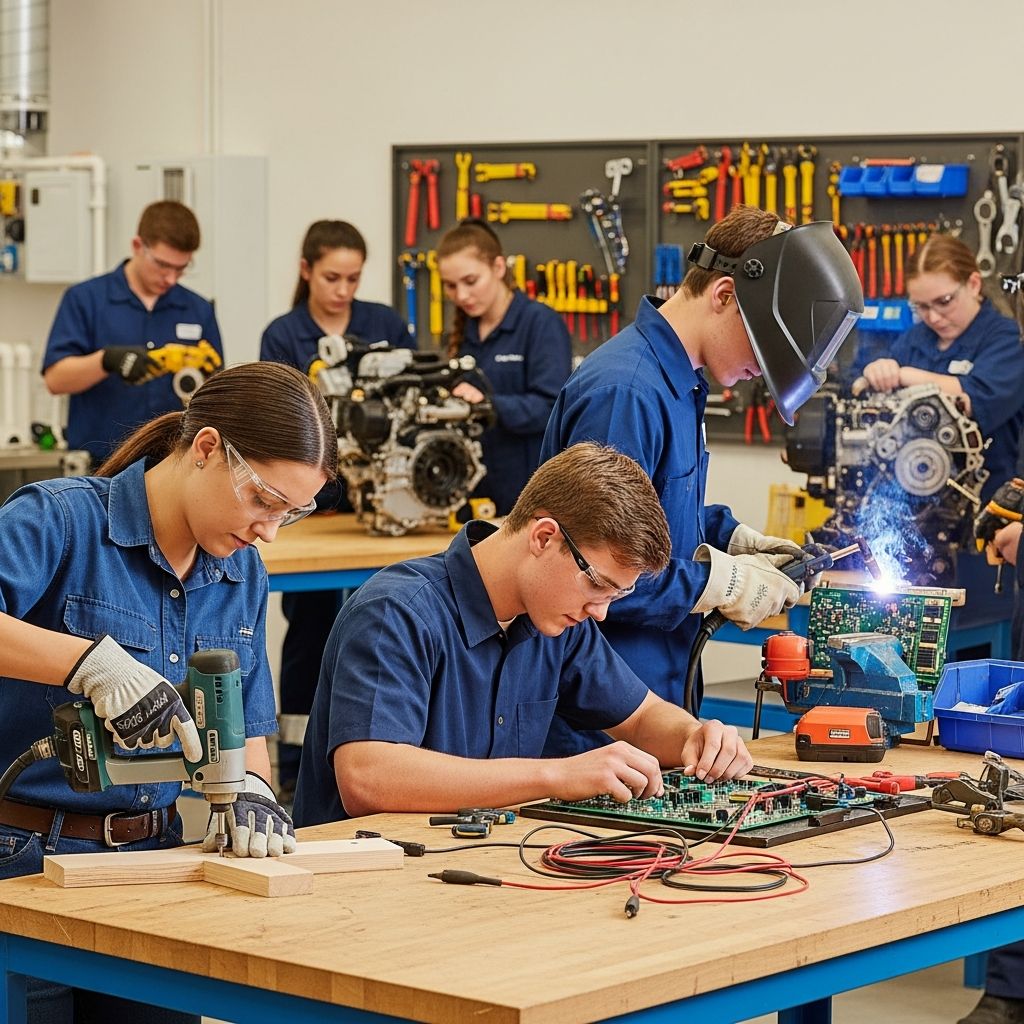
As parents and educators seek meaningful career preparation for young people, skilled trades education has emerged as a transformative option that bridges classroom learning with real-world employment. The landscape of career readiness is shifting, with growing recognition that not every student thrives on a traditional four-year college pathway. For many learners, particularly those who excel through hands-on instruction and direct application of concepts, the trades offer a compelling route to financial independence, professional fulfillment, and economic stability.
The skilled trades encompass a diverse range of professions—from electrical work and plumbing to HVAC installation, welding, construction management, and industrial fabrication. These careers consistently rank among the most accessible, well-compensated entry points into the workforce, requiring significantly less formal education debt than conventional university degrees while delivering faster pathways to employment and advancement.
Understanding the Broader Context of Skilled Trades Education
The demand for skilled workers continues to outpace the available supply. As experienced tradespeople approach retirement and fewer young people enter these professions, industries across construction, manufacturing, utilities, and service sectors face substantial staffing challenges. This shortage creates unprecedented opportunity for students who develop competency in trade-specific skills during their high school years.
Research demonstrates that career and technical education (CTE) programs in the skilled trades yield measurable positive outcomes for participating students. Evidence shows higher graduation rates among CTE participants compared to national high school averages, along with lower dropout rates and increased credential acquisition. Students gain not merely knowledge but verifiable, industry-recognized certifications that directly translate to employment prospects upon program completion.
However, representation in skilled trades remains uneven. White male students currently dominate enrollment across most trade courses, while participation rates among girls and students from diverse racial and ethnic backgrounds lag significantly. Addressing this disparity represents both an equity imperative and an economic necessity, as broadening access to skilled trades education expands the total workforce pipeline while creating pathways for underrepresented populations to achieve financial independence.
Financial Advantages That Transform Family Economics
Perhaps the most compelling argument for considering skilled trades involves the financial realities facing families today. The traditional college pathway increasingly demands substantial financial investment, with four-year degree programs regularly exceeding $100,000 in total costs. Graduates often enter the job market burdened by student loan debt that constrains their financial flexibility for years after completion.
Skilled trades programs present a starkly different financial profile. Training costs typically represent a fraction of traditional college expenses, with many programs costing substantially less and some offered tuition-free through public institutions or industry partnerships. More significantly, the most common pathway into trades—apprenticeship programs—fundamentally transforms the economic equation by paying students while they learn.
In apprenticeship models, participants earn wages from their first day while simultaneously completing classroom instruction and hands-on training under the supervision of experienced professionals. This “earn while you learn” structure allows students to build practical expertise without accumulating debt, develop employment history that enhances future opportunities, and begin establishing financial stability during years when college students are purely incurring expenses.
Upon completing their training, skilled trades workers enter careers offering competitive starting wages with clear pathways for salary growth through advancement, specialization, or business ownership. Many skilled trades workers report earning comparable or superior compensation to college graduates within five to ten years, while having avoided the debt burden that constrains their peers’ financial mobility.
The Practical Efficiency of Accelerated Training Programs
Time represents another critical advantage of skilled trades education. While traditional baccalaureate programs require four years of study, most trade programs can be completed in substantially shorter timeframes. Many accelerated programs take two years or less, with some specialized certifications available within months of intensive, focused training.
This compressed timeline reflects a strategic curricular focus: trades programs teach precisely what students need to know to perform their jobs competently, without peripheral coursework unrelated to their career objectives. Rather than requiring general education across multiple disciplines, trade students concentrate on technical knowledge, safety protocols, equipment operation, problem-solving specific to their field, and industry-standard practices.
The efficiency extends beyond mere time-savings. Earlier entry into the workforce means students begin accumulating work experience, developing professional networks, and earning income years before college graduates complete their degrees. This head start compounds over time, allowing trades workers to advance within their fields while age-peers are still completing formal education.
Learning Environments Designed for Different Brain Styles
Not all learners thrive in traditional classroom settings dominated by lecture, note-taking, and abstract conceptual work. Skilled trades education recognizes this reality by creating learning environments centered on direct engagement with tools, materials, and equipment used in actual job sites.
Hands-on instruction—whether in trade schools, apprenticeships, or hybrid models combining classroom and work-based learning—engages multiple learning modalities simultaneously. Students see principles demonstrated in context, immediately practice techniques under guidance, receive real-time feedback on their performance, and understand directly how their developing skills connect to professional application. This experiential approach typically produces higher knowledge retention compared to passive listening or reading-based instruction.
Apprenticeships represent the pinnacle of experiential learning in trades education. Working alongside experienced professionals in actual work environments, apprentices encounter authentic challenges, develop problem-solving abilities through real scenarios, build professional judgment through mentorship, and establish industry connections that often facilitate later career advancement. The feedback loop operates continuously—every task provides immediate learning, every challenge reinforces skill development, every success builds confidence and competence simultaneously.
This learning style advantages not only students whose cognitive strengths align with kinesthetic or visual processing, but also individuals who struggle with traditional academic environments. Students with different learning profiles, English language learners, and those facing barriers to traditional college paths often discover their capabilities flourish in trade-oriented instruction.
Introducing Trades to High School Students: Strategic Approaches
Effectively introducing skilled trades to secondary students requires multi-faceted engagement that shifts cultural perceptions while providing concrete information and experiences:
- Curriculum Integration: Incorporating career exploration modules within high school academics allows all students exposure to trades possibilities, not only those self-identifying as career-oriented. Interdisciplinary projects connecting STEM instruction to real construction challenges, manufacturing processes, or technical problem-solving plant seeds for later consideration.
- On-Site Learning Experiences: Virtual and in-person worksite visits demystify trade careers by showing students actual work environments, introducing them to practicing professionals, and demonstrating the daily reality of various occupations. These experiences often prove more persuasive than classroom instruction alone.
- Guest Practitioners: Inviting skilled trades professionals into schools to share career pathways, demonstrate equipment, discuss earning potential, and describe workplace culture provides peer-relatable perspective that resonates with student audiences more effectively than adult educators discussing abstract concepts.
- Dual Enrollment Programs: Many high schools partner with community colleges or trade schools to offer dual enrollment, allowing students to simultaneously earn high school and trade credentials. This pathway lets students test trades interests while building credentials before formal post-secondary education.
- Apprenticeship Pathway Information: Clear information about apprenticeship availability, application processes, earnings during training, and career progression helps students understand the concrete mechanics of entering trades rather than viewing them as mysterious options available only to others.
Addressing Representation and Access Barriers
Creating inclusive skilled trades pathways requires deliberate action to broaden participation among women, students of color, and other historically underrepresented populations. Research shows these groups participate in trades education at lower rates despite potential equivalent interest and capability.
Targeted recruitment, mentorship programs pairing underrepresented students with accomplished trades professionals who share their backgrounds, intentional workplace culture assessments ensuring trades environments welcome diverse workers, and addressing systemic barriers that have traditionally channeled some students away from trades consideration represent essential components of equity-focused expansion.
When skilled trades pathways become genuinely accessible to all students regardless of gender, racial, or socioeconomic background, the resulting workforce becomes both more diverse and substantially larger—benefiting employers seeking talent while creating opportunity for populations historically excluded from high-wage career access.
Comparing Educational and Career Outcomes
| Factor | Skilled Trades | Traditional Four-Year College |
|---|---|---|
| Program Duration | 1-2 years (typically) | 4 years |
| Total Program Cost | Minimal to moderate; apprenticeships paid | Often exceeds $100,000 |
| Entry-Level Salary | Competitive wages; earning during apprenticeship | Varies widely; often lower initially |
| Student Debt | Minimal to none | Substantial (average $37,000+) |
| Job Placement | High demand; immediate employment | Varies by field; sometimes requires additional credentials |
| Career Advancement | Through specialization, business ownership, or supervisory roles | Depends on field and continued education |
| Learning Style | Hands-on, experiential, immediately applicable | Lecture-based, theoretical, abstract application |
Job Security and Economic Stability in Skilled Trades
Skilled trades offer inherent job security advantages that few other career pathways can match. Unlike many professions vulnerable to automation, offshoring, or market disruption, the work of skilled trades is fundamentally local, requires human expertise, and cannot be easily outsourced or replaced by technology.
Whether installing electrical systems in new construction, repairing HVAC equipment in existing buildings, installing plumbing systems, fabricating steel for industrial facilities, or performing countless other trades work, the demand for skilled hands and professional judgment remains constant. As aging infrastructure requires replacement and new construction continues, employment demand in skilled trades remains robust and relatively recession-resistant compared to industries dependent on consumer discretionary spending.
Additionally, skilled trades offer pathways to entrepreneurship that many workers pursue after gaining experience as employees. A journeyman electrician, plumber, HVAC technician, or general contractor can establish independent businesses leveraging their credentials, expertise, and industry reputation. This entrepreneurial option provides wealth-building potential unavailable in many traditional employment paths and appeals to individuals desiring business independence without requiring startup capital comparable to other ventures.
Frequently Asked Questions About Skilled Trades Careers
What types of skilled trades exist?
Skilled trades span numerous fields including electrical work, plumbing, HVAC installation and repair, welding, carpentry, masonry, heavy equipment operation, automotive service, commercial cooking, cosmetology, and industrial fabrication. Each field offers distinct career trajectories and specialization opportunities.
How long does it take to become a skilled trades professional?
Timeline varies by field but typically ranges from 1-2 years for accelerated programs to 4-5 years for comprehensive apprenticeships. Some specialized certifications can be obtained within months, while master-level expertise develops through years of accumulated experience.
What earnings can skilled trades workers expect?
Entry-level wages vary by field and location but typically offer competitive compensation. Many skilled trades workers earn $50,000-$80,000+ annually with experience, and independent contractors often earn substantially more. Importantly, these earnings are achieved without the student debt constraining college graduates.
Are there advancement opportunities in skilled trades?
Yes. Workers can advance by developing specialized expertise, pursuing supervisory or management roles, obtaining additional certifications, or establishing independent businesses. Many skilled trades offer pathways to substantial career progression and increasing compensation throughout working life.
Do I need specific high school preparation for skilled trades?
Strong fundamentals in mathematics and communication assist trades training, but specific academic credentials beyond high school completion are typically not required. Trade schools and apprenticeship programs teach necessary technical skills to qualified applicants.
Moving Forward: Building a Culture That Values Skilled Trades
Successfully integrating skilled trades into students’ career awareness requires cultural shifts in how families, educators, and society value different career pathways. When discussions of success narrow exclusively to four-year degrees, talented students who would flourish in trades education remain unaware of viable alternatives.
Parents, school counselors, and educators serve as primary influences on adolescent career thinking. Providing balanced information about diverse pathways—neither pushing all students toward college nor prematurely limiting any student’s possibilities—empowers young people to make informed choices aligned with their interests, learning styles, and life goals.
Skilled trades represent not a consolation prize for students unable to pursue college but a legitimate, financially superior, and personally fulfilling pathway for many learners. As workforce needs intensify and student awareness grows, skilled trades education increasingly merits equal standing in conversations about meaningful career preparation.
References
- New Reports Investigate the State of High School Skilled Trades Education — New America, Education Policy Center. 2024. https://newamerica.org/education-policy/edcentral/new-reports-investigate-state-high-school-skilled-trades-education/
- Why Students Should Consider Skilled Trades Over Traditional College Paths — International Student Services. 2024. https://internationalstudentsvc.org/why-students-should-consider-skilled-trades-over-traditional-college-paths/
- Why Skilled Trades Are the Best Kept Secret for High School Students — Academy of Craft Training. 2024. https://academyofcrafttraining.org/skilled-trades-for-high-school-students/
- Hands-On Learning vs. Traditional Education: Why the Trades Offer a Powerful Alternative — Global Workforce Growth and Competitiveness Initiative. 2024. https://www.gwgci.org/hands-on-learning-vs-traditional-education-trades/
- Why Hands-On Learning is Essential for Skilled Trades Education — Big Ideas USA. 2024. https://bigideasusa.org/blog/the-benefits-of-hands-on-learning-why-skilled-trades-education-matters/
- Should I Go to Trade School? 10 Benefits of Trade Schools — Ontario Business College. 2024. https://obc.edu/should-i-go-to-trade-school-10-benefits-of-trade-schools/
- Is Trade School Right for You? Consider the Advantages and Disadvantages — OSHA Education Center. 2024. https://www.oshaeducationcenter.com/pros-and-cons-of-trade-schools/
Similar Articles







Read full bio of medha deb