Felon Voting Rights: State-by-State Guide
Navigate the complex landscape of felony disenfranchisement laws across U.S. states and learn when voting rights are restored.
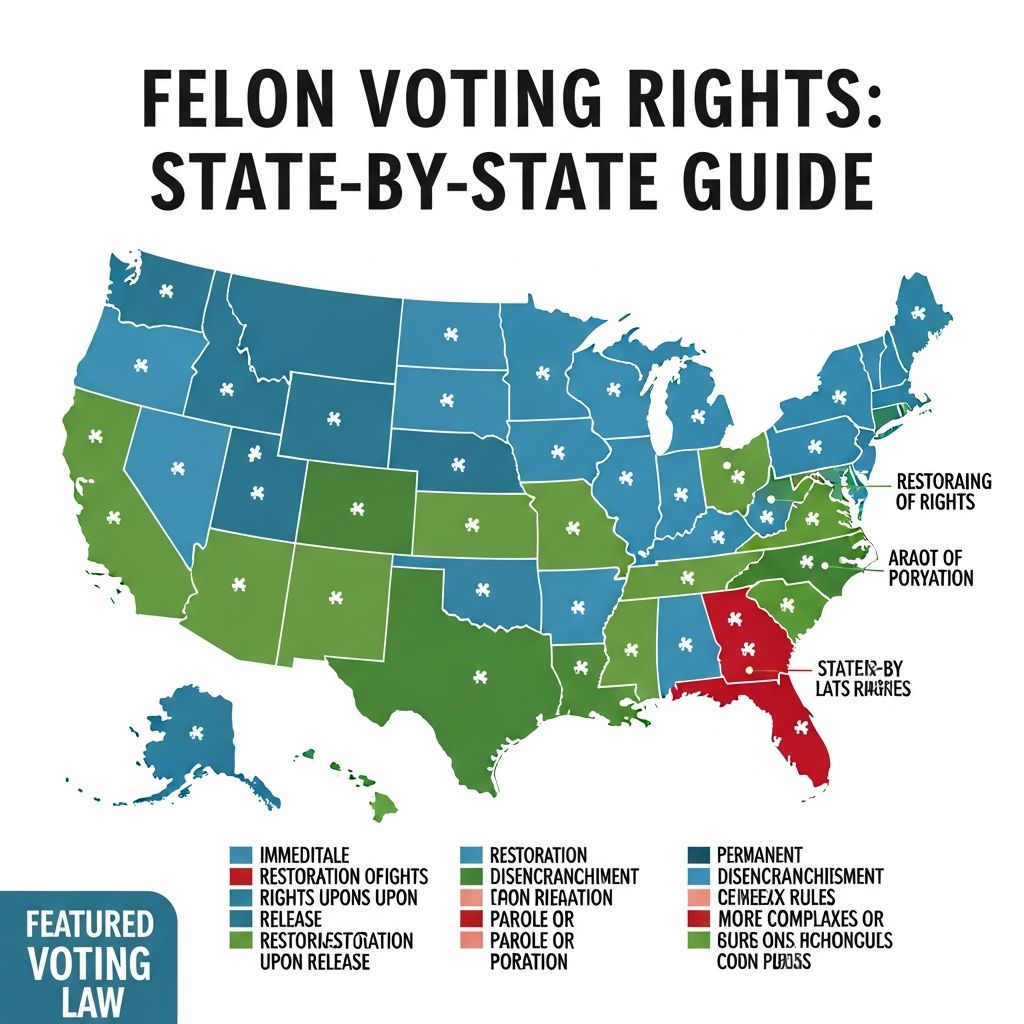
Felony disenfranchisement refers to the practice where individuals convicted of certain crimes lose their right to vote, a policy that varies significantly across the United States. While some states impose lifelong bans, others restore rights immediately upon release from prison or after completing full sentences including probation and parole. This guide synthesizes current laws to clarify eligibility for millions of Americans with criminal records seeking to participate in elections.
Understanding Felony Disenfranchisement Basics
Disenfranchisement laws stem from historical efforts to limit political power among certain groups, evolving through court challenges and legislative reforms. Today, most states—over 40—allow felons to regain voting rights post-sentence, but specifics differ on timing and requirements like paying fines or obtaining pardons. Only two states, Maine and Vermont, plus the District of Columbia, permit voting even while incarcerated. Reforms since the 1990s have restored rights to approximately 1.4 million people, reflecting a trend toward expanded access.
Key factors influencing eligibility include the type of felony, completion of sentence components (prison, parole, probation), unpaid fines or restitution, and state-specific restoration processes. Financial obligations can delay restoration in states like Florida, where court rulings have imposed strict conditions. Individuals must verify status through official channels to avoid illegal voting charges.
Categories of State Policies on Felon Voting
States fall into distinct categories based on restoration timing:
- No restrictions: Voting rights never lost, even during incarceration (Maine, Vermont, DC).
- Automatic upon prison release: Rights restored immediately after exiting prison, regardless of parole/probation status (e.g., 23 states like Illinois, Colorado).
- After full sentence completion: Includes prison, parole, and probation (15 states, e.g., North Carolina).
- Post-sentence action required: Petitions, pardons, or certificates needed (10 states, e.g., Alabama, Tennessee).
- Permanent or conditional bans: Lifelong loss for certain crimes unless rights formally restored (e.g., Florida, Virginia pre-reform).
These categories highlight a patchwork system, with recent shifts like Virginia’s 2026 ballot measure aiming to end lifetime bans.
Detailed State-by-State Breakdown
Below is a comprehensive overview grouped by policy type, current as of 2026.
States with No Disenfranchisement
- Maine and Vermont: Felons retain full voting rights at all times, including from prison via absentee ballot. This unrestricted approach maximizes participation.
- District of Columbia: Similar to these states, no loss of rights post-conviction.
Automatic Restoration Upon Release from Incarceration
In 23 states, rights return automatically once individuals leave prison, simplifying reentry into civic life.
| State | Key Details |
|---|---|
| California | Automatic post-incarceration; Proposition 17 (2020) confirmed this. |
| Colorado | Restored upon release; no probation wait. |
| Illinois | Immediate upon prison exit. |
| Massachusetts | No disenfranchisement after conviction. |
| New York | Automatic post-release since 2021 reforms. |
Restoration After Full Sentence (Prison + Parole/Probation)
15 states require completing all supervision terms. For example:
- North Carolina: Rights automatically return post-supervision; fines do not block eligibility.
- Texas: Full sentence completion required.
States Requiring Additional Action
10 states mandate petitions or approvals.
- Alabama: Submit Certificate of Eligibility to Board of Pardons; response within 44 days.
- Florida: Amendment 4 (2018) promised automatic restoration, but 2019 law and court stays require clearing fines/fees first.
- Georgia: Exceptions for certain convictions; early probation termination possible after 3 years.
- Tennessee: Pardon needed for serious felonies like murder; certificate for others, with restitution paid.
Permanent Disenfranchisement States
A minority impose lifelong bans without restoration unless pardoned.
- Kentucky, Mississippi: Permanent for most felonies; individual applications rare.
- Virginia: Lifetime ban historically; reforms restore upon release, with 2026 ballot to automate.
Recent Reforms and Landmark Changes
Since 1997, 28 states have eased restrictions, with Florida’s Amendment 4 (2018) restoring rights to over 1 million, later complicated by financial hurdles. Virginia’s ongoing push eliminates Jim Crow-era bans. Federal courts, like the 11th Circuit in Florida, continue shaping outcomes. These shifts have reintegrated 1.4 million voters.
How to Check and Restore Your Voting Rights
Steps include:
- Confirm sentence completion with court or lawyer.
- Review state-specific rules via official sites like Vote.gov.
- Apply for restoration if needed (e.g., CERV in Alabama).
- Register anew, even if previously registered.
- Contact advocacy groups like Brennan Center for assistance.
Avoid voting prematurely to prevent prosecution. Tools like RestoreYourVote provide state quizzes.
Frequently Asked Questions (FAQs)
Can felons vote while in prison?
Only in Maine, Vermont, and DC; elsewhere, rights are suspended during incarceration.
Do unpaid fines prevent voting?
In states like Florida, yes; most others separate financial obligations from eligibility.
What about out-of-state convictions?
Your home state’s laws apply, but check conviction state’s restoration impact.
Can misdemeanors affect voting?
Typically no; focus is on felonies.
How have laws changed recently?
Many states automated restoration post-2020, expanding access.
Impact on Democracy and Communities
Disenfranchisement affects over 5 million, disproportionately communities of color, undermining representation. Restoration boosts turnout, reduces recidivism, and fosters reintegration. Advocacy continues for uniform federal standards[10].
This evolving landscape demands vigilance; consult primary sources for updates.
References
- Can People Convicted of a Felony Vote? — Brennan Center for Justice. 2023. https://www.brennancenter.org/our-work/research-reports/can-people-convicted-felony-vote
- Democracy Maps: Voting Rights for Formerly Incarcerated People — Movement Advancement Project. 2024. https://www.lgbtmap.org/democracy-maps/voting_rights_for_formerly_incarcerated_people
- Restore Your Vote — Campaign Legal Center. 2025. https://campaignlegal.org/restoreyourvote
- Registering as a Person in the Criminal Justice System — North Carolina State Board of Elections. 2024-04-01. https://www.ncsbe.gov/registering/who-can-register/registering-person-criminal-justice-system
- Voting Rights — The Sentencing Project. 2026-01-15. https://www.sentencingproject.org/issues/voting-rights/
- Felony Disenfranchisement in the United States — Wikipedia (primary sources referenced). 2026. https://en.wikipedia.org/wiki/Felony_disenfranchisement_in_the_United_States
- Voting After a Felony Conviction — Vote.gov. 2025. https://vote.gov/guide-to-voting/after-felony-conviction
Similar Articles








Read full bio of Sneha Tete