Friedrich Nietzsche and the Architect Mindset
Exploring how Friedrich Nietzsche’s relentless independence and radical vision resonate with the modern INTJ “Architect” personality.
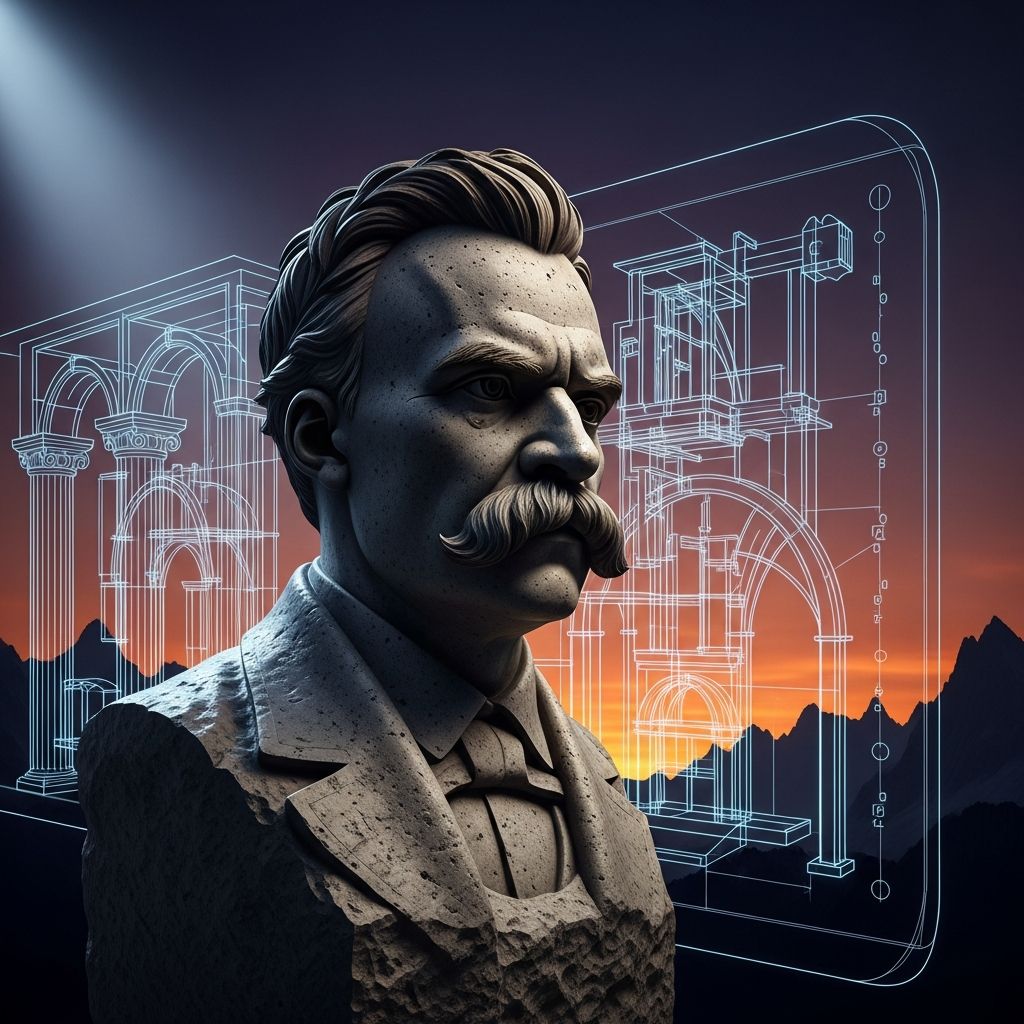
Friedrich Nietzsche is often remembered as the radical philosopher who declared that “God is dead,” challenged conventional morality, and demanded that individuals create their own values in a disenchanted world. Beyond his groundbreaking ideas, Nietzsche’s intense independence, strategic thinking, and uncompromising pursuit of inner truth strongly resemble what personality theory today calls the INTJ or Architect type. This article explores Nietzsche’s life and work as a vivid case study of the Architect mindset in action.
Nietzsche in Brief: A Visionary Out of Step with His Time
Nietzsche (1844–1900) was a German classical philologist turned philosopher whose writings transformed how later generations think about morality, religion, culture, and the self. He began as a professor of Greek language and literature, but his dissatisfaction with purely scholarly work led him to develop a radical critique of European culture.
- Profession: Classical scholar, then independent philosopher and cultural critic.
- Central themes: Revaluation of values, critique of Christian morality, will to power, nihilism, self-overcoming, and the creation of new values.
- Legacy: His ideas influenced existentialism, psychoanalysis, literary modernism, and 20th-century cultural criticism.
Personal correspondence and biographical studies reveal a man who preferred solitude, distrusted crowds, and held himself to punishing intellectual standards. These traits align closely with the independent, analytical, and future-oriented style associated with the Architect personality.
The Architect Personality: Strategic, Reserved, Future-Focused
In modern personality theory, the INTJ / Architect type is typically described as:
- Introverted: Energized by solitude and deep thought rather than social interaction.
- Intuitive: Drawn to patterns, theories, and abstract possibilities more than concrete facts.
- Thinking-oriented: Valuing logic, coherence, and structural soundness over sentiment in decision-making.
- Judging: Preferring structure, long-term planning, and a sense of direction.
Nietzsche’s life and philosophical style highlight all of these tendencies. He walked alone in the Alps for hours, using the isolation to crystallize ideas. His books are filled with large-scale diagnoses of Western culture and imaginative visions of what humanity could become rather than narrow technical arguments. He prized clear thinking and merciless self-critique, even when these processes were painful.
Solitude, Health Struggles, and the Inner Laboratory
Architect personalities typically need periods of withdrawal to process complex ideas. Nietzsche took this need to an extreme. Persistent migraines, eyesight problems, and other health issues forced him to resign from his university post in his mid-30s and live as an independent writer, often in near isolation.
Instead of viewing this isolation as a purely tragic limitation, Nietzsche turned it into a sort of inner laboratory:
- He spent summers in the Swiss Alps and winters in southern Europe, walking and writing in relative seclusion.
- He treated his own suffering as raw material for understanding human psychology, morality, and the drive for meaning.
- He refined his key ideas – like nihilism, the will to power, and self-overcoming – during these solitary years.
This pattern mirrors a common Architect experience: feeling pushed to the margins of conventional life, then converting that marginality into a vantage point for deep insight. Physical limits and social distance can become fuel for a sharper, more original worldview.
Reinventing Values: A Strategic Rebuild of Culture
Architect personalities often think in terms of systems: if an existing system is flawed, they look for ways to redesign it from the ground up. Nietzsche applied this logic not just to an institution or a field, but to the entire moral and cultural framework of Europe.
Modern scholars highlight four especially important strands in his thought:
- Nihilism and the “death of God”: Nietzsche argued that traditional religious and metaphysical beliefs had lost their persuasive power, leaving a vacuum of meaning. He feared this would lead to nihilism – the sense that nothing has value.
- Revaluation of values: Rather than lament this collapse, he proposed a radical reassessment of moral values, asking which beliefs strengthen life and creativity, and which weaken them.
- Will to power: He described a deep drive in human beings not merely to survive but to expand their capacities, reinterpret their experiences, and assert creative control over their lives.
- Eternal recurrence: As a provocative thought experiment, he asked whether we would affirm our lives if we had to live them over identically, again and again – a test of how fully we say “yes” to existence.
This is cultural engineering on a grand scale. Instead of accepting inherited assumptions, Nietzsche dissected them to their foundations and imagined new, life-affirming alternatives. That insistence on structural clarity and wholesale redesign is deeply characteristic of the Architect temperament.
INTJ Traits Reflected in Nietzsche’s Life and Work
| Architect Trait | Nietzschean Expression |
|---|---|
| Independence of mind | Resigned from a prestigious academic position and broke with cultural idols like Wagner to pursue his own philosophical path. |
| Long-term vision | Wrote not for immediate acceptance but for “readers of the future,” expecting his work to be fully understood only later. |
| Analytical skepticism | Questioned prevailing religious, moral, and philosophical assumptions, tracing them to psychological and historical roots. |
| Strategic restructuring | Proposed a “revaluation of all values,” seeking to rebuild cultural norms in a more life-affirming direction. |
| Emotional reserve | Maintained a private, often solitary lifestyle; even close relationships often became strained as his views evolved. |
Strengths of the Architect Spirit in Nietzsche
Many of Nietzsche’s most admired qualities line up with the potential strengths of an INTJ personality developed to a high degree.
1. Fearless Intellectual Honesty
Nietzsche was willing to follow uncomfortable questions wherever they led. He treated ideas as hypotheses to be stress-tested, not dogmas to be defended. In typical Architect fashion, he preferred harsh truths over reassuring illusions, even if they made life more demanding.
- He challenged moral ideals that he believed promoted weakness or resentment rather than flourishing.
- He interpreted philosophical systems as expressions of deeper psychological needs and power dynamics.
- He embraced self-critique, revising earlier positions as his thinking sharpened.
2. Strategic Vision for Human Development
Nietzsche’s notion of “becoming who one is” captures a distinctly Architect-like focus on self-development as a long-term project. He saw identity not as a fixed essence but as something crafted through deliberate choices, struggle, and ongoing re-interpretation of one’s life.
According to contemporary scholarship, this vision involves:
- Cultivating one’s strengths and instincts rather than suppressing them.
- Accepting conflict and hardship as necessary for growth.
- Creating a personal style of living that expresses one’s deepest values.
This resembles the way many Architects view their lives: as a multi-decade strategy for realizing a chosen ideal, even if it goes against social expectations.
3. Capacity for Deep, System-Level Insight
Nietzsche’s writings model the Architect tendency to move beyond surface-level problems and probe deeper structures. He linked moral rules to historical power struggles, religious beliefs to psychological needs, and cultural trends to the hidden logic of values.
Instead of treating crises of belief as isolated events, he saw them as symptoms of an underlying shift in how people understand truth, authority, and meaning. For modern INTJs, his example showcases the impact that system-level analysis can have when applied consistently and courageously.
Shadow Sides: When the Architect Turns Against Itself
Nietzsche’s life also illustrates some of the risks that come with an intensely analytical, ideal-driven personality.
1. Isolation and Misunderstanding
Architects can find it difficult to feel at home in mainstream social environments. Nietzsche spent much of his adult life apart from academic circles, estranged from former friends, and largely unrecognized by the wider public.
This isolation allowed him to think freely but also deepened his sense of being out of step with his time. Many INTJs report similar feelings of not quite belonging, which can become corrosive if they harden into contempt for others or total withdrawal.
2. Perfectionism and Inner Severity
Nietzsche judged both himself and his culture by extremely demanding standards. Biographical studies suggest that he often criticized his own work harshly and felt tormented by the gap between his vision and reality.
For Architect personalities, this kind of inner severity can be double-edged:
- It drives high achievement and originality.
- It can also lead to burnout, chronic dissatisfaction, and difficulty appreciating incremental progress.
3. The Risk of Being Misused or Misread
Nietzsche opposed nationalism, antisemitism, and crude power politics, yet portions of his work were later misappropriated by fascist movements in the 20th century. This disturbing history shows how abstract, provocative ideas can be distorted when stripped of their nuance and context.
Architects, who often think at a high level of abstraction, face a related challenge: complex insights may be simplified, misunderstood, or weaponized by others. Communicating clearly and anticipating how ideas might be interpreted becomes crucial.
Nietzsche as a Model for INTJs: Lessons and Cautions
Reading Nietzsche through the lens of the Architect personality does not mean claiming he “was an INTJ” in any technical or clinical sense. Instead, it uses his example to illuminate patterns that many INTJs recognize in themselves.
What INTJs Can Learn from Nietzsche’s Strengths
- Trust your long-term vision: Nietzsche wrote for future readers, accepting that his contemporaries might not understand him. INTJs can draw courage from this when their ideas feel out of sync with the present.
- Cultivate inner alignment: His call to “become who you are” encourages Architect types to seek coherence between their values, choices, and lifestyle rather than living by default scripts.
- Use analysis to liberate, not just demolish: Nietzsche didn’t stop at critique; he also tried to imagine life-affirming alternatives. Similarly, INTJs can aim to build better systems, not only expose flaws.
What INTJs Can Learn from Nietzsche’s Struggles
- Guard against destructive isolation: Solitude can sharpen thought, but complete withdrawal can intensify suffering and misunderstanding. INTJs benefit from a small circle of intellectually compatible peers.
- Balance rigor with self-compassion: Nietzsche’s relentless self-demand contributed to both brilliance and fragility. Architect types may need intentional practices that balance critique with appreciation.
- Communicate complexity responsibly: Given how Nietzsche’s work was misused, INTJs can learn to clarify intentions, anticipate misreadings, and stay engaged with how their ideas circulate.
Frequently Asked Questions (FAQs)
Q: Was Friedrich Nietzsche definitely an INTJ or Architect personality?
A: There is no definitive way to type historical figures using modern personality models, and Nietzsche never took such an assessment. Describing him as “Architect-like” is a heuristic: his independence, strategic vision, and analytic style closely resemble traits associated with the INTJ profile, but this remains an interpretive comparison rather than a clinical fact.
Q: How did Nietzsche’s philosophy reflect an Architect-style approach to life?
A: Nietzsche approached life as a long-term project of self-creation. He critically examined inherited beliefs, identified hidden psychological motives, and then tried to design new values that would foster strength, creativity, and resilience. This mirrors the Architect tendency to diagnose flawed systems and then propose more coherent, future-oriented alternatives.
Q: Why is Nietzsche associated with nihilism, and how would an INTJ relate to that?
A: Nietzsche analyzed how the decline of traditional religious and metaphysical beliefs could produce nihilism – the feeling that nothing has meaning or value. Rather than endorsing nihilism, he sought ways to overcome it through the creation of new values grounded in life and creativity. Architects confronted with a similar loss of meaning might resonate with his impulse to rebuild a more rational, self-chosen framework of purpose.
Q: Did Nietzsche’s personal suffering shape his Architect-like traits?
A: Biographical research shows that Nietzsche’s chronic health problems, social isolation, and professional setbacks pushed him into a life of intense solitude and reflection. He transformed this adversity into a source of psychological and philosophical insight, which is consistent with the Architect inclination to treat hardship as data for refining one’s worldview and long-term strategy.
Q: What is the main takeaway for modern INTJs from Nietzsche’s example?
A: Nietzsche’s life demonstrates how far a determined, structurally minded, and visionary person can go in reshaping cultural conversations. For modern INTJs, his example underscores both the power and the cost of radical independence: it encourages them to trust their strategic imagination, yet also to remain mindful of relationships, communication, and psychological balance while pursuing far-reaching goals.
References
- Friedrich Nietzsche — Encyclopaedia Britannica. 2024-01-10. https://www.britannica.com/biography/Friedrich-Nietzsche
- Nietzsche, Friedrich — Internet Encyclopedia of Philosophy. 2017-08-03. https://iep.utm.edu/nietzsch/
- Friedrich Nietzsche — Stanford Encyclopedia of Philosophy. 2017-05-30. https://plato.stanford.edu/entries/nietzsche/
- Friedrich Nietzsche’s Life, Insanity, and Legacy — Philosophy Break. 2022-03-14. https://philosophybreak.com/articles/friedrich-nietzsches-life-insanity-and-legacy/
- Friedrich Nietzsche: A Philosophical Biography (Book Review) — Notre Dame Philosophical Reviews. 2011-06-30. https://ndpr.nd.edu/reviews/friedrich-nietzsche-a-philosophical-biography/
Similar Articles








Read full bio of Sneha Tete