Geodesic Domes: Engineering Marvels of Strength and Efficiency
Discover the innovative world of geodesic domes, from their structural genius to modern sustainable applications across industries.
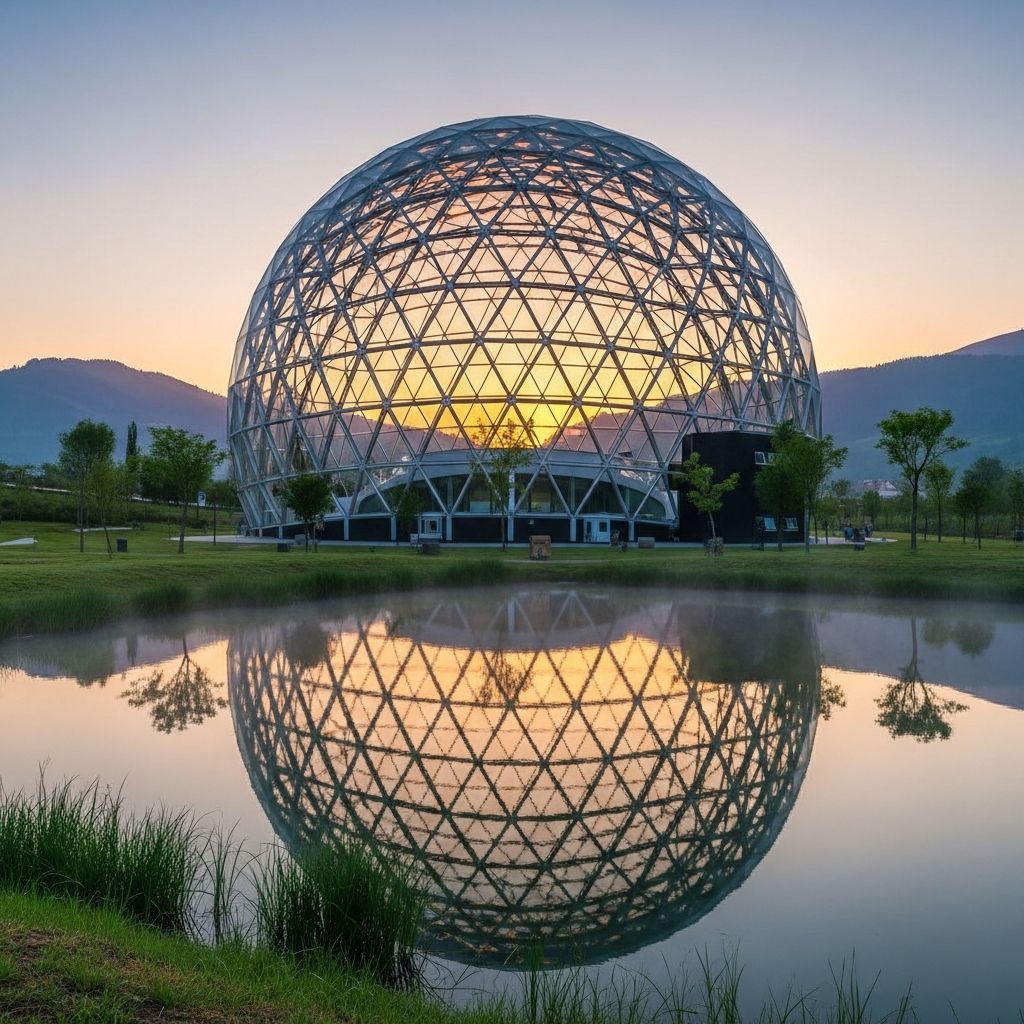
Geodesic domes represent a pinnacle of structural innovation, combining geometric precision with remarkable efficiency to create enclosures that are stronger, lighter, and more adaptable than traditional buildings. These hemispherical structures, composed of interlocking triangular panels, distribute forces evenly across their surface, enabling them to support immense loads while using minimal materials.
Origins in Geometry and Early Innovations
The concept of the geodesic dome draws from natural patterns observed in geometry, such as those found in viruses, crystals, and radiolarians, where triangulated forms provide optimal stability. While ancient civilizations experimented with dome-like structures, the modern geodesic dome emerged in the early 20th century through engineering ingenuity.
In the 1920s, Walther Bauersfeld, chief engineer at Carl Zeiss in Jena, Germany, developed the first practical geodesic dome for a planetarium projector. His initial prototype, a small structure on the Zeiss factory roof, evolved into the larger ‘Wonder of Jena’ dome, which opened to the public in 1926. Constructed with thousands of thin iron rods forming a triangulated framework coated in a thin concrete shell, it mimicked the strength-to-weight ratio of an eggshell.
These early designs laid the groundwork by demonstrating how subdividing a sphere into smaller triangles could create a rigid, self-supporting form capable of enclosing vast spaces without internal supports.
Buckminster Fuller’s Revolutionary Contributions
American visionary Richard Buckminster Fuller popularized and perfected the geodesic dome in the mid-20th century, patenting it in 1949 after years of research inspired by nature’s efficient structures. Fuller, often called ‘Bucky,’ was driven by a philosophy of ‘doing more with less,’ and the dome embodied this ideal: it encloses the maximum volume with the minimum surface area, optimizing material use.
Fuller’s breakthrough came from refining icosahedral geometry—dividing the 20 faces of an icosahedron into smaller triangles to approximate a sphere. This ‘omnitriangulated’ surface ensured even stress distribution, making domes up to 95% lighter than equivalent traditional roofs.
One of his early triumphs was the 1953 renovation of Ford Motor Company’s Rotunda in Michigan, where a geodesic dome addition proved visually stunning and structurally superior. By 1967, Fuller constructed the iconic 76-meter Biosphere for Expo ’67 in Montreal, a landmark that showcased the dome’s scalability.
Core Structural Principles and Mechanics
At its heart, a geodesic dome functions through a network of geodesics—the shortest paths on a sphere—forming a lattice of equilateral or near-equilateral triangles. This grid divides the spherical surface into facets that interlock, creating a monolithic structure resistant to deformation.
- Stress Distribution: Loads from wind, snow, or earthquakes spread evenly via tension and compression in the triangles, preventing localized failures.
- Material Efficiency: Fewer struts and panels are needed compared to rectilinear buildings, reducing costs and weight.
- Aerodynamic Shape: The curved form deflects wind smoothly, minimizing turbulence and uplift forces.
Modern constructions often use prefabricated panels of aluminum, fiberglass, or insulated composites, allowing rapid assembly. For instance, kits with polystyrene triangles laminated to concrete enable homeowners to erect watertight domes.
| Feature | Geodesic Dome | Traditional Dome |
|---|---|---|
| Weight Efficiency | 95% lighter for same span | Heavier, requires thick materials |
| Internal Supports | None needed | Often required for large sizes |
| Wind Resistance | High; smooth airflow | Prone to uplift |
| Construction Time | Days for large domes | Weeks or months |
Key Advantages for Modern Construction
Geodesic domes excel in energy efficiency, with their low surface-to-volume ratio minimizing heat loss—up to 30% less energy use than conventional homes, per studies from dome builders. The shape also promotes natural convection for better air circulation and light penetration, ideal for greenhouses.
Durability shines in extreme conditions: domes have endured Arctic winters for decades, serving as radar stations and research outposts. Their modularity supports expansion or disassembly, enhancing versatility.
Diverse Applications Across Industries
Residential and Sustainable Housing
Homeowners increasingly choose geodesic domes for eco-friendly living. These structures offer spacious, open interiors without load-bearing walls, customizable for off-grid setups with solar panels and rainwater collection.
Agricultural and Greenhouse Uses
The Climatron at Missouri Botanical Garden, one of the first geodesic greenhouses, demonstrated optimal sunlight capture and temperature control. Today, biodomes extend growing seasons in harsh climates.
Commercial and Institutional Projects
From auditoriums to storage facilities, domes like the 1958 Union Tank Car dome in Louisiana highlight industrial applications. Expo pavilions and observatories benefit from their aesthetic appeal and functionality.
Emergency and Extreme Environments
Military and space agencies value quick-deploy domes for shelters. NASA’s interest stems from lightweight assembly in remote areas, paving the way for lunar or Martian habitats.
Challenges and Practical Considerations
Despite advantages, geodesic domes face hurdles like irregular wall angles complicating interior fittings and higher upfront design costs. Flooring must be engineered for the curved base, and permitting can vary by locale. However, advancements in prefabrication mitigate these issues.
Future Prospects and Innovations
With sustainability demands rising, geodesic domes are poised for growth in smart cities and climate-resilient architecture. Integrations with IoT for climate control and 3D-printed panels promise even greater efficiency. Fuller’s vision of mile-wide climate-controlled urban domes may yet inspire megastructures.
Frequently Asked Questions (FAQs)
What materials are best for building a geodesic dome?
Common choices include aluminum struts for frames, PVC or ETFE panels for transparency, and insulated foam composites for homes. Select based on climate and use.
Are geodesic domes cost-effective long-term?
Yes, due to 30% energy savings and low maintenance, though initial costs may exceed standard builds.
Can I build a geodesic dome myself?
Prefabricated kits make it feasible for DIYers with basic skills, often erectable in days.
How do geodesic domes perform in earthquakes?
Exceptionally well, as the flexible triangulated frame absorbs and distributes seismic forces.
Are they suitable for hot climates?
Absolutely; the shape reduces solar heat gain and promotes ventilation, outperforming flat roofs.
References
- Geodesic dome – Wikipedia — Wikipedia Contributors. 2023-10-15. https://en.wikipedia.org/wiki/Geodesic_dome
- Geodesic dome: characteristics and applications — Domus. 2025-01-20. https://www.domusweb.it/en/architecture/2025/01/20/geodesic-dome-characteristics-applications.html
- The history behind Geodesic Domes — Ekodome. 2023-05-12. https://ekodome.com/the-history-behind-geodesic-domes/
- The Architectural Genius of the Geodesic Dome — Smithsonian Magazine. 2023-06-08. https://www.smithsonianmag.com/smithsonian-institution/the-architectural-genius-of-the-geodesic-dome-and-the-challenge-of-putting-it-all-back-together-180982492/
- Geodesic Domes — Buckminster Fuller Institute. 2024-02-14. https://www.bfi.org/about-fuller/geodesic-domes/
- Buckminster Fuller and the Geodesic Biodome — Growing Spaces. 2023-11-03. https://growingspaces.com/blog/buckminster-fuller-geodesic-dome
Similar Articles







Read full bio of Sneha Tete