Gulf Stream: Earth’s Mighty Ocean River
Discover the Gulf Stream's vital role in global climate, its powerful flow, and potential changes amid warming oceans.
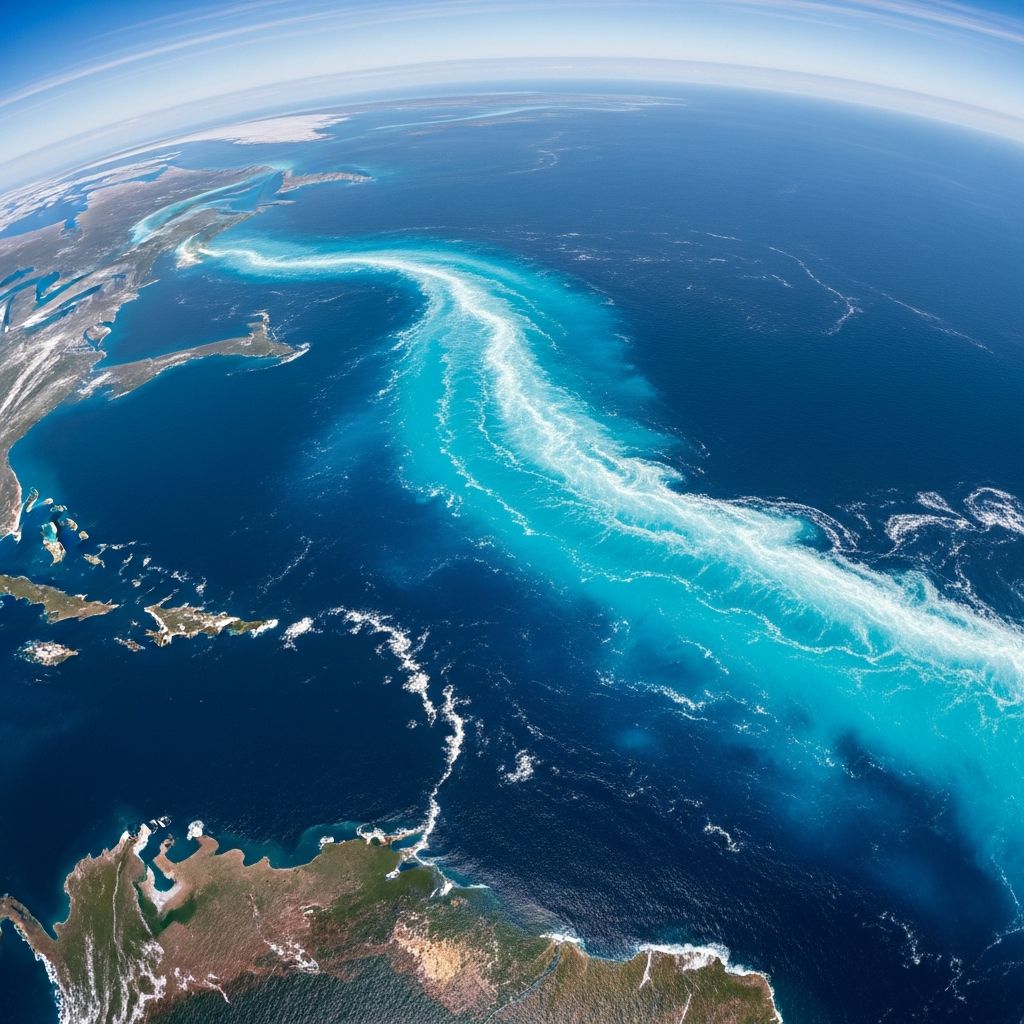
The Gulf Stream stands as one of the planet’s most powerful ocean currents, channeling vast volumes of warm water from the tropics northward across the Atlantic. This dynamic flow profoundly influences weather patterns, marine ecosystems, and human societies along its path.
Origins and Path of the Gulf Stream
Warm waters gather in the Gulf of Mexico, warmed by intense solar radiation in the subtropics. These waters funnel through the Straits of Florida, accelerating as the channel narrows, forming the Florida Current. From there, the current hugs the U.S. East Coast, gaining strength until it veers northeast near Cape Hatteras, North Carolina.
Crossing the open Atlantic, the Gulf Stream reaches speeds that dwarf many rivers. It eventually branches around 40°N, 30°W: the North Atlantic Drift continues toward Europe, while a southern arm feeds the Canary Current. This path integrates into the broader North Atlantic Subtropical Gyre, a massive clockwise circulation driven by trade winds and planetary winds.
Physical Power: Speed, Width, and Volume
The Gulf Stream’s velocity peaks near the surface at about 9 km/h (5.6 mph), with an average of 6.4 km/h (4 mph). Speeds taper to 1.6 km/h (1 mph) as it broadens northward. Typically 100 km wide and 800-1,200 meters deep, it transports 30 million cubic meters per second (30 sverdrups) through the Florida Straits, surging to 150 sverdrups south of Newfoundland—far exceeding all Atlantic rivers combined at 0.6 sverdrups.
| Characteristic | Value | Comparison |
|---|---|---|
| Average Speed | 6.4 km/h (4 mph) | Twice as fast as Olympic swimmers |
| Max Surface Speed | 9 km/h (5.6 mph) | Equals a brisk bicycle ride |
| Volume Transport | 30-150 sverdrups | 100s of times Mississippi River flow |
| Width/Depth | 100 km / 1 km | Wider than many countries are long |
This table highlights the Gulf Stream’s immense scale, underscoring its status as a western boundary current intensified by Earth’s rotation and wind patterns.
Mechanisms Driving the Current
Wind stress from the northeast trade winds pushes surface waters westward across the Atlantic. Western intensification—due to Earth’s rotation (Coriolis effect)—concentrates the return flow into a swift, narrow stream along the western boundary. Conservation of potential vorticity accelerates the poleward current, outweighing friction.
Deeper dynamics involve thermohaline circulation: warm surface waters cool and sink in the North Atlantic, driving a global conveyor belt. The Gulf Stream contributes heat and salt northward, fueling this overturning. Unlike purely wind-driven flows, this blend makes it resilient yet vulnerable to density changes.
Climate Regulation Across Continents
The Gulf Stream transfers heat equivalent to millions of power plants, warming Western Europe dramatically. Without it, London might resemble Labrador’s chill. It maintains mild winters in the UK, Norway, and beyond via the North Atlantic Drift.
- Florida’s Mild Winters: The Florida Current keeps coastal waters at 24°C (75°F) minimum, buffering against cold snaps.
- European Warmth: Heat transport prevents ice ages in high latitudes, supporting agriculture and populations.
- U.S. East Coast: Moderates temperatures, influences snowfall patterns in the Appalachians.
Storms intensify along its path: extratropical cyclones deepen over its warm waters, and 75% of subtropical cyclones from 1951-2000 formed nearby, peaking in May and October.
Ecosystems Thriving in the Warm Flow
Nutrient upwelling and temperature gradients foster rich biodiversity. The current’s edges spawn eddies—warm and cold vortices—that mix waters, boosting plankton blooms and fisheries. Tuna, swordfish, and whales migrate along it, while sea turtles nest on warmed beaches.
Coral reefs off Florida benefit from stable warmth, though bleaching risks rise with anomalies. The Stream’s stability supports commercial fishing grounds from the Carolinas to the Grand Banks.
Human Impacts: Navigation, Energy, and Weather
Sailors have harnessed its speed for centuries; clipper ships shaved weeks off transatlantic voyages. Today, it challenges offshore rigs and shipping, with eddies causing rogue waves. Coastal erosion accelerates where it undercuts beaches.
Wind farms in its path tap steady breezes amplified by warm waters. It influences hurricane tracks, steering them poleward and intensifying them via heat fuel.
Observing the Gulf Stream: Modern Science
Satellites like NASA’s track sea surface heights and temperatures, revealing meanders and rings. Buoys and Argo floats measure salinity and velocity in real-time. Since the mid-20th century, observations have refined models, confirming wind and density drivers.
GEOMAR and NOAA monitor fluctuations, using interdisciplinary tools to probe Atlantic Meridional Overturning Circulation (AMOC) health.
Threats from Climate Change
Global warming introduces freshwater from melting Greenland ice, diluting North Atlantic salinity and potentially slowing the AMOC. Models predict weakening within decades, cooling Europe by several degrees. While surface winds may intensify the Gulf Stream, the deeper conveyor risks collapse.
Studies show underestimated meltwater effects; even moderate ice loss could disrupt the ‘heat pump.’ Observational data hints at slowdowns already, though debated.
Future Outlook and Research Priorities
Projections vary: some see resilience, others abrupt shifts. Enhanced monitoring via satellites and submersibles is crucial. Mitigating emissions preserves this climate engine.
Interdisciplinary efforts at centers like GEOMAR integrate models, observations, and paleoclimate data to forecast changes.
Frequently Asked Questions (FAQs)
What causes the Gulf Stream to flow so fast?
Western intensification from winds and Earth’s rotation concentrates flow into a narrow, accelerating current along the North American coast.
How does the Gulf Stream affect Europe’s weather?
It carries tropical heat northeast, warming winters and enabling milder climates than similar latitudes elsewhere.
Could the Gulf Stream stop due to climate change?
A full stop is unlikely soon, but weakening from ice melt could cool Europe significantly within decades.
How much water does the Gulf Stream move?
About 30-150 sverdrups, vastly more than all rivers into the Atlantic combined.
Is the Gulf Stream getting stronger or weaker?
Surface speeds may rise with winds, but the overturning circulation shows signs of slowdown from freshwater input.
References
- How fast is the Gulf Stream? — NOAA’s National Ocean Service. 2024-06-16. https://oceanservice.noaa.gov/facts/gulfstreamspeed.html
- Gulf Stream — Wikipedia (citing primary sources). Accessed 2026. https://en.wikipedia.org/wiki/Gulf_Stream
- Gulf Stream | Map, Definition, Location, & Facts — Britannica. Accessed 2026. https://www.britannica.com/place/Gulf-Stream
- Gulf Stream and Atlantic Circulation — GEOMAR Helmholtz Centre for Ocean Research Kiel. Accessed 2026. https://www.geomar.de/en/discover/ocean-and-climate/ocean-observation/gulf-stream-and-atlantic-circulation
- What Is the Gulf Stream? — NESDIS NOAA. Accessed 2026. https://www.nesdis.noaa.gov/about/k-12-education/oceans-coasts/what-the-gulf-stream
- The Gulf Stream (Western Boundary Current) — NASA Earthdata. Accessed 2026. https://www.earthdata.nasa.gov/data/instruments/czcs/classic-scenes/gulf-stream-western-boundary-current
Similar Articles








Read full bio of Sneha Tete