Understanding the Higgs Field and Mass Generation
Explore how the Higgs field gives fundamental particles their mass and shapes our universe.
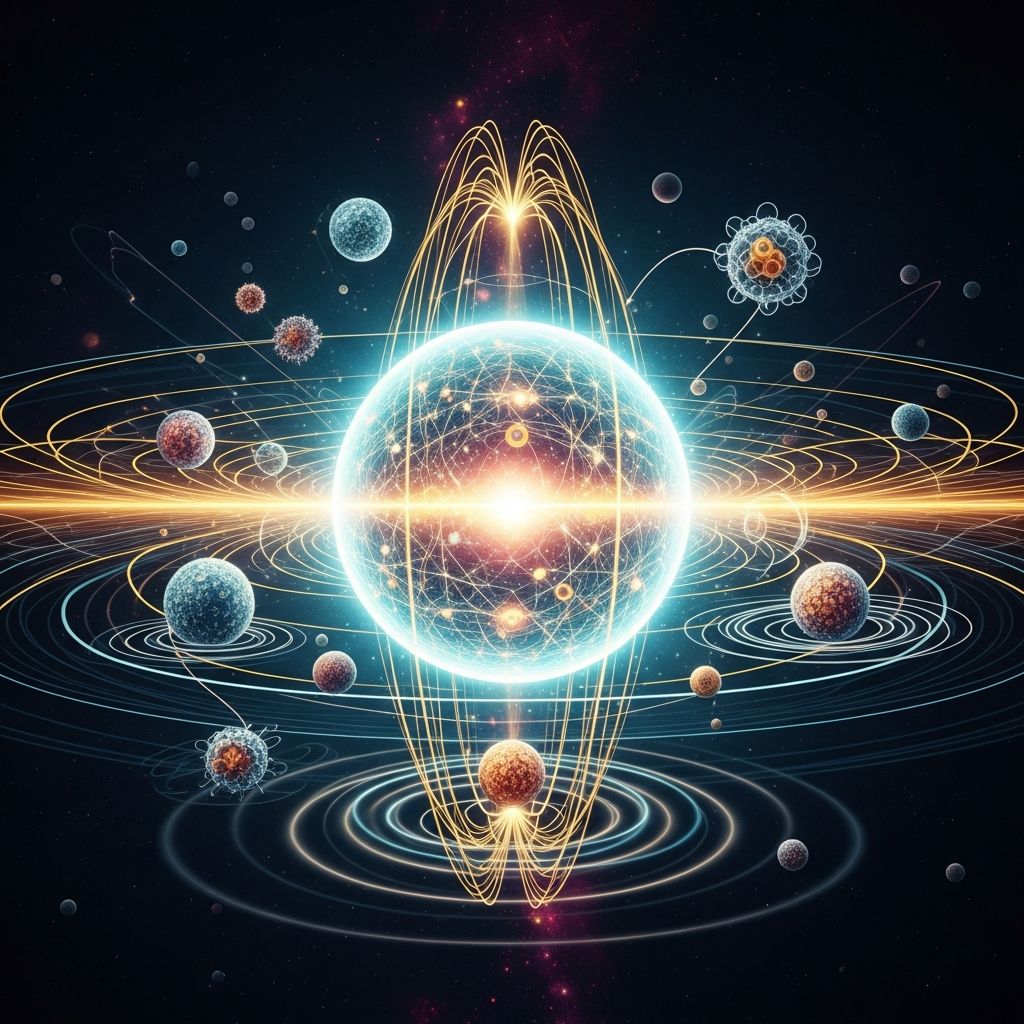
Introduction to Quantum Fields and Particle Physics
Modern physics operates on a principle that fundamentally differs from our everyday intuition about how the world works. Rather than thinking of particles as tiny balls traveling through empty space, contemporary particle physics describes the universe as filled with interconnected fields. Each of these fields has an associated particle type that emerges from ripples or vibrations within that field. The electromagnetic field produces photons as its ripples, the electron field generates electrons, and the Higgs field produces the Higgs boson. This framework, known as quantum field theory, has become the most successful description of fundamental reality we possess.
Among all the fields that populate the cosmos, the Higgs field occupies a unique and essential position. Unlike other fields that were conceptualized to explain known particles and forces, the Higgs field was theoretically proposed in 1964 to resolve a fundamental problem in physics: explaining why certain particles possess mass while others do not. This theoretical necessity eventually led to one of the most significant experimental discoveries in modern science.
The Mass Problem in Fundamental Physics
Before the introduction of the Higgs field concept, physicists faced a profound inconsistency in their theories. According to the Standard Model of particle physics, W and Z bosons—particles responsible for mediating the weak nuclear force—should theoretically be massless, similar to photons. However, experimental measurements conclusively demonstrated that these particles possessed substantial mass, approximately 80 GeV/c². This discrepancy between theoretical predictions and experimental observations created a crisis in fundamental physics.
Without a mechanism to explain this mass generation, the mathematical framework of the Standard Model appeared incomplete. Scientists needed to find a way to reconcile their elegant theories with the stubborn facts of experimental reality. The solution came from an unexpected direction: a new kind of field that permeates all of space and interacts with particles to grant them mass.
The Conceptual Framework of the Higgs Field
The Higgs field represents a revolutionary concept in physics. It is not a field that carries a force, like the electromagnetic or gravitational fields. Instead, it is a scalar field with a special property: it possesses a non-zero vacuum expectation value throughout all of spacetime. This means that even in its lowest energy state—the vacuum—the Higgs field maintains a constant value everywhere in the universe. Think of this as an invisible ocean permeating all of existence, present even in what we consider empty space.
What makes the Higgs field extraordinary is its role in spontaneous symmetry breaking. At extremely high temperatures in the early universe, the Higgs field behaved differently, exhibiting different symmetry properties. As the universe cooled following the Big Bang, the field underwent a phase transition, similar to water freezing into ice. This transition caused the field to acquire its non-zero value, triggering spontaneous symmetry breaking and unleashing the mass-giving mechanism that now defines our universe.
How the Higgs Mechanism Generates Particle Mass
The actual mechanism by which the Higgs field generates mass involves the strength of interaction between particles and the field itself. Every massive particle in the universe couples to the Higgs field with a particular strength characterized by what physicists call a coupling constant. The stronger this coupling—meaning the more intensely a particle interacts with the field—the greater the mass that particle acquires.
A more sophisticated understanding corrects a common misconception. The Higgs field does not slow particles down like a viscous medium or cosmic molasses. Rather, stronger interactions with the Higgs field cause particles to vibrate at higher resonant frequencies. These higher vibrational frequencies correspond directly to increased mass. In this sense, the Higgs field acts as a “cosmic stiffening agent,” increasing the resonant frequencies of other quantum fields and thereby conferring mass upon their associated particles.
Consider the contrast between different particles: electrons couple strongly to the Higgs field and thus acquire significant mass, while photons do not interact with the Higgs field at all and consequently remain massless. Quarks, which compose protons and neutrons, couple with varying strengths and therefore possess different masses from one another. This elegant mechanism explains the observed spectrum of particle masses we measure experimentally.
The Higgs Boson: Detecting the Field
While the Higgs field itself cannot be directly observed—it exists as the background sea permeating all space—the particle associated with its ripples can be detected. The Higgs boson represents the most energetic ripple in the Higgs field, a quantum excitation that can be created when enough energy is concentrated in a small region.
Creating a Higgs boson requires extraordinary conditions. Scientists cannot simply reach into space and pluck a Higgs boson out; instead, they must create one through violent particle collisions. At the CERN laboratory near Geneva, Switzerland, the Large Hadron Collider accelerates protons to nearly the speed of light and smashes them together, briefly generating conditions energetic enough to produce Higgs bosons. When created, Higgs bosons almost immediately decay into other particles that can be detected by sophisticated instruments.
The discovery of the Higgs boson in 2012 represented confirmation of the theoretical prediction made decades earlier. Finding this particle provided experimental verification that the Higgs field actually exists and operates as physicists had theorized. This discovery earned the 2013 Nobel Prize in Physics and marked a triumphant moment for the Standard Model of particle physics.
Mathematical Structure and Symmetry
The Higgs field possesses specific mathematical properties that determine how it interacts with other particles. In the Standard Model, the Higgs field is classified as an SU(2) doublet, a mathematical structure consisting of two complex components related by weak isospin symmetry. The field carries zero electric charge while possessing specific weak isospin and weak hypercharge values.
The profound significance of the Higgs field lies in its role in breaking the electroweak symmetry. At high energies, the electromagnetic force and weak nuclear force appear as different manifestations of a single unified electroweak interaction. However, at lower energies present in our universe today, this symmetry is broken, and these forces reveal themselves as distinct phenomena with different properties. The Higgs field mediates this symmetry breaking, and in the process, three of its four degrees of freedom combine with W and Z bosons to render them massive, while one degree of freedom produces the observable Higgs boson. The remaining degree of freedom contributes to creating the massless photon.
The Universal Role of the Higgs Field
The implications of the Higgs field extend throughout the entire universe and into the deep past of cosmic history. When the universe existed mere fractions of a second after the Big Bang, temperatures were so extraordinarily high that the Higgs field existed in a different state. Particles including electrons and quarks moved at the speed of light, possessing no rest mass. In this primordial cosmos, the conditions necessary for stars, planets, and ultimately life could not exist.
As the universe expanded and cooled, the Higgs field underwent its critical phase transition. Once this transition occurred and the field acquired its non-zero value, particles began coupling to it and acquiring mass. This fundamental transformation enabled the formation of atomic nuclei, atoms, and eventually all the complex structures we observe today. Without the Higgs field and its mass-generating mechanism, our universe would consist only of massless particles racing at light speed—no chemistry, no biology, no observers.
Relationship to Other Fundamental Forces
The Higgs mechanism represents a specific application of a more general principle in physics. The Standard Model describes three of the four fundamental forces through gauge field theories: electromagnetism, the weak nuclear force, and the strong nuclear force. Gravity, described by Einstein’s general relativity, operates through a different framework. The Higgs field plays a crucial role specifically in the weak force by breaking the electroweak symmetry and generating the masses of the W and Z bosons that mediate weak interactions.
The weak force, responsible for radioactive decay, operates at extremely short ranges—much shorter than the electromagnetic force, despite their being unified at high energies. The Higgs mechanism explains this short range: the massive W and Z bosons cannot travel far before their mass causes them to decay or dissipate. By analogy, if you shine a lantern in dense fog, its light disappears within a certain distance due to the fog absorbing the radiation. Similarly, the weak force becomes effectively short-range because the field generated by the Higgs mechanism absorbs its influence beyond a characteristic distance related to the boson masses.
Current Understanding and Remaining Questions
While the discovery of the Higgs boson in 2012 vindicated the theoretical framework, numerous questions remain open. Some theoretical models propose the existence of multiple Higgs bosons—perhaps as many as five different types—rather than just the single particle discovered thus far. These hypothetical additional Higgs particles might appear at higher energies or in alternative theories extending beyond the current Standard Model.
Physicists also continue investigating whether the Higgs field might reveal connections to other fundamental mysteries. Some theories suggest links between the Higgs field and dark matter, the enigmatic substance comprising most of the universe’s mass but invisible to direct observation. Others explore whether the Higgs field might provide insights into the matter-antimatter asymmetry that allowed matter to predominate in our universe. These investigations represent the cutting edge of contemporary particle physics research.
Frequently Asked Questions
Q: What exactly is the Higgs field?
A: The Higgs field is a quantum field that permeates all of space and gives fundamental particles their mass through interactions. It possesses a non-zero value even in its vacuum state, unlike other quantum fields.
Q: How does the Higgs field differ from the Higgs boson?
A: The Higgs field is the underlying field itself, while the Higgs boson is the particle that emerges from ripples or excitations in that field. The field is always present; the boson is created temporarily during high-energy collisions.
Q: Why did scientists need to propose the Higgs field?
A: Theoretical predictions suggested certain particles should be massless, but experiments showed they possessed mass. The Higgs field provided the mechanism to explain how particles acquire mass while maintaining mathematical consistency.
Q: Do all particles interact with the Higgs field?
A: No. Photons, which carry electromagnetic force, do not interact with the Higgs field and therefore remain massless. Massive particles like electrons and quarks couple to the field with varying strengths.
Q: When was the Higgs field theoretically proposed?
A: The Higgs field was proposed in 1964 by theorists including Peter Higgs, Robert Brout, and François Englert. The associated Higgs boson was not experimentally discovered until 2012.
Q: Could there be more than one type of Higgs boson?
A: Yes. Some theoretical models predict the existence of up to five different Higgs bosons. Discovering additional types would require higher energies than currently available at the Large Hadron Collider.
References
- Higgs Mechanism — Wikipedia. Accessed 2026. https://en.wikipedia.org/wiki/Higgs_mechanism
- The Higgs Boson — CERN. Accessed 2026. https://home.cern/science/physics/higgs-boson
- How the Higgs Field Actually Gives Mass to Elementary Particles — Quanta Magazine. 2024-09-03. https://www.quantamagazine.org/how-the-higgs-field-actually-gives-mass-to-elementary-particles-20240903/
- DOE Explains: The Higgs Boson — U.S. Department of Energy Office of Science. Accessed 2026. https://www.energy.gov/science/doe-explainsthe-higgs-boson
- How to Explain the Higgs Mechanism — Sean Carroll, Preposterous Universe. 2012-12-07. https://www.preposterousuniverse.com/blog/2012/12/07/how-to-explain-the-higgs-mechanism/
- What the Higgs Boson Tells Us About the Universe — Symmetry Magazine. Accessed 2026. https://www.symmetrymagazine.org/article/what-the-higgs-boson-tells-us-about-the-universe
Similar Articles








Read full bio of Sneha Tete