La Niña: The Cold Phase of Pacific Climate Dynamics
Discover La Niña's mechanisms, global weather impacts, historical patterns, and future outlook in this comprehensive climate guide.
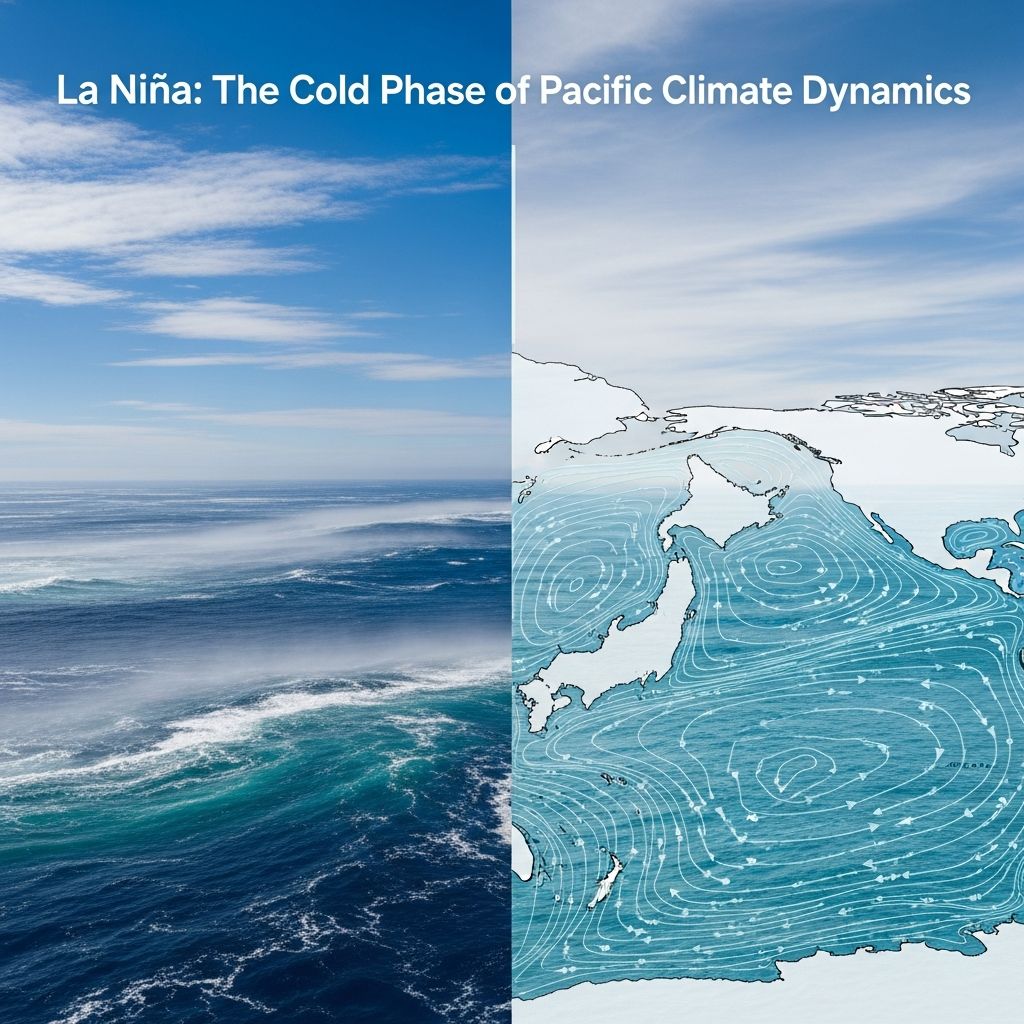
La Niña represents a critical cooling episode in the equatorial Pacific Ocean, triggering widespread atmospheric shifts that influence global weather for months or years. This phenomenon, part of the El Niño-Southern Oscillation (ENSO) cycle, features sea surface temperatures at least 0.5°C below average in key Pacific regions, sustained over multiple overlapping three-month periods.
Understanding the Oceanic and Atmospheric Foundations
The equatorial Pacific serves as the epicenter for La Niña, where trade winds intensify beyond normal levels. These easterly winds propel warm surface waters westward toward Indonesia and Australia, allowing colder, nutrient-rich waters to upwell along South America’s coasts. This upwelling process cools the eastern Pacific significantly, often by several degrees, altering the ocean’s thermal structure.
Unlike neutral conditions, where warm waters pool moderately westward, La Niña exaggerates this pattern. The strengthened winds suppress convection over the eastern Pacific, shifting thunderstorm activity westward. This creates high pressure in the east and low pressure in the west, reinforcing the Southern Oscillation component of ENSO.
| Phase | Trade Winds | Warm Water Position | Eastern Pacific Temperature | Key Atmospheric Effect |
|---|---|---|---|---|
| La Niña | Stronger than usual | Far west (Asia) | Colder (upwelling) | Jet stream shifts north |
| Neutral | Normal | Moderate west | Normal | Balanced convection |
| El Niño | Weaker | Shifts east (Americas) | Warmer | Enhanced eastern convection |
La Niña events typically endure longer than their El Niño counterparts, averaging 15.4 months compared to 9.5 months, with extremes lasting up to 37 months, as seen from 1973 to 1976.
Defining La Niña: Scientific Criteria and Intensity Levels
Officially, NOAA classifies La Niña when sea surface temperatures in the Niño 3.4 region (5°N-5°S, 120°W-170°W) drop 0.5°C or more below the long-term average for at least five consecutive overlapping three-month seasons. Intensity scales further categorize events: weak (-0.5°C to -0.9°C), moderate (-1.0°C to -1.4°C), and strong (≤ -1.5°C).
- Weak La Niña: Subtle cooling with modest global impacts.
- Moderate La Niña: Pronounced effects on mid-latitude weather.
- Strong La Niña: Severe disruptions, including extreme droughts and floods.
These thresholds ensure detection of persistent anomalies, distinguishing transient fluctuations from true ENSO phases.
Historical Timeline: Notable La Niña Episodes
Since 1950, numerous La Niña events have shaped modern climate records. Strong episodes include 1988-1989, marked by profound eastern Pacific cooling visible in sea surface temperature plots. Others in 1995, 1998, 2007, and 2011 followed major El Niños, illustrating the oscillatory nature of ENSO.
The 1973-1976 event stands as the longest on record at 37 months, while the 2020-2023 “triple dip” La Niña—three consecutive years—echoed rare precedents from 1973-1976 and 1998-2001. Such prolonged phases amplify cumulative weather extremes.
Peruvian and Ecuadorian fishers coined “La Niña” (Spanish for “little girl”) as the counterpart to El Niño (“little boy” or “Christ child”), noting cold waters that boosted fish stocks around Christmas.
Global Weather Disruptions Driven by La Niña
La Niña’s cooling redirects the jet stream northward, steering storm tracks away from the southern U.S. while intensifying them in the Pacific Northwest and Canada. This pattern fosters drier conditions in the U.S. Southwest and Midwest, alongside wetter winters in the North.
- U.S. Impacts: Warmer southern winters, cooler northern ones; drought in the south, flooding in the northwest.
- Asia-Pacific: Excessive rainfall in Indonesia and Australia from piled-up warm waters.
- Hurricanes: More active Atlantic seasons due to favorable conditions.
- Australia: Severe droughts in the east, floods in the north.
In California, La Niña correlates with below-average precipitation, contrasting El Niño’s wetter regime.
Sectoral Vulnerabilities: Agriculture, Health, and Beyond
Agriculture faces heightened risks from erratic rainfall: U.S. southern droughts curb crop yields, while Asian deluges cause flooding. Water resources strain under prolonged dry spells, affecting reservoirs and irrigation.
Health sectors grapple with vector-borne diseases thriving in altered climates, alongside heat stress in warmer southern regions. Disaster management demands readiness for intensified hurricanes and wildfires fueled by dry conditions.
Climate-sensitive economies, including fisheries benefiting from nutrient upwelling, experience booms in cold-water species but disruptions in warm-water dependent areas.
Monitoring and Forecasting La Niña Developments
Agencies like NOAA’s Climate Prediction Center and PMEL track ENSO via buoys, satellites, and models. The Niño 3.4 index anchors forecasts, predicting onset, peak, and decay. WMO coordinates global observations, noting ENSO’s 3-7 year cycle.
Early warnings enable mitigation, from agricultural adjustments to emergency preparations. Recent triple-dip events underscore improving predictive accuracy.
La Niña in the Context of Climate Change
While ENSO remains natural, warming backgrounds may intensify extremes. La Niña’s cold phase juxtaposed against global trends could yield paradoxical warmth in some regions, complicating attribution. Research continues on frequency shifts, with no consensus yet on long-term alterations.
Frequently Asked Questions (FAQs)
What causes La Niña to form?
Intensified trade winds pile warm water westward, triggering eastern Pacific upwelling and cooling.
How long does a typical La Niña last?
Average duration is 15.4 months, though some extend to 37 months.
Does La Niña always follow El Niño?
Not always, but many do, as part of the ENSO cycle.
What are La Niña’s effects on U.S. weather?
Droughts in the south, wetter northwest, warmer southern winters.
Can La Niña influence hurricane activity?
Yes, often leading to more severe Atlantic hurricane seasons.
References
- What are El Nino and La Nina? — NOAA National Ocean Service. 2023. https://oceanservice.noaa.gov/facts/ninonina.html
- What is La Niña? — NOAA PMEL El Niño Theme Page. 2023. https://www.pmel.noaa.gov/elnino/what-is-la-nina
- What is the La Niña weather pattern? All you need to know — World Economic Forum. 2021-12-13. https://www.weforum.org/stories/2021/12/what-is-la-nina-weather-pattern-climate/
- What is La Niña? — National Weather Service. 2023. https://www.weather.gov/arx/why_lanina
- What Is La Niña? — NASA Space Place. 2023. https://spaceplace.nasa.gov/la-nina/
- El Niño / La Niña — World Meteorological Organization. 2023. https://wmo.int/topics/el-nino-la-nina
- EXPLAINER: El Niño and La Niña: What does it mean for California? — Maven’s Notebook. 2023. https://mavensnotebook.com/explainers/el-nino-and-la-nina-what-do-they-mean-for-california/
Similar Articles








Read full bio of medha deb