Lustreware: The Radiant History of Metallic Ceramics
Discover the shimmering legacy of lustreware, from ancient Mesopotamian innovations to modern artistic revivals across cultures.
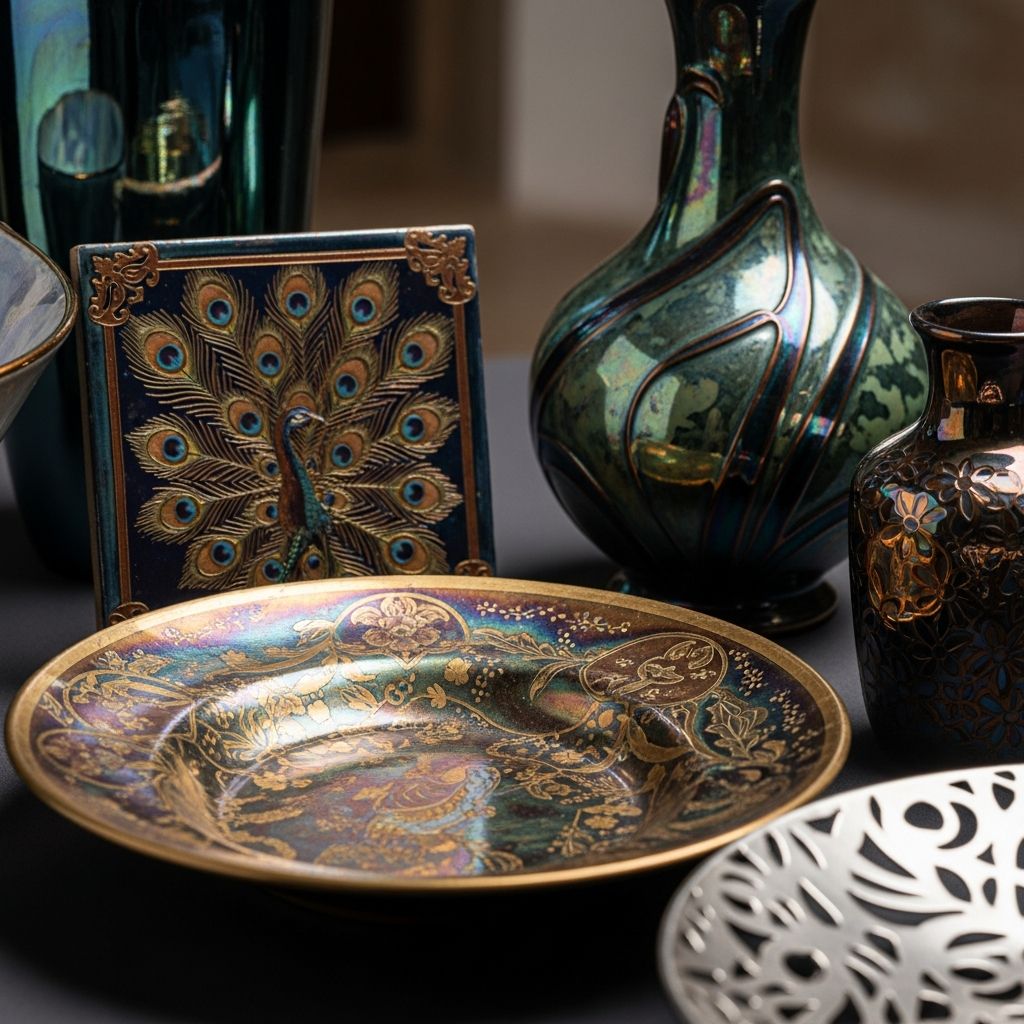
Lustreware represents one of humanity’s most ingenious ceramic innovations, featuring an iridescent metallic sheen that mimics gold, silver, and other precious metals on pottery surfaces. This technique, which emerged over a millennium ago, transformed everyday earthenware into luxurious artifacts coveted by elites across continents.
Ancient Beginnings in the Islamic World
The story of lustreware begins in the heart of the Abbasid Caliphate during the 9th century, primarily in regions of modern-day Iraq such as Basra, Baghdad, and Kufa. Potters there pioneered the application of metallic lusters to tin-glazed earthenware, initially drawing inspiration from lustre techniques used on glass vessels. These early pieces, often small bowls no larger than 16 cm in diameter, adorned the palaces of caliphs, including those at Samarra.
Experimental polychrome effects marked the initial phase, employing silver and copper compounds to produce gold, ruby, and other hues. By the 10th century, designs evolved from geometric patterns to more elaborate figural motifs, reflecting an Iraqi style that dominated production. Fragments discovered in distant locations like Spain, North Africa, and Pakistan attest to the ware’s rapid trade and prestige.
Egypt emerged as a pivotal hub following the Fatimid conquest in 969 CE, with Fustat (old Cairo) becoming a renowned center until its decline in 1171 after a devastating fire in 1169. Here, lustreware reached artistic heights, blending technical mastery with intricate iconography.
Techniques Behind the Shimmer
Creating lustreware involves a complex, multi-stage firing process that demands precise control. After glazing and initial firing, potters apply a solution of metallic salts—typically copper for ruby-red tones and silver for golden iridescence—directly onto the cooled glaze. A reduction firing in a low-oxygen kiln then causes the metals to oxidize partially, forming a thin, reflective film that catches light dynamically.
Two primary methods distinguish lustre production. The Middle Eastern approach, foundational to Hispano-Moresque and maiolica wares, ‘stains’ the ceramic through repeated firings, embedding the metallic particles into the glaze. In contrast, the simpler 19th-century English variant used pigments with gold, platinum, or bismuth salts mixed in media like aqua regia, turpentine, and oils, fired in enameling kilns for a pearlescent effect.
| Technique | Origin | Key Materials | Firing Process | Notable Effect |
|---|---|---|---|---|
| Middle Eastern Staining | Iraq/Egypt (9th-12th C) | Copper/Silver salts | Multi-stage reduction | Deep iridescence |
| English Pigment Application | Staffordshire (19th C) | Gold/Platinum/Bismuth | Single enameling fire | Mother-of-pearl sheen |
This table highlights how adaptations in materials and firing allowed lustreware to thrive across eras and regions.
Expansion Across Empires and Continents
As artisans migrated, lustreware traversed the Islamic world. From Iraq, the craft moved eastward to Iran during the Safavid dynasty (1502-1736 CE), flourishing anew in the 17th and 18th centuries with vibrant designs. Westward, it reached North Africa and al-Andalus (Islamic Spain) by the 11th century, where Malaga in Andalusia became an early production epicenter around the 13th century.
In Spain, under Almoravid and Almohad rule, lustreware symbolized elite refinement. After the Reconquista, Morisco potters—Muslim converts to Christianity—sustained the tradition, shifting major output to Valencia’s Manises and Paterna by the 14th century, and later to Catalonia and Aragon. These Hispano-Moresque pieces, exported widely, influenced European tastes profoundly.
By the 15th century, Italian potters in Deruta, Gubbio, and Gualdo Tadino adopted the technique, producing maiolica with signature ruby-red and golden lusters until the Renaissance wane around 1630. Gubbio specialized in its rich crimson glow, while Deruta excelled in diverse metallic palettes.
Renaissance and Early Modern Developments
The Renaissance marked lustreware’s integration into European courtly arts. Spanish exports to Italy spurred local innovations, transforming pottery into high-status tableware. In Gubbio, potters achieved a ruby lustre through copper reduction, a guarded secret that defined the town’s output until circa 1570.
Despite interruptions—such as the Fatimid fall and later political upheavals—the technique persisted through artisan mobility. In Iran, Safavid revival emphasized bold patterns, bridging medieval and modern expressions. This era solidified lustreware’s role as a luxury good, bridging Islamic and Christian artistic spheres.
19th-Century Revival in Britain
The Industrial Revolution ignited a lustreware renaissance in England, particularly Staffordshire and Wedgwood factories. Inspired by Spanish majolica, potters like Wedgwood introduced silver lustre in 1805 and pink/white variants mimicking mother-of-pearl on shell-shaped dishes. Platinum and bismuth innovations enabled cost-effective production for mass markets.
William De Morgan, influenced by the Aesthetic Movement, elevated lustre to artistic heights in the late 19th century. His tiles, vases, and bowls featured medieval motifs and animals in bold, iridescent glazes, reviving ancient methods for fine art rather than commerce. This period democratized the ware while preserving its allure.
Cultural Significance and Artistic Impact
Lustreware’s mesmerizing sheen evoked alchemy, symbolizing wealth and sophistication. In Abbasid palaces, it rivaled metalwork; in Spanish courts, it graced noble tables; in Victorian homes, it adorned middle-class shelves. Its global journey underscores cultural exchange, with Islamic innovations shaping European aesthetics.
- Symbolic Value: Mimicking precious metals, it democratized luxury.
- Artistic Innovation: Enabled complex designs on durable earthenware.
- Economic Driver: Fueled trade from Iraq to Italy.
Modern collectors and museums, like the Ashmolean and Art Institute of Chicago, celebrate lustreware for its technical brilliance and historical narrative.
Modern Interpretations and Legacy
Today, lustreware inspires contemporary ceramists worldwide, blending tradition with innovation. While industrial methods have evolved, the core allure—light-play on metallic surfaces—endures. Exhibitions trace its path from Basra to Valencia, highlighting cross-cultural triumphs.
Challenges like recipe secrecy once stifled spread, but globalization now fosters experimentation with new metals and sustainable firings.
Frequently Asked Questions
What is the origin of lustreware?
Lustreware originated in 9th-century Iraq under the Abbasid Caliphate, with Basra as a key center.
How is the metallic effect achieved?
It results from applying metallic salts over glaze and reduction-firing to form a thin reflective film.
Where was Hispano-Moresque lustreware produced?
Primarily in Malaga, then Valencia’s Manises and Paterna from the 13th-15th centuries.
Did lustreware influence European pottery?
Yes, it inspired Italian maiolica and 19th-century English wares like Wedgwood’s.
Is lustreware still made today?
Yes, modern artists continue the tradition with updated techniques.
References
- Lustreware – Wikipedia — Wikipedia Contributors. 2023-10-15. https://en.wikipedia.org/wiki/Lustreware
- Lustreware, a short history — The De Morgan Foundation. N/A. https://www.demorgan.org.uk/lustreware-a-short-history/
- Lustreware: from Abbasid Iraq to Renaissance Italy — Sam Fogg. N/A. https://www.samfogg.com/exhibitions/65/
- Lustreware — Encyclopædia Britannica. 2024-01-20. https://www.britannica.com/art/lustreware
- Lustreware Across Borders — Ashmolean Museum. N/A. https://www.ashmolean.org/article/lustreware-across-borders
- Spanish Lustreware — Historic Jamestowne. N/A. https://historicjamestowne.org/collections/artifacts/material/spanish-lustreware/
Similar Articles








Read full bio of Sneha Tete