Mastering Communicative Competence: Core Skills & Applications
Develop essential communication abilities: Learn the four pillars of effective interaction across diverse contexts.
Understanding Communicative Competence: A Comprehensive Framework
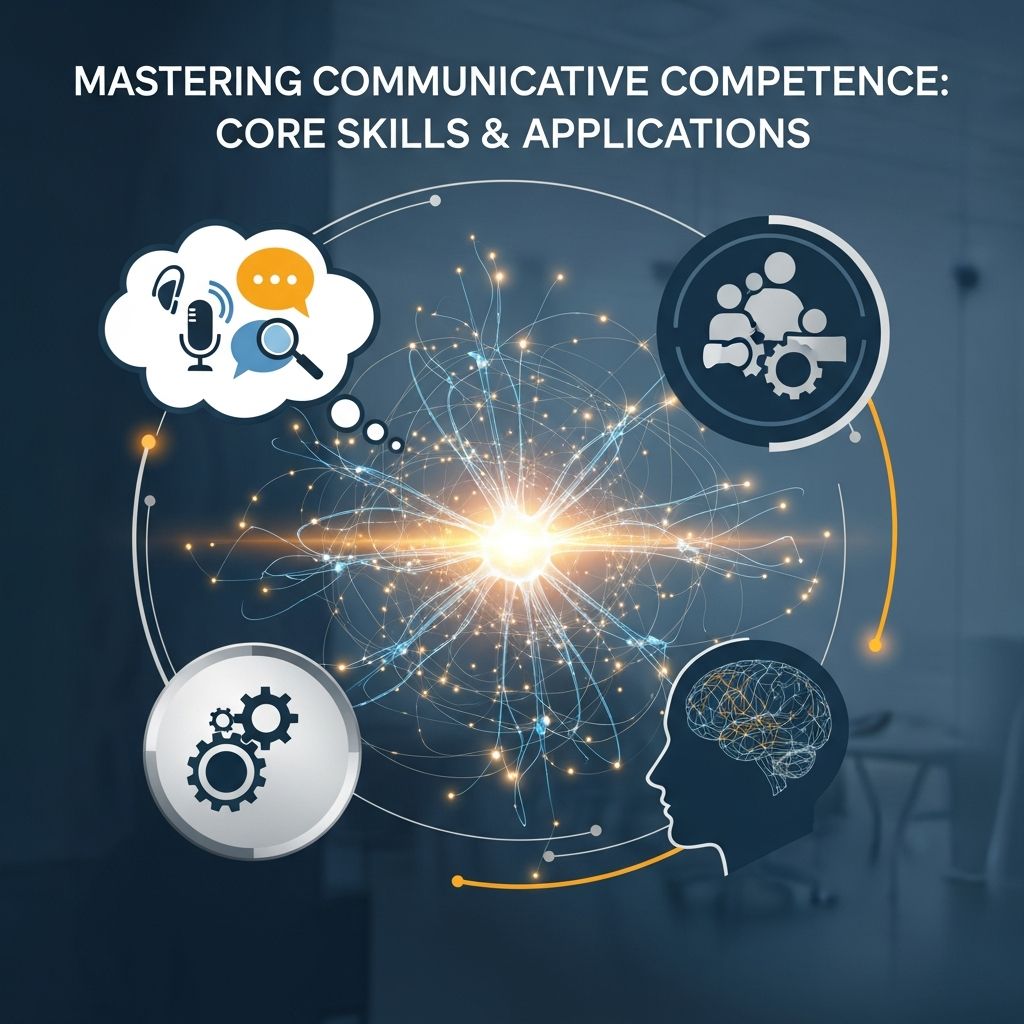
The ability to communicate effectively extends far beyond knowing vocabulary and grammar rules. Communicative competence represents the complete skillset that enables individuals to express ideas, thoughts, and feelings appropriately across multiple contexts and audiences. This concept emerged from linguistic theory and has become foundational to language education, professional development, and interpersonal interaction. Rather than viewing language as merely a collection of structural rules, communicative competence recognizes that successful communication requires understanding when, where, and how to use language appropriately within social and cultural frameworks.
The development of communicative competence theory marked a significant shift in how linguists and educators conceptualize language mastery. Traditional approaches emphasized grammatical accuracy as the primary measure of language proficiency, yet this narrow focus failed to account for the social and contextual dimensions essential to real-world communication. Today’s understanding acknowledges that communicative competence is both organized and goal-oriented, meaning it involves selecting and applying skills strategically to achieve communication objectives while maintaining social appropriateness.
The Four Pillars of Communicative Competence
Research has consistently identified four interconnected components that together constitute communicative competence. Each dimension addresses distinct aspects of language use and contributes uniquely to overall communication effectiveness.
Grammatical Competence: The Foundation of Language Structure
Grammatical competence encompasses the mastery of linguistic systems that form the foundation of language production and comprehension. This competency includes knowledge of vocabulary, pronunciation, phonology, morphology, syntax, and the rules governing word and sentence formation. While often associated with traditional language instruction, grammatical competence remains essential because it provides the structural tools necessary for expressing meaning clearly.
However, grammatical competence alone does not guarantee effective communication. A speaker may possess perfect grammar yet fail to communicate appropriately in specific social situations. Grammatical knowledge represents the mechanical foundation upon which the other three competencies build, enabling individuals to construct linguistically sound utterances that can then be deployed strategically across varied contexts.
Sociolinguistic Competence: Navigating Social Context
Sociolinguistic competence refers to the ability to understand and produce appropriate speech acts within different social contexts. This dimension goes beyond language structure to encompass awareness of social relationships, cultural norms, register variations, and the expectations governing communication in specific situations. It addresses the critical question: What is the right thing to say in this particular context with this specific person?
Developing sociolinguistic competence requires familiarity with how communication varies across professional environments, informal settings, cross-cultural encounters, and situations involving people of different backgrounds and status levels. For instance, the language appropriate for addressing a supervisor differs significantly from casual conversation with peers, and formal presentations demand different linguistic choices than intimate personal discussions. This competency reflects recognition that social and linguistic characteristics of particular audiences shape communication choices and influence overall effectiveness.
Discourse Competence: Coherence and Meaningful Text
Discourse competence focuses on the ability to create coherent, well-organized communication across various genres and extended interactions. Beyond individual sentences, discourse competence enables individuals to construct longer texts—whether written documents, multi-turn conversations, or presentations—that maintain logical flow and meaningful progression of ideas.
This competency involves understanding how different communication forms require different organizational strategies. A business email follows conventions distinct from casual messaging; an academic paper demands different structural principles than storytelling; a debate follows different coherence patterns than collaborative problem-solving. Discourse competence ensures that extended communication maintains purpose, clarity, and audience engagement throughout its development.
Strategic Competence: Managing Communication Challenges
Strategic competence encompasses the techniques individuals employ to compensate for gaps or uncertainties in their language knowledge. This dimension recognizes that even highly competent communicators encounter situations where they lack specific vocabulary, encounter unfamiliar topics, or face communication breakdowns.
Strategic competence includes techniques such as paraphrasing, requesting clarification, using gestures, describing concepts indirectly, changing the subject to more familiar ground, or employing circumlocution. These strategies transform potential communication failures into opportunities for successful interaction. Rather than abandoning communication when encountering difficulty, strategically competent individuals adjust their approach, find alternative expressions, and persist in achieving their communicative goals. This flexibility proves particularly valuable in cross-cultural communication and in situations involving language learners interacting with native speakers.
The Historical Development of Communicative Competence Theory
The term communicative competence was originally coined by linguist Dell Hymes in 1966 as a direct response to what he perceived as limitations in Noam Chomsky’s earlier concept of linguistic competence. Chomsky’s framework distinguished between linguistic competence (abstract knowledge of language rules) and performance (actual language use), but Hymes recognized this distinction failed to account for the social and contextual dimensions fundamental to real communication.
Hymes undertook ethnographic research exploring how communicative competence integrated both form and function, examining how individuals actually use language within social contexts. This foundational work established that genuine language mastery requires understanding not just language structure but also appropriate application within cultural and social frameworks.
Building on Hymes’ foundation, researchers Canale and Swain developed the widely-cited framework identifying the four core components of communicative competence. Their work systematized the concept, providing educators and researchers with a clear model for understanding and teaching communicative abilities. This framework has remained influential in language education for decades, guiding curriculum design, assessment practices, and teaching methodologies across educational levels and contexts.
Application in Language Education and Learning Contexts
Communicative competence theory has fundamentally transformed how language is taught and assessed in educational settings. Rather than emphasizing isolated grammar exercises or vocabulary memorization, communicative language teaching prioritizes authentic interaction, contextual appropriateness, and goal-oriented communication practice.
The communicative approach recognizes that learners benefit from exposure to and practice with language in realistic communicative situations. This methodology encourages:
- Interactive communication tasks requiring negotiation of meaning
- Authentic materials and situations reflecting real-world language use
- Attention to social and cultural appropriateness alongside accuracy
- Development of compensation and problem-solving strategies
- Integration of both verbal and non-verbal communication elements
Assessment of communicative competence similarly reflects this comprehensive understanding. Rather than measuring only grammatical accuracy, modern language assessment evaluates whether learners can achieve communication goals appropriately within varied contexts. This shift has led to increased use of performance-based assessments, oral proficiency interviews, and portfolio-based evaluation that capture the multidimensional nature of communicative ability.
Communicative Competence in Professional and Workplace Contexts
Beyond language learning, communicative competence has become recognized as essential in professional environments. Organizations increasingly identify communication skills as critical competencies in job descriptions and professional development initiatives. The business definition of communicative competence reflects the level of communication skills a person possesses and their ability to apply those skills effectively in workplace situations.
In professional settings, communicative competence encompasses:
- Selecting communication strategies appropriate to business context and audience
- Achieving organizational goals through effective and appropriate interaction
- Communicating effectively across diverse workplace cultures and backgrounds
- Adapting communication style to different professional relationships and situations
- Managing both formal presentations and informal workplace interactions
Employees with well-developed communicative competence can navigate complex organizational communication demands, build professional relationships, lead teams effectively, and represent their organizations persuasively to external audiences.
Special Applications: Communication and Enhanced Accessibility
Communicative competence frameworks have proven particularly valuable for individuals using augmentative and alternative communication (AAC) systems. Dr. Janice Light expanded the conceptualization of communicative competence to address the specific needs of individuals with complex communication requirements, identifying five interconnected competency areas: linguistic, operational, social, strategic, and psychosocial.
For AAC users, developing communicative competence requires combining knowledge, judgment, and skills across these dimensions while accounting for environmental barriers and supports. This specialized application underscores communicative competence as essential to enhancing quality of life and recognizing communication as a fundamental human right and capability. Understanding communicative competence in this context emphasizes that effective communication serves personal, educational, vocational, and social goals across the population.
The Integration of Verbal and Non-Verbal Communication
Communicative competence encompasses both verbal and non-verbal behavior, recognizing that effective communication extends beyond words. Body language, facial expressions, tone of voice, eye contact, and spatial awareness all contribute to communicative success. Strategic competence includes awareness of how non-verbal elements support, reinforce, or occasionally contradict verbal messages.
This integrated understanding proves especially important in professional presentations, cross-cultural interactions, and conflict resolution situations where non-verbal elements can either enhance or undermine verbal communication. Culturally competent communication requires understanding that non-verbal norms vary significantly across cultural contexts, making awareness of these differences essential to communicative success.
Developing and Acquiring Communicative Competence
Communicative competence is not innate but rather acquired through intentional practice and experience. Development occurs through repeated, reflected engagement with communication tasks in varied contexts. Learners build communicative abilities progressively, refining skills through successive attempts, feedback, reflection, and adjusted practice.
Several principles support effective communicative competence development:
- Contextual practice in authentic or realistic communication situations
- Exposure to diverse audiences, topics, and communication purposes
- Reflection on communication successes and challenges
- Systematic feedback addressing multiple competency dimensions
- Gradual complexity increase as foundational abilities strengthen
- Integration of explicit instruction with communicative practice
The development process requires both individual effort and supportive instructional environments. Trainers and educators can facilitate competence development by creating safe practice opportunities, providing targeted feedback, modeling appropriate communication, and gradually increasing demands as learners demonstrate readiness.
Contemporary Understanding and Ongoing Debates
While communicative competence theory has significantly influenced educational practices, some ongoing discussions remain within the field. Educators and researchers continue examining questions regarding the relative effectiveness of implicit versus explicit instruction methods, optimal assessment approaches for measuring communicative competence, and how digital communication technologies affect traditional understandings of communicative competence.
Despite these debates, communicative competence remains a foundational framework for understanding what individuals need to communicate effectively. Its influence extends across language education, professional communication training, speech pathology, intercultural communication studies, and organizational development. The framework’s enduring value lies in its comprehensive recognition that effective communication requires mastery of multiple interconnected competencies rather than isolated language skills.
Frequently Asked Questions
Q: What is the difference between communicative competence and linguistic competence?
A: Linguistic competence refers to abstract knowledge of language structure and rules, while communicative competence encompasses the ability to use language appropriately and effectively within social contexts. Communicative competence includes linguistic knowledge but extends far beyond it to include social awareness, strategic flexibility, and contextual appropriateness.
Q: Can communicative competence be taught, or is it only developed through experience?
A: Communicative competence develops through a combination of explicit instruction and authentic practice. Trainers can teach specific skills, model appropriate communication, and provide structured practice opportunities, but true competence requires learners to apply these skills repeatedly across varied contexts and reflect on their effectiveness.
Q: How does cultural background affect communicative competence?
A: Cultural background significantly influences communicative competence development because communication norms, appropriateness standards, and interaction patterns vary across cultures. Individuals develop competence within their native cultural context, and communicating across cultural boundaries requires explicit awareness of different communication conventions and willingness to adapt to different expectations.
Q: Is communicative competence equally important for all types of communication?
A: While the fundamental components remain relevant across contexts, the emphasis shifts depending on communication purpose and context. Professional communication may prioritize sociolinguistic competence and strategic competence, while creative writing emphasizes discourse competence. Academic contexts may highlight grammatical competence alongside others, while casual conversation may rely heavily on strategic competence and social awareness.
Q: How can someone assess their own communicative competence?
A: Self-assessment can examine performance across the four competency dimensions: grammatical accuracy, social appropriateness, discourse coherence, and strategic flexibility. Seeking feedback from diverse audiences, reflecting on communication successes and challenges, and practicing in varied contexts provides evidence of developing communicative competence. Professional assessment by communication specialists provides more formal measurement.
References
- Communicative Competence — EBSCO Research Starters: Language and Linguistics. Accessed April 2026. https://www.ebsco.com/research-starters/language-and-linguistics/communicative-competence
- What is Communication Competence? — Chris Fenning. Accessed April 2026. https://chrisfenning.com/what-is-communication-competence/
- What is Communicative Competence and How Can It Be Acquired? — National Center for Biotechnology Information (NCBI). Accessed April 2026. https://pmc.ncbi.nlm.nih.gov/articles/PMC7994879/
- Communicative Competence: What Are We Talking About? — Northwest AAC Service. Accessed April 2026. https://nwacs.info/aac/basics/communicative-competence/what-is-communicative-competence/
- Communicative Competence — Wikipedia. Accessed April 2026. https://en.wikipedia.org/wiki/Communicative_competence
- Communication Competence — Social Science LibreTexts. Accessed April 2026. https://socialsci.libretexts.org/Bookshelves/Communication/Introduction_to_Communication/Communication_in_the_Real_World_-_An_Introduction_to_Communication_Studies/01:_Introduction_to_Communication_Studies/1.04:_Communication_Competence
- Communicative Competence — British Council TeachingEnglish. Accessed April 2026. https://www.teachingenglish.org.uk/professional-development/teachers/teaching-knowledge-database/c/communicative-competence
Similar Articles







Read full bio of Sneha Tete