Mastering Density Calculations: Formula and Methods
Unlock the secrets of density with step-by-step guides, real-world examples, and practical applications for students and professionals.
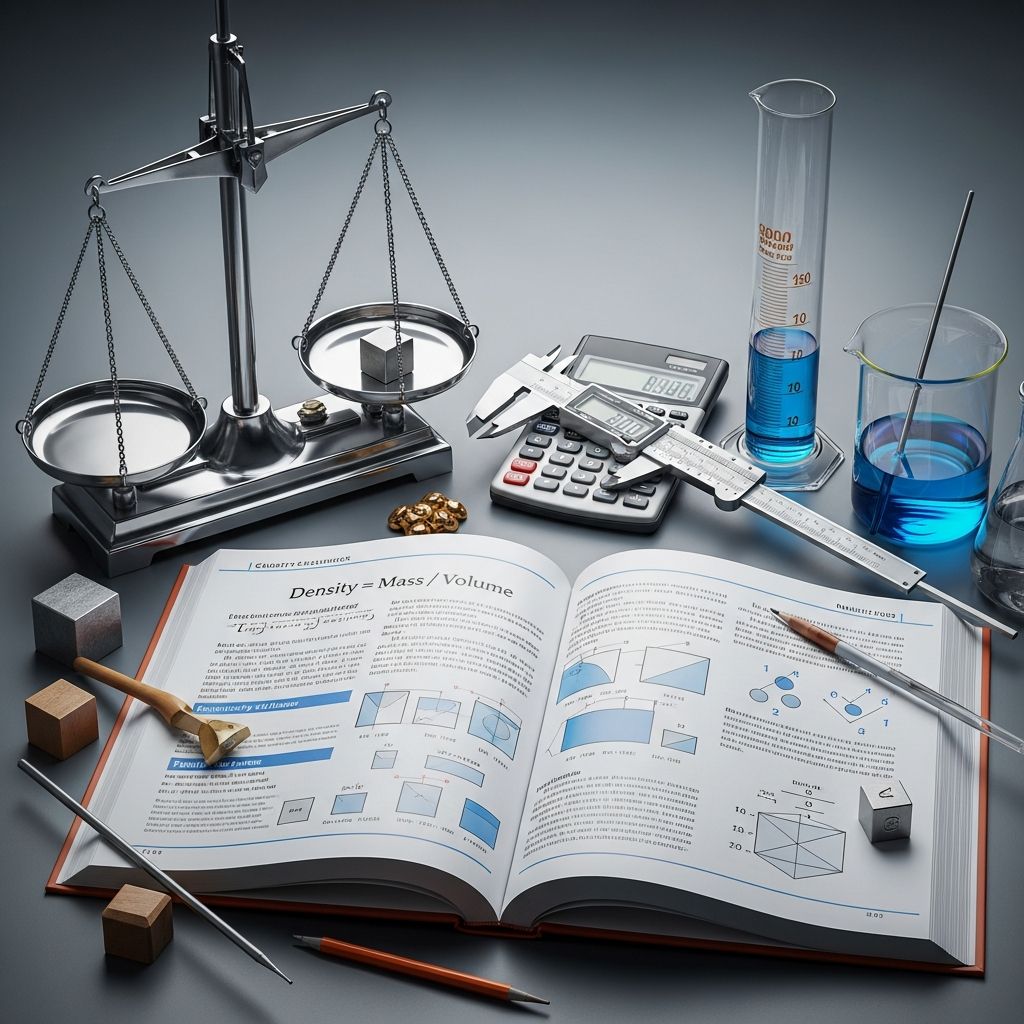
Density is a fundamental property in physics and chemistry, defined as the mass of a substance per unit volume, calculated using the formula ρ = m/V, where ρ represents density, m is mass, and V is volume. This measure helps distinguish materials, predict behaviors, and understand natural phenomena like why objects float or sink.
Understanding the Core Concept of Density
At its essence, density quantifies how much matter is packed into a given space, making it intensive—independent of sample size. For instance, a small gold nugget and a large bar share the same density because both consist of tightly packed atoms. This contrasts with extensive properties like total mass or volume, which scale with size.
Density reveals material characteristics: metals like lead (11.34 g/cm³) are dense due to heavy atoms in compact structures, while wood (around 0.5 g/cm³) is less dense with more empty space.[10] In fluids, density variations drive ocean currents and atmospheric circulation, underscoring its role beyond laboratories.
The Universal Density Formula Explained
The equation ρ = m/V forms the backbone of all density computations. Here, mass (m) is measured in grams (g) or kilograms (kg), and volume (V) in cubic centimeters (cm³) or cubic meters (m³). Rearrangements allow solving for unknowns: m = ρV or V = m/ρ.
Consider a practical breakdown:
- Mass (m): Obtained via balance or scale, ensuring precision to avoid errors.
- Volume (V): For regular shapes, V = length × width × height; irregular ones use displacement.
- Density (ρ): Resulting units reflect inputs, e.g., g/cm³ or kg/m³.
Consistency in units is crucial; mismatches require conversion, like 1 cm³ = 10^{-6} m³.
Step-by-Step Guide to Measuring Mass and Volume
Accurate density starts with reliable measurements. For mass, use a digital scale calibrated for the object’s weight, taring containers if needed. Liquids require dry, zeroed graduated cylinders.
Volume determination varies:
- Regular solids: Calipers measure dimensions; cube volume = l × w × h.
- Irregular solids: Submerge in water; displaced volume equals object volume (Archimedes’ principle).
- Liquids: Read meniscus at eye level in graduated cylinders.
- Gases: Use specialized containers, accounting for pressure and temperature via ideal gas law adjustments.
Steps for solids: (1) Measure mass, (2) Calculate or displace volume, (3) Divide m by V.
Practical Examples Across Material Types
Apply the formula with real scenarios. A 27 g cube (3 cm sides): V = 27 cm³, ρ = 27/27 = 1 g/cm³, matching water. Scale up: 500 kg block (2.5 m³) yields ρ = 200 kg/m³.
For liquids: 53 g oil (57.6 cm³) gives ρ ≈ 0.92 g/cm³. Irregular rock: 265 g displaces 100 mL (100 cm³), ρ = 2.65 g/cm³.
| Material | Mass (g) | Volume (cm³) | Density (g/cm³) |
|---|---|---|---|
| Aluminum | 27 | 10 | 2.7 |
| Iron | 78 | 10 | 7.8 |
| Water | 100 | 100 | 1.0 |
| Ethanol | 78.9 | 100 | 0.789 |
This table illustrates comparisons; higher density means sinking in water (ρ > 1 g/cm³).[10]
Navigating Density Units and Conversions
Standard units include g/cm³ (solids/liquids) and kg/m³ (SI). Conversions: 1 g/cm³ = 1000 kg/m³. Common table:
| Unit | Equivalent (kg/m³) |
|---|---|
| g/cm³ | 1000 |
| kg/L | 1000 |
| lb/ft³ | 16.02 |
| lb/in³ | 27,680 |
Always verify: for 2.7 g/cm³ aluminum, convert to 2700 kg/m³.
Advanced Calculations: Irregular Shapes and Mixtures
Irregular objects demand displacement: fill graduated cylinder to 50 mL, add rock raising to 65 mL; V = 15 mL. Mixtures average densities weighted by volume fractions; composite rock (2.8 and 3.5 g/cm³ minerals) falls between, not summed.
Gases: Density adjusts with PV = nRT; air ≈ 1.2 kg/m³ at STP.
Real-World Applications and Importance
Density aids buoyancy (float if ρ_object < ρ_fluid), material identification in forensics, and engineering (concrete ~2.4 g/cm³). In environment, ocean density gradients drive thermohaline circulation; medicine uses contrast agents with tailored densities.
Industries: Shipping optimizes via density for cargo; food science ensures product consistency (e.g., syrup ρ >1 g/cm³).
Common Pitfalls and Troubleshooting Tips
- Unit errors: Mismatched systems skew results; double-check.
- Precision: Significant figures from least precise measurement.
- Air bubbles: Tap liquids to remove.
- Temperature effects: Liquids expand when heated, lowering density.
Frequently Asked Questions (FAQs)
What is the density formula?
The density formula is ρ = mass / volume (ρ = m/V).
How do you calculate density of an irregular object?
Weigh it, then measure displaced water volume in a graduated cylinder.
What units are used for density?
Commonly g/cm³ or kg/m³; convert as needed.
Why does ice float on water?
Ice density (0.917 g/cm³) is less than water’s (1 g/cm³).[10]
Can density change with temperature?
Yes, most substances expand when heated, reducing density.
Interactive Problem-Solving Exercises
Test skills: A 15.2 g sample occupies 8 cm³. ρ = ? (1.9 g/cm³). Gold coin: 17.0 g, V=0.89 cm³, ρ=19.1 g/cm³—authentic!
References
- How to Calculate Density | Formula, Units & Examples — Study.com. 2023. https://study.com/learn/lesson/density-formula-units-examples.html
- Density Calculator p = m/V — CalculatorSoup. 2023. https://www.calculatorsoup.com/calculators/physics/density.php
- Density Formula – Math Steps, Examples & Questions — Third Space Learning. 2023. https://thirdspacelearning.com/us/math-resources/topic-guides/ratio-and-proportion/density-formula/
- How To Calculate Density – With Examples — YouTube (Khan Academy style). 2023. https://www.youtube.com/watch?v=NJhxwlVKong
- How Do I Calculate Density? Density and Specific Gravity — SERC Carleton. 2023. https://serc.carleton.edu/mathyouneed/density/index.html
- Density Calculator — Calculator.net. 2023. https://www.calculator.net/density-calculator.html
Similar Articles








Read full bio of Sneha Tete