Mastering Japanese Rhythm: Pitch Over Stress
Unlock natural Japanese pronunciation by embracing mora timing and pitch accent instead of English-style stress patterns.
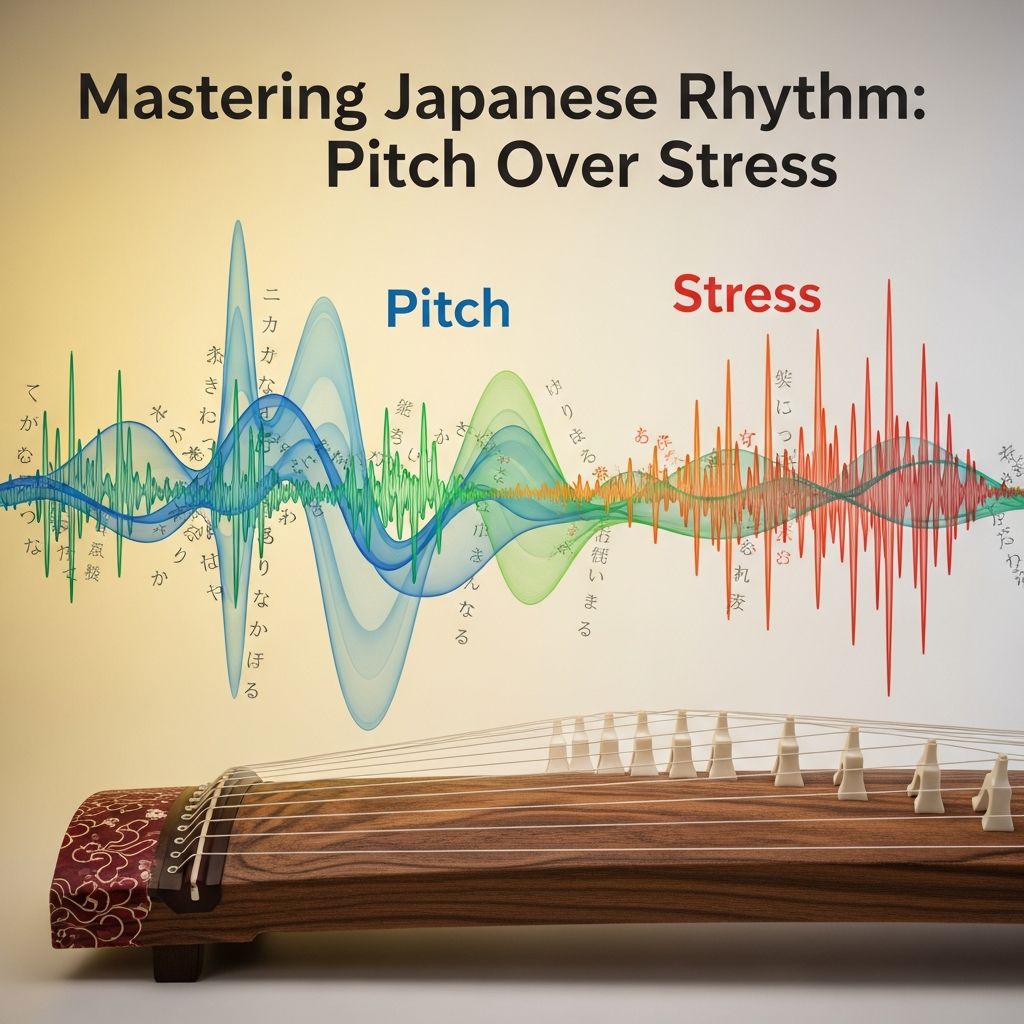
Japanese pronunciation challenges many learners due to its unique rhythmic structure, which prioritizes consistent timing across units called moras rather than varying stress on syllables like in English. This approach creates a steady, musical flow that defines natural-sounding speech.
The Core of Japanese Sound: Understanding Moras
In Japanese, speech rhythm builds around
moras
, the fundamental timing units that ensure every sound segment receives equal duration. Unlike English syllables, which can stretch or shorten based on stress, moras maintain uniformity, giving Japanese its characteristic even cadence.A mora typically consists of a vowel, a consonant-vowel pair, or special elements like long vowels and nasal sounds. For instance, the word for ‘school’, gakkō, divides into four moras: ga-k-kō. Each mora gets the same beat, akin to clapping steadily while speaking.
- Mora examples: Single vowels (a, i), consonant-vowel (ka, shi), geminated consonants (small tsu like in gakkō), long vowels (ō as two moras), and syllabic n (ん).
- Practice tip: Count moras by tapping a finger for each, saying words like tokyo as to-kyo (three moras).
This equality fosters predictability, helping listeners parse speech effortlessly. Learners often err by compressing moras, making Japanese sound rushed or uneven.
Why English Speakers Struggle with Japanese Rhythm
English relies on
stress accent
, where certain syllables receive louder, longer emphasis, altering word rhythm profoundly. Words like ‘record’ shift meaning based on stress: RE-cord (noun) vs. re-CORD (verb). Japanese lacks this dynamic; instead, all moras share equal volume and length.Common pitfalls include over-stressing the first mora, as one learner noted: approximating with initial emphasis on words like sakura as SA-ku-ra until mastering flat intonation. Pitch, not force, conveys nuance in Japanese.
| English Example | Stress Pattern | Japanese Equivalent | Mora Pattern |
|---|---|---|---|
| Photograph | PHO-to-graph (strong-weak-weak) | Shashin (写真) | sha-shi-n (equal-equal-equal) |
| Present | PRE-sent (noun) vs. pre-SENT (verb) | Gift (プレゼント) | pu-re-ze-n-to (five equal moras) |
Adapting requires unlearning stress habits through repetitive drills focusing on metronomic timing.
Pitch Accent: The Subtle Melody of Japanese
Japanese employs
pitch accent
, a high-low tonal shift across moras, rather than stress. In standard Tokyo dialect, words feature a single ‘accent drop’ where pitch falls sharply, signaling meaning distinctions.For example, hashi can mean ‘bridge’ (high-flat pitch) or ‘chopsticks’ (high-low drop). Pitch contours are word-specific and dialect-sensitive, but beginners benefit from hearing native models. Unlike Mandarin’s lexical tones, Japanese pitch is simpler, affecting prosody over individual morae.
- High pitch: Starts elevated, stays or drops.
- Low pitch: Begins low after drop.
- Practice: Listen to minimal pairs like ami (net, high-low) vs. ami (sew, flat high).
Over time, immersion tunes the ear to these patterns, enhancing comprehension.
Special Sounds and Exceptions in Mora Timing
While most Japanese uses open syllables (ending in vowels), exceptions like geminates (double consonants) and syllabic n demand attention.
Geminated consonants, marked by small tsu (っ), form a silent mora. In kakko (parentheses), it’s ka-k-ko: the middle k is a brief pause, counting as a full mora via clap-timing practice.
Syllabic n (ん) before vowels nasalizes the prior vowel or pauses briefly, avoiding fusion like in konbanwa (good evening, ko-n-ba-n-wa). Long vowels (ā, ī) double as two moras, extending duration precisely.
Plosives like t, k, p involve pressure buildup and release; doubles merge into one extended hold.
Practical Drills for Perfect Rhythm
Build fluency with targeted exercises:
- Clapping method: Clap per mora while saying phrases like ohayō gozaimasu (seven moras: o-ha-yō-go-za-i-ma-su). Ensure even spacing.
- Metronome practice: Set to 60-80 BPM, align one mora per beat for words and sentences.
- Shadowing: Mimic native audio, matching timing and pitch exactly.
- Mora counting game: Break down vocabulary: sushi (su-shi, two), arigatō (a-ri-ga-tō, four).
Record yourself weekly, comparing to natives. Apps with mora feedback accelerate progress.
Common Myths and Misconceptions Debunked
Myth 1: Japanese has no accent. Reality: Pitch accent exists but is gentle.
Myth 2: All syllables equal. Clarification: Moras are key; syllables approximate but miss nuances like geminates.
Myth 3: Stress first mora. Advice: Flat delivery first, add pitch later.
Advanced Tips: Intonation in Sentences
Full sentences follow mora equality with sentence-level pitch: rising for questions, falling for statements. Topic markers (wa) often drop pitch, while particles maintain rhythm.
In connected speech, avoid English reductions; pronounce every mora crisply. Dialects vary—Kyoto rises more than Tokyo—but standard pitch suits learners.
Frequently Asked Questions (FAQs)
What is a mora in Japanese?
A mora is a timing unit roughly equaling a short vowel’s length, including CV pairs, long vowels (as two), geminates, and n. It ensures even rhythm.
How does Japanese differ from English pronunciation?
Japanese uses equal moras and pitch accent; English stresses syllables variably for rhythm.
Can I learn pitch accent as a beginner?
Yes, start with minimal pairs via audio; focus on mora timing first for solid foundation.
Why do Japanese words sound ‘flat’ to me?
You’re applying stress; train even timing to perceive the natural melody.
How long to master Japanese rhythm?
Weeks of daily practice yield improvement; fluency needs months of immersion.
Conclusion: Rhythm Unlocks Fluency
Embracing mora timing and pitch accent transforms Japanese from mechanical to melodic. Consistent practice bridges the gap to native-like speech.
References
- My biggest problem with Japanese — WaniKani Community. 2023-05-12. https://community.wanikani.com/t/my-biggest-problem-with-japanese/58803
- Japanese Pronunciation — IPRC, University of Hawaii. 2022-08-15. https://iprc.soest.hawaii.edu/users/furue/jp-pron.html
- Moras vs. Syllables: The Japanese Pronunciation Rule — Kokoro Communications (YouTube). 2024-03-10. https://www.youtube.com/watch?v=la2jYoyZSOs
- Stress, intonation and tones — JapanesePod101 Forum. 2021-11-20. http://www.japanesepod101.com/forum/viewtopic.php?t=2365
- Stress Accent vs Japanese Pitch Accent — SpeakJapaneseNaturally (YouTube Short). 2023-07-05. https://www.youtube.com/shorts/GTWZxMaet1I
Similar Articles








Read full bio of Sneha Tete