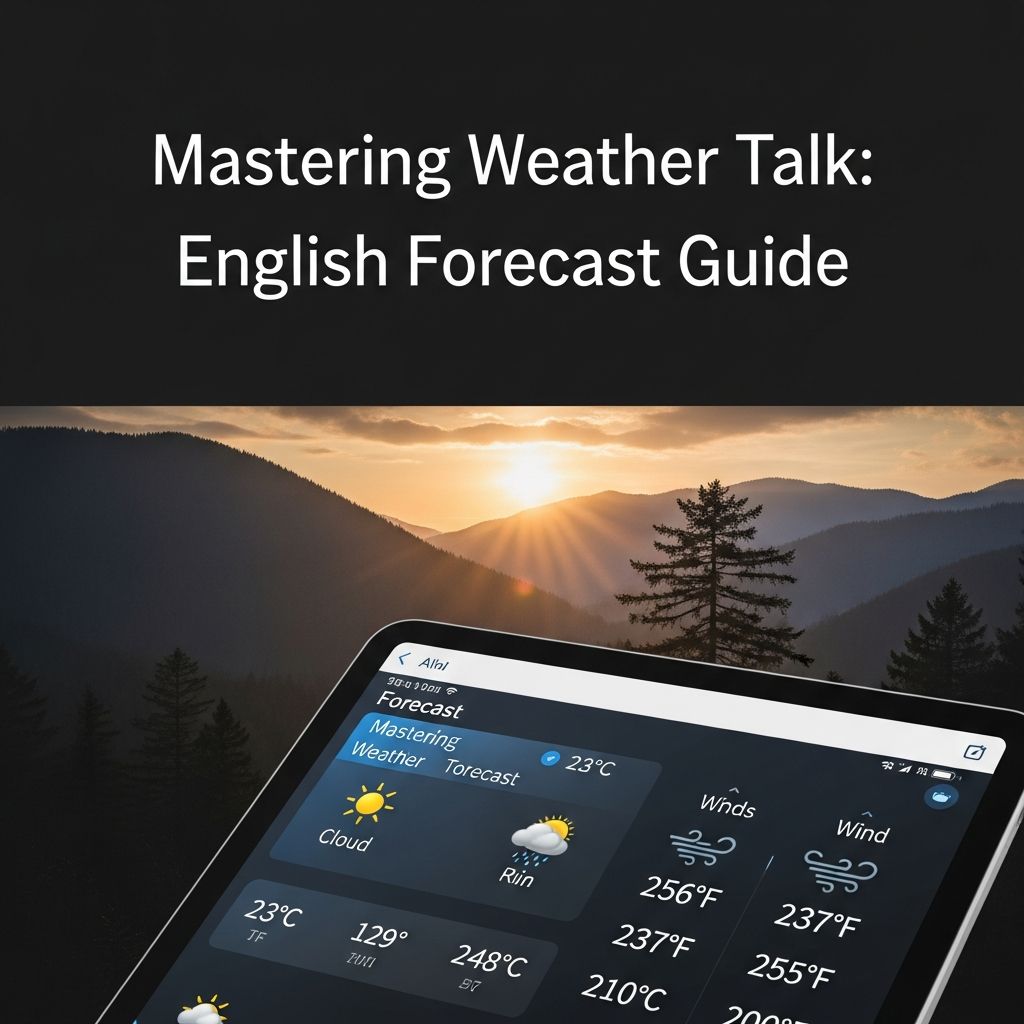
Mastering Weather Talk: English Forecast Guide
Unlock the language of weather forecasting in English: essential terms, phrases, and tips to sound like a pro meteorologist.
Weather conversations are a universal icebreaker in English, whether chatting casually or following professional forecasts. This guide equips you with the vocabulary, phrases, and structures to describe current conditions, predict future weather, and understand meteorologist reports. From basic descriptors to advanced forecasting lingo, you’ll gain confidence in everyday discussions and media interpretation.
Core Vocabulary for Everyday Weather Descriptions
Start with foundational words that paint a picture of atmospheric conditions. These terms help you respond to questions like “What’s the weather like today?”
- Sunny: Bright skies with direct sunlight, ideal for outdoor activities.
- Cloudy: Covered by clouds, ranging from partly obscured to fully overcast.
- Rainy: Precipitation falling as water droplets, from light drizzle to heavy downpours.
- Snowy: Snowflakes accumulating on the ground, often with colder temperatures.
- Windy: Strong air movement, measured in speed and direction.
- Foggy: Reduced visibility due to suspended water droplets near the surface.
- Hot or Cold: Temperature extremes, quantified in degrees Fahrenheit (°F) or Celsius (°C).
Temperature is central: “It’s 75°F outside” or “The low will be 5°C tonight.” Combine terms for precision, like “chilly and windy” or “muggy and overcast.”
Key Measurements in Weather Reports
Forecasts rely on quantifiable data. Familiarize yourself with these to decode apps, TV reports, or conversations.
| Term | Description | Example Phrase |
|---|---|---|
| Temperature | High/low air heat levels | “High of 82°F, low of 65°F” |
| Wind Speed/Direction | Gusts in mph/kph, from compass points | “Winds from the northwest at 15 mph” |
| Humidity | Moisture in air, as percentage | “Humidity at 80%, feeling muggy” |
| Precipitation Chance | Probability of rain/snow (%) | “60% chance of showers” |
| Visibility | Distance one can see clearly | “Visibility down to 1 mile in fog” |
These metrics form the backbone of reports. For instance, “Expect winds gusting to 30 mph from the south, with 40% chance of rain.”
Asking and Answering Weather Questions
Engage in dialogues with these common queries and responses. Practice makes natural flow.
- What’s the weather like? – “It’s partly cloudy and mild.”
- How’s it outside? – “Pretty warm, around 70°F.”
- Is it raining? – “Not yet, but clouds are building.”
- What’s the forecast say? – “Sunny intervals tomorrow, turning stormy by evening.”
- How windy is it? – “Gusts up to 20 mph, hold onto your hat!”
Specificity adds depth: “What’s the temperature like later?” Reply: “Dropping to 50°F with increasing winds.”
Phrases for Predicting Future Conditions
Forecasting language shifts to future tense. Use “will,” “expected to,” or “chance of” for predictions.
- “It looks like rain this afternoon.”
- “Tomorrow will be sunny with a high of 80°F.”
- “We’re in for heavy snow overnight.”
- “The forecast calls for thunderstorms.”
- “Clear skies ahead, perfect weekend weather.”
Idiomatic expressions spice it up: “Raining cats and dogs” for torrential rain, or “shorts weather” for hot days.
Techniques Meteorologists Use and How to Discuss Them
Professional forecasts draw from science. Key methods include:
- Sky Observation: Visual cues like cloud types predict changes. “Cirrus clouds suggest approaching front.”
- Weather Radar: Detects precipitation and storms. “Radar shows a band of rain moving east.”
- Satellites: Overhead imagery tracks systems. “Satellite images confirm hurricane development.”
- Weather Balloons: Measure upper atmosphere. “Balloons indicate falling pressure, storm likely.”
- Computer Models: Simulate weather patterns. “Models predict drought conditions persisting.”
Discuss like an expert: “The latest model run forecasts mild warming.”
Interpreting Weather Maps and Symbols
Maps use icons for quick reading. Common symbols:
- Sun icon: Clear.
- Cloud with rain: Showers.
- Lightning bolt: Thunderstorms.
- Snowflakes: Wintry precipitation.
- Wind arrows: Direction and strength.
Lines indicate fronts: Warm (red), cold (blue), occluded (purple). Isobars (pressure circles) show wind intensity—tight lines mean strong winds.
Regional and Seasonal Variations in Language
Weather talk adapts by location. In the UK: “Bit nippy out” (cold). US South: “Humid as a swamp.” Winters bring “whiteout” (blizzard), summers “heatwave.” Coastal areas mention “onshore breeze.” Tailor phrases: “Balmy evening by the sea” or “Arctic blast incoming.”
Advanced Broadcasting Lingo and Catchy Phrases
Broadcasters engage audiences with vivid language. Examples:
- “Winds howling like a wolf pack.”
- “Hang on tight—gusts incoming!”
- “Picture-perfect skies ahead.”
- “Flood watch: Rivers rising fast.”
- “Balmy breeze for your barbecue.”
These make forecasts memorable, turning data into stories.
Frequently Asked Questions (FAQs)
What are essential phrases for casual weather chats?
Try “What’s it like out?” or “Looking forward to sun?” Responses: “Mild and dry” or “Storm brewing.”
How do I describe temperature accurately?
Use highs/lows and feels-like: “85°F but feels like 95° with humidity.”
What’s the difference between forecast and prediction?
Forecast is official, data-driven outlook; prediction is casual guess. “The forecast says rain; I predict delays.”
How can ESL learners practice weather English?
Check daily apps, describe aloud, role-play forecasts. Videos aid pronunciation.
What do precipitation percentages mean?
20% chance: Rain in 1/5 areas; 80%: Widespread, prepare umbrellas.
Practice Scenarios for Fluency
Simulate real talks:
- Friend calls: “Weather update?” You: “Cloudy now, 30% rain chance later. Bring layers.”
- TV forecast: Echo: “High pressure builds, dry and warming through midweek.”
- Travel planning: “Monday looks iffy—scattered storms.”
Record yourself for improvement.
References
- An Easy Guide to Forecasting the Weather in English — YouTube (ESL Video). 2023. https://www.youtube.com/watch?v=feMDybBE9MI
- How do I talk about the weather? Learn essential English phrases — Lingoneo. 2024. https://www.lingoneo.org/learn-english/page/learn-essential-phrases/small-talk/the-weather/page-1729
- How to Talk About the weather in English — YouTube (English Conversation Practice). 2023. https://www.youtube.com/watch?v=CNAcfr13P_k
- Broadcast Meteorology Terminology and Catchy Phrases — The Weather Prediction. 2024. https://theweatherprediction.com/basic/terms/
- A Guide to Weather Forecasts: Key Symbols and Terms Explained — Climavision Blog. 2024-03-15. https://climavision.com/blog/a-guide-to-weather-forecasts/
- Weather Report in English — EnglishClub. 2024. https://www.englishclub.com/speaking/weather-report.php
- Understanding Weather Forecasts (for advanced beginners) — YouTube (ESL Directions). 2023. https://www.youtube.com/watch?v=KupdFIv0Iis
Similar Articles








Read full bio of medha deb