Mesopotamia: Cradle of Civilization
Discover the land between the Tigris and Euphrates where humanity's first cities, writing, and empires emerged over 5,000 years ago.
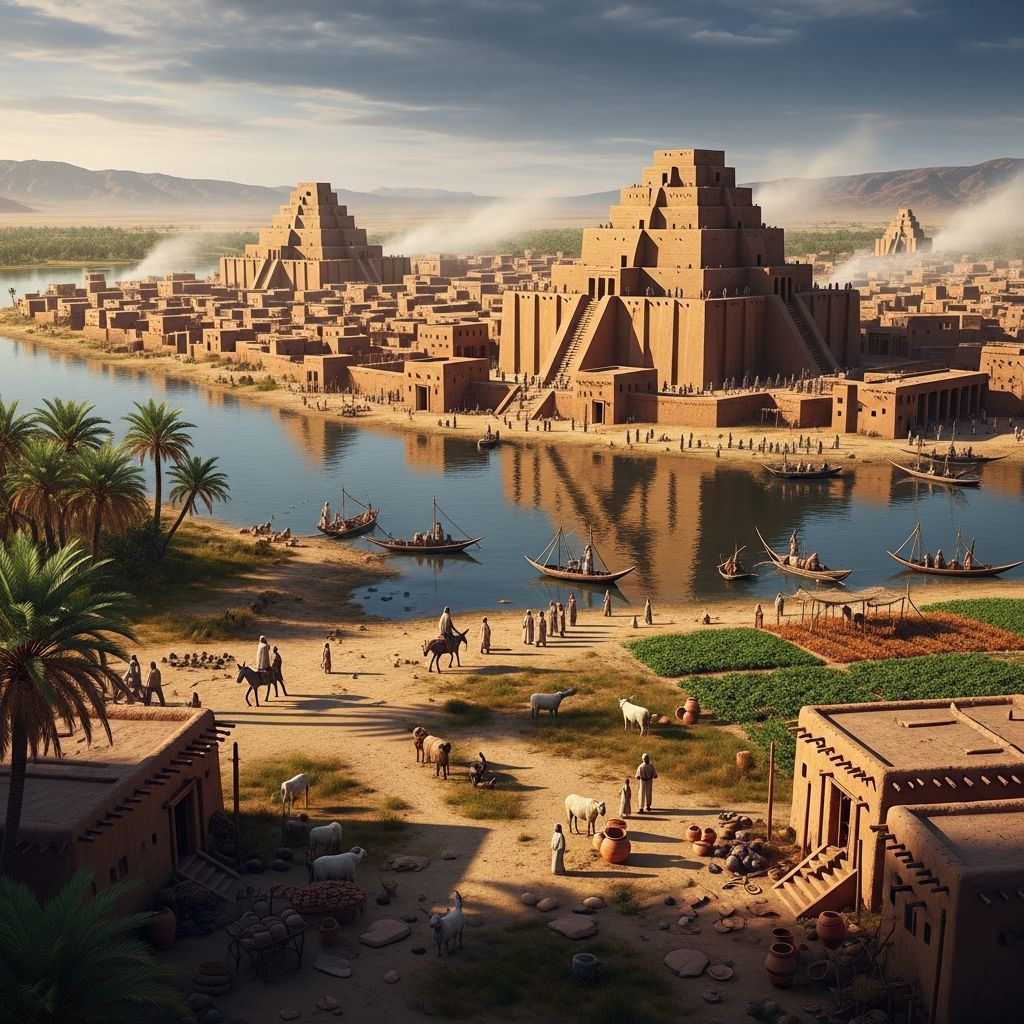
The ancient region known as
Mesopotamia
, meaning “land between the rivers” in Greek, occupies a pivotal place in human history as the birthplace of the world’s earliest complex societies. Nestled primarily in modern-day Iraq, with extensions into Syria, Turkey, and Iran, this fertile plain supported innovations that continue to influence global culture today.Geographical Foundations of a Thriving Region
Mesopotamia’s geography is defined by the
Tigris
andEuphrates
rivers, which originate in the mountains of eastern Turkey and flow southeast through Iraq into the Persian Gulf. These rivers created theFertile Crescent
, a semicircular band of arable land that enabled agriculture from around 10,000 BC during the Neolithic Revolution.Unlike the predictable Nile in Egypt, the Tigris and Euphrates brought unpredictable floods, necessitating advanced irrigation systems like canals and levees. This engineering feat transformed arid plains into bountiful fields growing barley, wheat, dates, and other crops, supporting population growth and urbanization.
- Northern Mesopotamia (Upper Mesopotamia): Hilly terrain with reliable rainfall, home to Assyrian cultures.
- Southern Mesopotamia (Lower Mesopotamia): Flat alluvial plains, cradle of Sumerian city-states.
The region’s position as a trade crossroads linked it to the Mediterranean, Anatolia, Iran, and the Indus Valley, fostering cultural exchange.
From Villages to the World’s First Cities
Around 4000 BC, farming villages evolved into the first true cities, such as
Uruk
,Eridu
, andUr
, with populations exceeding 50,000. These urban centers featured monumental architecture, includingziggurats
—massive stepped temples symbolizing mountains linking earth and heaven.Urbanization brought social stratification: priests, kings, scribes, artisans, and farmers formed complex hierarchies. Temples served as economic hubs, managing grain storage, trade, and labor.
| Key Early Cities | Location | Significance |
|---|---|---|
| Uruk | Southern Mesopotamia | Oldest city (c. 4000 BC); epic of Gilgamesh origin. |
| Ur | Southern Mesopotamia | Royal tombs with advanced jewelry and chariots. |
| Nineveh | Northern Mesopotamia | Assyrian capital with vast library. |
| Babylon | Southern Mesopotamia | Hammurabi’s seat; Hanging Gardens legend. |
Pioneering Inventions That Changed Humanity
Mesopotamians invented technologies foundational to civilization.
Cuneiform writing
, developed by Sumerians around 3400–3000 BC, began as pictographs on clay tablets for record-keeping and evolved into a script for literature, law, and science.Other breakthroughs included the
wheel
(c. 3500 BC) for pottery and transport,mathematics
with base-60 system (basis for 60 minutes/hour),astronomy
tracking planets, andagriculture
with plows and seed drills.- Writing: Enabled bureaucracy, epics like Gilgamesh.
- Law: Hammurabi’s Code (c. 1750 BC), eye-for-eye justice.
- Architecture: Arches, domes, brick construction.
Religion permeated life, with a polytheistic pantheon led by Anu (sky god) and Enlil (wind god). Ziggurats hosted rituals to appease gods controlling floods and fertility.
Sumerians: Architects of the First Civilization
The
Sumerians
, non-Semitic people arriving c. 4500 BC, built independentcity-states
ruled by priest-kings (lugal). Each city worshipped a patron deity, like Inanna at Uruk.By 3000 BC, Sumerians achieved literacy, trade networks, and standardized weights. Their myths influenced later biblical stories, such as the flood narrative.
Akkadian Empire: Uniting the Land
Around 2350 BC,
Sargon of Akkad
, a Semitic ruler, conquered Sumerian cities, creating the first empire spanning Mesopotamia to the Mediterranean. He standardized administration, weights, and language (Akkadian).The empire lasted until c. 2150 BC, felled by Gutian invaders, but introduced imperial governance models.
Babylonian and Assyrian Dominance
The
Old Babylonian Empire
peaked underHammurabi
(r. 1792–1750 BC), whose stele codified 282 laws promoting justice and commerce. Babylon became a cultural jewel.In the north,
Assyrians
built empires: Middle Assyrian (c. 1400 BC), Neo-Assyrian (911–612 BC) under kings like Ashurbanipal, whose Nineveh library preserved 30,000 tablets. Assyrians excelled in military tech—iron weapons, siege engines.After Assyrian fall in 612 BC,
Neo-Babylonian Empire
under Nebuchadnezzar II (r. 605–562 BC) rebuilt Babylon with Ishtar Gate and ziggurats.Foreign Conquests and Cultural Eclipse
In 539 BC,
Cyrus the Great
of Persia conquered Babylon, ending native rule. Alexander the Great took it in 331 BC, followed by Seleucids, Parthians, Romans, and Sassanids. By 7th century AD, Arab conquests renamed it Iraq.Despite conquests, Mesopotamian ideas endured in law, science, and religion.
Lasting Legacy in Modern World
Mesopotamia’s contributions underpin society: 360-day calendar, zodiac, algebra precursors. Its stories echo in the Bible; city-state model influenced Greece and Rome.
Archaeology, from 19th-century digs at Nineveh to modern UNESCO sites like Babylon, reveals cuneiform archives illuminating daily life.
Frequently Asked Questions (FAQs)
What is the exact location of ancient Mesopotamia?
It lies between the Tigris and Euphrates rivers, mainly in modern Iraq, parts of Syria, Turkey, and Iran.
Who were the first people in Mesopotamia?
Sumerians around 4500 BC, followed by Akkadians.
What ended Mesopotamian independence?
Persian conquest by Cyrus in 539 BC.
Why is it called the Cradle of Civilization?
Site of first writing, cities, wheels, and empires.
Are there modern remnants?
Yes, ruins like Ur and Babylon are UNESCO sites.
References
- Mesopotamia — Wikipedia. 2023-10-01. https://en.wikipedia.org/wiki/Mesopotamia
- The Significance of Mesopotamia for World History — Human Liberty Texts (Berger et al.). 2023-01-15. https://human.libretexts.org/Bookshelves/History/World_History/Book:_World_History_-_Cultures_States_and_Societies_to_1500_(Berger_et_al.)/02:_Early_Middle_Eastern_and_Northeast_African_Civilizations/2.08:_The_Significance_of_Mesopotamia_for_World_History
- Mesopotamia: Civilization Begins — Getty Museum. 2019-06-01. https://www.getty.edu/art/exhibitions/mesopotamia/explore.html
- Ancient Mesopotamia – an overview — University of Cambridge Department of Archaeology. 2022-09-12. https://www.arch.cam.ac.uk/about-us/mesopotamia/mesopotamia-history
- History of Mesopotamia — Encyclopædia Britannica. 2024-02-28. https://www.britannica.com/place/Mesopotamia-historical-region-Asia
- Ancient Mesopotamian civilizations — Khan Academy. 2023-05-20. https://www.khanacademy.org/humanities/world-history/world-history-beginnings/ancient-mesopotamia/a/mesopotamia-article
- Highlights from the Collection: Mesopotamia — Institute for the Study of Ancient Cultures, University of Chicago. 2021-11-10. https://isac.uchicago.edu/collections/highlights/highlights-collection-mesopotamia
Similar Articles







Read full bio of medha deb