North American Air Masses: Types and Weather Effects
Discover the four primary air masses shaping North America's climate, from icy polar blasts to humid tropical flows.
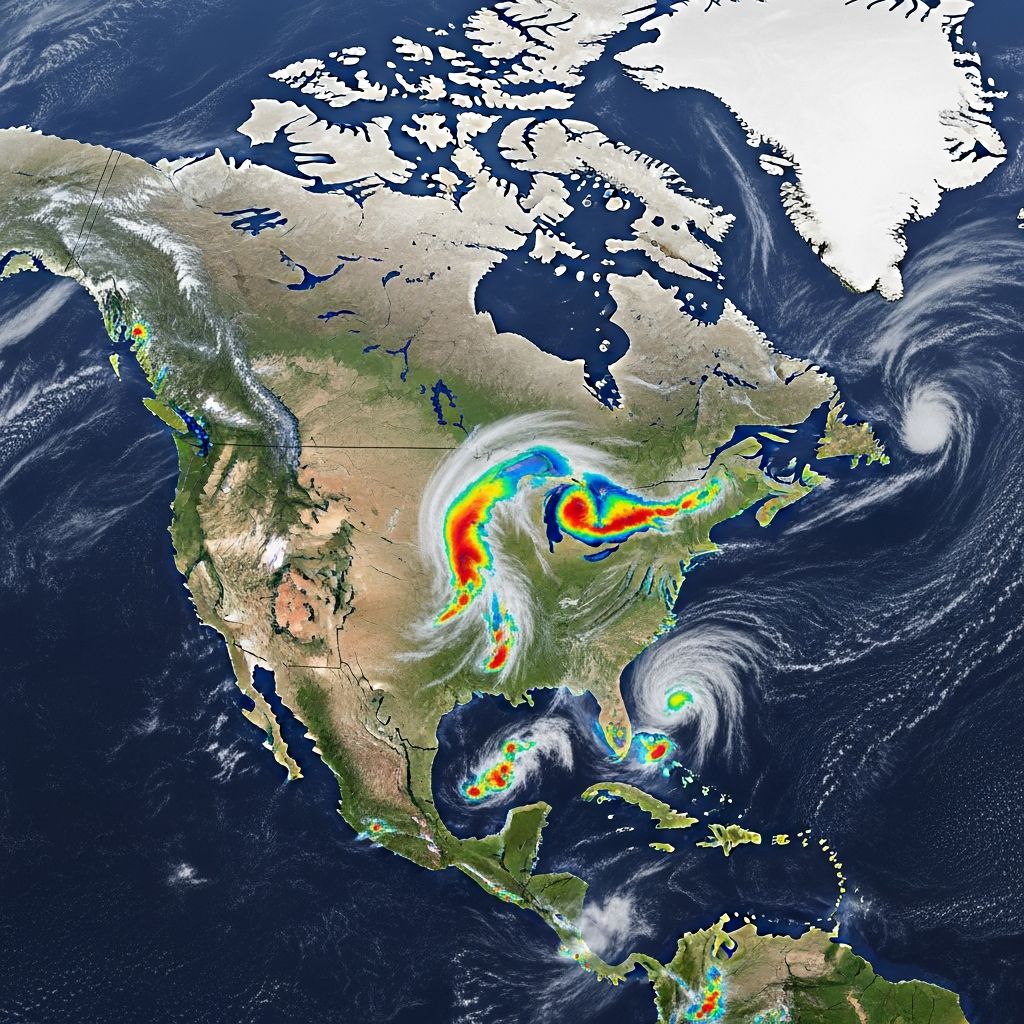
Air masses are vast bodies of air with uniform temperature and humidity characteristics, formed over large source regions. In North America, these masses play a pivotal role in determining daily weather and long-term climate patterns. Classified by their moisture content (continental for dry, maritime for moist) and temperature (polar for cold, tropical for warm), they migrate across the continent, interacting to create fronts, storms, and seasonal shifts.
Fundamentals of Air Mass Formation
Air masses develop when air stagnates over expansive, uniform surfaces like oceans or landmasses, acquiring those areas’ thermal and moisture properties. Continental air masses form over land, resulting in drier conditions, while maritime ones gather moisture from water bodies. Polar types originate in high latitudes, staying cold, and tropical ones brew in equatorial zones, warming significantly. As they move, they modify slightly but retain core traits, influencing weather upon arrival.
- Source Region Size: Must be large enough, like Canada’s interior or the Gulf of Mexico, for uniformity.
- Stability: High pressure promotes subsidence, fostering even conditions.
- Movement: Winds carry them away, leading to advection across regions.
Continental Polar: The Arctic Chill
Continental polar (cP) air masses emerge from the frozen heartlands of Canada and sometimes Siberia. These cold, dry parcels dive south during winter, delivering sharp temperature plunges and clear skies. Stable and dense, they sink under high pressure domes, often linked to the polar vortex.
When cP air surges into the U.S. Plains or Midwest, it triggers rapid cooling—sometimes 30-40°F drops in hours—freezing soil and halting outdoor activities. Summer incursions are rarer but can stabilize atmospheres, suppressing thunderstorms.
| Characteristic | Details |
|---|---|
| Temperature | Cold to very cold (below freezing in winter) |
| Moisture | Dry (low dew points) |
| Source | Northern Canada, Arctic land |
| Weather Impact | Clear, sunny; frost, snow if lifted |
Maritime Polar: Cool Pacific Moisture
Maritime polar (mP) air forms over chilly northern Pacific and Atlantic waters, notably the Gulf of Alaska. Cool and moist, it brings cloud decks, persistent drizzle, and mild temperatures to the West Coast. As it crosses mountains like the Rockies, it loses moisture via orographic lift, drying eastward.
In winter, mP fuels Pacific storms, slamming California with rain and the Northwest with snow. Inland, it clashes with warmer air, spawning fronts and cumuliform clouds. Its instability promotes showers, contrasting cP’s stability.
Maritime Tropical: Gulf Humidity Engine
The warm, humid maritime tropical (mT) air mass brews over the Gulf of Mexico, Caribbean, and subtropical Atlantic. It dominates eastern U.S. summers, fueling mugginess, convective storms, and hurricane development. High dew points often exceed 70°F, creating uncomfortable heat indices.
mT advances north in spring and summer, interacting with polar air to form squall lines and derechos. Its warmth destabilizes atmospheres, leading to severe thunderstorms with hail, winds, and tornadoes.
Continental Tropical: Desert Heat Wave
Continental tropical (cT) air masses ignite over the sun-baked deserts of the Southwest U.S. and northern Mexico. Extremely hot and arid, they scorch the southern Plains in summer, with temperatures soaring above 100°F and humidity below 10%.
cT outbreaks clear skies and intensify heat domes, exacerbating droughts and wildfires. Though unstable near the surface, upper-level stability caps convection, limiting rain.
Seasonal Movements and Regional Impacts
Air mass dominance shifts with seasons. Winter favors cP and mP from the north, blanketing the continent in cold. Summer sees mT and cT pushing north, heating the interior. Transitional seasons feature battles at fronts, where contrasts sharpen.
- West Coast: mP drives rainy winters, dry summers.
- Plains: cP winters vs. mT/cT summers create extremes.
- East Coast: mT humidity year-round, polar clashes in winter.
The polar continental mass, per Britannica, spreads negative temperature anomalies continent-wide, reaching as far as Florida in extreme cases.
Interactions: Fronts and Storm Genesis
Air mass boundaries, or fronts, are where weather intensifies. Cold fronts (cP advancing) lift warm air, spawning thunderstorms. Warm fronts (mT advancing) create stratiform clouds and steady rain. Stationary fronts prolong wet periods.
Nor’easters form when mP meets mT along the Atlantic, while Midwest supercells arise from cP-mT clashes. These dynamics explain North America’s volatile weather.
Climate Change Influences on Air Masses
Warming trends alter air mass behaviors. Arctic amplification weakens polar vortexes, potentially increasing cP outbreaks. Warmer oceans boost mT moisture, intensifying storms. Desert expansion may strengthen cT heat.
Colorado Climate Center notes modified air masses show hybrid traits, complicating forecasts.
Air Mass Classification Table
| Type | Abbr. | Source Region | Temp | Moisture | Key U.S. Impact |
|---|---|---|---|---|---|
| Continental Polar | cP | Canada interior | Cold | Dry | Winter cold snaps |
| Maritime Polar | mP | N. Pacific/Atlantic | Cool | Moist | Coastal rain/snow |
| Maritime Tropical | mT | Gulf of Mexico | Warm | Moist | Summer storms |
| Continental Tropical | cT | SW deserts | Hot | Dry | Heat waves |
Frequently Asked Questions
What causes sudden winter cold snaps in the U.S.?
Continental polar air masses from Canada plunge south when the polar vortex weakens, causing dramatic temperature drops.
Why is the U.S. East Coast so humid in summer?
Maritime tropical air from the Gulf of Mexico brings abundant moisture, leading to high dew points and frequent thunderstorms.
How do mountains affect air masses?
Orographic lift forces moist air like mP to rise, producing rain on windward sides and drier conditions leeward.
Can air masses cause tornadoes?
Yes, clashes between cool cP/mP and warm mT create instability for supercells and twisters in the Plains.
Are there Arctic air masses distinct from polar?
Continental Arctic (cA) is colder and drier than cP, originating farther north, but both bring extreme cold.
References
- Air Masses Explained: Types, Movement & Weather Impact — EcoFlow. 2023-12-15. https://www.ecoflow.com/us/blog/air-masses-types-winter-weather-impact
- North America – Air Masses, Climate, Weather — Britannica. 2024-01-10. https://www.britannica.com/place/North-America/Air-masses
- Pressure Systems, Air Masses & Fronts — Colorado Climate Center, Colorado State University. 2022-09-01. https://climate.colostate.edu/pdfs/Pressure%20Systems%20Air%20Masses%20&%20Fronts_Colorado.pdf
- Air Masses of North America — Mesonet, University of Oklahoma. 2021-05-20. https://www.mesonet.org/files/materials/airmasses.pdf
- Air Masses — Aircraft Owners and Pilots Association (AOPA). 2023-07-12. https://www.aopa.org/training-and-safety/online-learning/safety-spotlights/weather-wise-air-masses-and-fronts/air-masses
Similar Articles







Read full bio of Sneha Tete