The Origins and Mechanics of Time Zones
Discover how Earth's rotation shaped global timekeeping, from ancient solar methods to modern standardized zones.
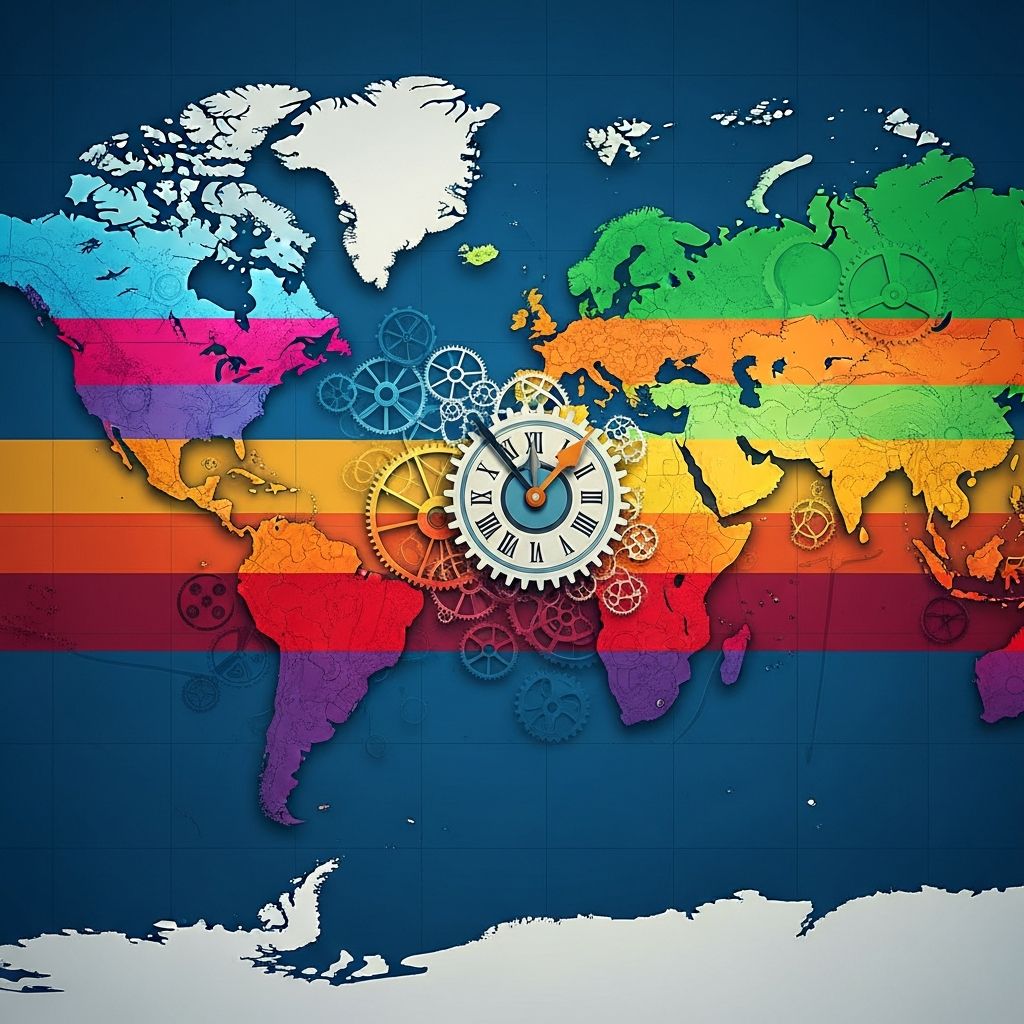
Time zones represent a fundamental human invention to synchronize daily life with the Earth’s natural rotation. As our planet spins on its axis once every 24 hours, completing a full 360-degree turn, different regions experience daylight at staggered intervals. This rotation divides the globe into 24 primary time zones, each roughly 15 degrees of longitude wide, ensuring that local time aligns closely with solar positions. Without such divisions, a uniform global clock would mismatch noon with darkness in many areas, disrupting routines from work to transportation.
Earth’s Rotation: The Foundation of Time Differences
The core reason for time zones lies in Earth’s eastward rotation at approximately 15 degrees per hour. When the sun rises over the Pacific, it is morning there while evening falls in Europe. This gradual shift means locations 15 degrees apart differ by one hour in solar time. Historically, communities relied on local solar time, setting clocks by the sun’s highest point, or noon. However, as travel accelerated in the 19th century, these discrepancies—sometimes minutes apart between nearby towns—created chaos.
Imagine boarding a train in one city at 10 a.m. local time, only to arrive in the next at 9:50 a.m. by that city’s clock. Such scenarios were common before standardization, highlighting the need for coordinated systems. Today, this principle underpins global timekeeping, with the Prime Meridian at Greenwich, England (0 degrees longitude), as the reference point.
Historical Evolution: From Chaos to Coordination
Before railroads, slow travel by foot, horse, or ship made local times sufficient. Communities in North America alone used over 144 distinct times, with adjacent towns varying by minutes. The railroad boom in the 1830s-1840s changed everything, enabling rapid cross-country journeys that exposed these inconsistencies. Travelers often arrived ‘early’ relative to departure times, risking scheduling errors and even collisions.
Railroad companies pioneered solutions, creating proprietary zones aligned with their routes. In Britain, imperial expansion from the 1600s prompted early standardization for navigation, referencing London time via the Greenwich Meridian, championed by astronomer Sir George Airy. By 1883, North American railroads adopted four continental zones—Eastern, Central, Mountain, and Pacific—reducing confusion dramatically. Governments soon followed; the U.S. Interstate Commerce Commission formalized five zones (adding Alaska) in 1918 amid World War I needs.
Global Standardization and the Role of the Prime Meridian
The 1884 International Meridian Conference in Washington, D.C., cemented Greenwich as the world’s Prime Meridian, dividing Earth into 24 hour-wide zones eastward and westward. This wasn’t arbitrary; Greenwich’s Royal Observatory had long served mariners calculating longitude. Each zone spans 15 degrees, but boundaries rarely follow longitude precisely. Instead, they respect political borders for unity within countries.
For example, China spans five theoretical zones but uses a single time for national cohesion. Similarly, U.S. states like Indiana aligned with Eastern Time for business ties to New York. These adjustments prioritize practicality over pure solar accuracy.
Practical Variations and Half-Hour Zones
Not all zones adhere to 60-minute increments. Several regions use 30- or 45-minute offsets for better solar alignment:
- India Standard Time (UTC+5:30): Balances its vast longitude span.
- Iran Standard Time (UTC+3:30): A post-1920s adjustment.
- Newfoundland Time (UTC-3:30): Canada’s unique half-hour zone.
- Nepal Time (UTC+5:45): Further customized locally.
These exceptions arose from local needs, blending science with policy. Political decisions also create anomalies, like Spain’s Central European Time despite its western position, matching France for EU integration.
Daylight Saving Time: An Added Layer of Complexity
Many regions overlay Daylight Saving Time (DST), advancing clocks by an hour in summer to extend evening daylight. Originating in World War I for energy savings, DST affects about 40% of countries but varies widely. The U.S. zones shift, e.g., Eastern Daylight Time (EDT) is UTC-4 versus Eastern Standard Time (EST) UTC-5.
| Region | Standard Offset (UTC) | DST Offset (UTC) | Notes |
|---|---|---|---|
| Eastern (US) | -5 | -4 | Includes NY, Florida |
| Central (US) | -6 | -5 | Includes Texas, Illinois |
| Mountain (US) | -7 | -6 | Includes Colorado; AZ opts out |
| Pacific (US) | -8 | -7 | Includes CA, WA |
| India | +5:30 | N/A | No DST |
Arizona skips DST, while Europe coordinates changes on the last Sunday in March and October. Debates persist over DST’s benefits, with some places abolishing it.
Challenges in a Connected World
Globalization amplifies time zone issues. Business calls span continents; a 9 a.m. New York meeting is 2 p.m. in London and 10 p.m. in Tokyo. Aviation and shipping rely on UTC (Coordinated Universal Time), the modern Greenwich successor, for precision. Satellites and space missions extend this: astronauts use UTC, while Mars rovers account for a 24.6-hour ‘sol’.
Digital tools mitigate confusion—smartphones auto-adjust—but exceptions persist. Russia’s 11 zones were reduced to nine in 2010 for simplicity, yet anomalies remain. Climate and economics influence changes; half-hour zones save energy by matching solar noon closer.
Time Zones in Daily Life and Travel
When traveling west, you ‘gain’ time; eastbound, you ‘lose’ it. Crossing the International Date Line (180th meridian) flips the day. Apps like world clocks simplify planning, but vigilance avoids errors—e.g., missing flights due to DST shifts.
In education, understanding zones teaches geography and astronomy. Children learn Earth’s spin causes day-night cycles, necessitating zones for order.
Frequently Asked Questions (FAQs)
Why can’t the world use a single time zone?
A universal time would desynchronize daily activities from sunlight; noon could mean midnight elsewhere, impractical for life and safety.
How many time zones are there?
Theoretically 24, but political tweaks create about 38, including fractions.
What is UTC?
Coordinated Universal Time, the global standard based on atomic clocks, replacing GMT for precision.
Do all countries observe DST?
No; about 70 countries do partially, varying by region.
Why do time zone boundaries zigzag?
To follow political borders, easing commerce and communication over strict longitude.
Future of Timekeeping
As technology evolves, proposals for fewer zones or perpetual DST emerge. Yet, Earth’s rotation ensures time zones endure, balancing nature with human needs. International bodies like the IERS maintain UTC, adjusting for Earth’s slight slowdown.
In summary, time zones transformed from railroad necessities to global lifelines, harmonizing our spinning world.
References
- Why do we have different time zones? | #aumsum #kids — It’s AumSum Time (YouTube). Accessed 2026. https://www.youtube.com/watch?v=AgINA9_IFiI
- Why Are There Different Time Zones? — Encyclopaedia Britannica. Accessed 2026. https://www.britannica.com/science/Why-Are-There-Different-Time-Zones
- Understanding Time Zones — Scholastic Inc. (Kid Reporters’ Notebook). Accessed 2026. https://kpcnotebook.scholastic.com/post/understanding-time-zones
- Why Do We Have Time Zones? — YouTube Educational Video. Accessed 2026. https://www.youtube.com/watch?v=qjUT7FbmNZ8
- Time zone — Wikipedia (informational overview). Accessed 2026. https://en.wikipedia.org/wiki/Time_zone
- History of Time Zones and Daylight Saving Time (DST) — Bureau of Transportation Statistics (bts.gov). Accessed 2026. https://www.bts.gov/explore-topics-and-geography/geography/geospatial-portal/history-time-zones-and-daylight-saving
Similar Articles








Read full bio of Sneha Tete