Orogeny: Earth’s Mountain-Building Force
Discover the dynamic forces of orogeny that shape majestic mountain ranges through tectonic collisions and crustal deformation.
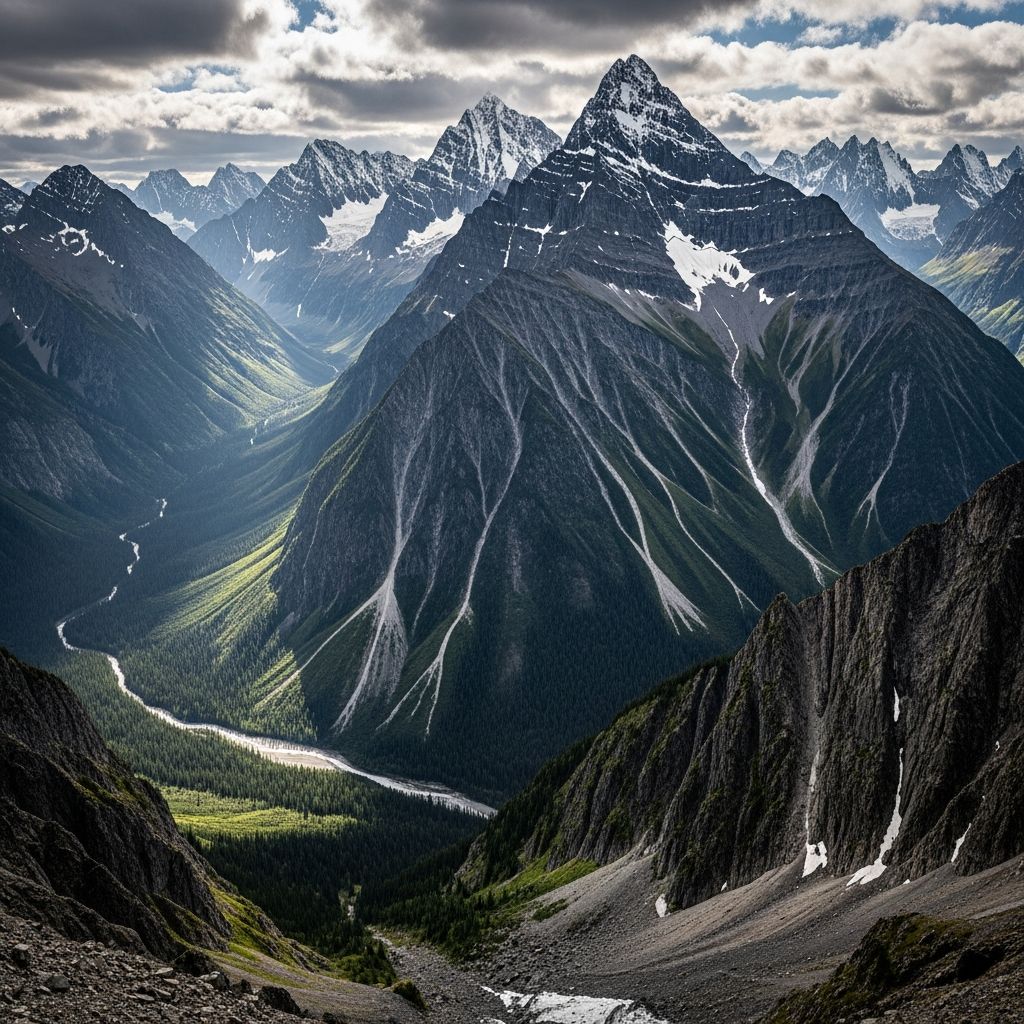
Mountain ranges dominate landscapes worldwide, from the towering Himalayas to the rugged Andes. These features arise through orogeny, a complex geological process where tectonic forces deform the Earth’s crust to produce elongated belts of folded and uplifted rock. Unlike gradual erosion or sedimentation, orogeny involves intense compression at convergent plate boundaries, leading to the creation of new continental crust and profound landscape changes. This article delves into the mechanisms, types, historical examples, and ongoing impacts of orogeny, revealing how it sculpts our planet.
Understanding the Fundamentals of Orogeny
At its core, orogeny represents a major episode of lithospheric deformation triggered by the collision of tectonic plates. The term derives from Greek roots meaning ‘mountain creation,’ aptly describing how converging plates crumple, fold, and thrust crustal materials upward. This process distinguishes itself from epeirogeny, which involves broad vertical uplifts without significant folding.
Key stages include initial compression, where plates push together; deformation through folding and faulting; and often, magmatic intrusion as subduction melts crustal rocks. Orogenic belts typically form linear zones along continent edges, contrasting with stable cratonic interiors. Young belts feature active seismicity and volcanism, while older ones expose deeply eroded, metamorphosed rocks and massive batholiths.
Tectonic Drivers Behind Mountain Formation
Orogeny hinges on plate tectonics, the theory explaining Earth’s lithospheric plates’ movement. At convergent margins, oceanic or continental plates collide, generating immense forces. Subduction occurs when denser oceanic crust dives beneath lighter continental or oceanic plates, forming deep trenches and volcanic arcs.
In continental collisions, buoyant crust resists subduction, leading to thickening and uplift. This ‘India-Asia’ style collision exemplifies how horizontal compression builds the highest peaks. Associated phenomena include thrust faults—where rock slices override others—and isostatic rebound, where eroded mountains rise due to crustal buoyancy.
Key Processes in Orogenic Deformation
During orogeny, rocks respond to stress in predictable ways:
- Folding: Layers buckle into anticlines (upward arches) and synclines (downward troughs), creating wave-like structures.
- Faulting: Brittle failure produces normal, reverse, or strike-slip faults, with thrust faults dominant in compression.
- Metamorphism: Heat and pressure recrystallize minerals, forming schists and gneisses.
- Igneous Activity: Subduction-generated magma intrudes as plutons or erupts as volcanoes.
- Sedimentation: Eroded debris forms foreland basins adjacent to rising ranges.
These interplay over millions of years, with synorogenic events like ongoing deformation marking active phases.
Types of Orogenic Events
Orogenies vary by tectonic setting. Here’s a comparison:
| Type | Description | Examples | Key Features |
|---|---|---|---|
| Accretionary | Oceanic plate subducts under continent, accreting terranes | Andes | Volcanic arcs, trenches |
| Collisional | Continent-continent smash-up | Himalayas | Extreme thickening, no subduction |
| Obduction | Oceanic crust overthrusts continental | Oman | Rare, ophiolites |
Accretionary orogenies dominate circum-Pacific ‘Ring of Fire,’ while collisional ones define Alpine-Himalayan chain.
Iconic Orogenies Through Geologic Time
Earth’s history records multiple orogenies, each reshaping continents. The Caledonian Orogeny (Silurian-Devonian) fused Laurentia and Baltica, forming proto-Appalachians. The Variscan (Carboniferous) welded Europe to Africa, influencing modern coal basins.
The Alleghanian Orogeny (Late Paleozoic) collided North America with Gondwana, raising Appalachians and shedding vast sediments. Mesozoic Laramide Orogeny uplifted Rockies via shallow subduction. Today, ongoing Himalayan orogeny from India-Asia crunch averages 5-10 mm/year uplift.
These events not only build mountains but recycle crust, with erosion exposing roots like the Tibetan Plateau’s underthrust slabs.
Modern Impacts and Monitoring
Active orogenies pose hazards: earthquakes ravage zones like the Alpide belt, while volcanism threatens populations. The 2015 Nepal quake, tied to Himalayan thrust faulting, killed thousands, underscoring risks. GPS tracks deformation rates, revealing strain buildup.
Climate links emerge too—rising ranges enhance weathering, drawing down CO2 and cooling Earth. Orogenic gold and mineral deposits fuel economies, from California’s Sierra batholiths.
Distinguishing Orogeny from Related Processes
| Process | Force Type | Outcome | Scale |
|---|---|---|---|
| Orogeny | Horizontal compression | Folded linear ranges | Regional belts |
| Epeirogeny | Vertical isostatic | Plateaus, basins | Continental |
| Rifting | Tensional | Valleys, oceans | Linear grabs |
This table highlights orogeny’s unique compressive signature.
Frequently Asked Questions (FAQs)
What causes orogeny?
Orogeny results from tectonic plate convergence, compressing crust into mountains via folding and faulting.
How long does an orogeny last?
Typically 100-300 million years, with active phases spanning tens of millions.
Are there active orogenies today?
Yes, the Himalayas, Andes, and Zagros continue building.
What’s the difference between orogeny and volcanism?
Orogeny encompasses broad deformation; volcanism is one facet, often subduction-linked.
Can orogeny create new crust?
Yes, via magmatic addition and differentiation in the lithosphere.
Future Prospects in Orogeny Research
Advances in seismology, satellite geodesy, and computational modeling illuminate subduction dynamics. Thermochronology dates uplift histories, while paleomagnetism reconstructs past collisions. Climate-orogeny feedbacks gain attention amid global warming, as erosion rates shift. Understanding these sustains hazard mitigation and resource exploration.
In summary, orogeny embodies Earth’s restless dynamism, forging barriers that influence climate, biodiversity, and human history. From ancient Variscans to nascent Himalayas, these events remind us of geology’s grand scale.
References
- Orogeny – Definition, Physiography, Types and FAQs — Vedantu. 2023. https://www.vedantu.com/geography/orogeny
- Orogeny — SLB Energy Glossary. Accessed 2026. https://glossary.slb.com/terms/o/orogeny
- Orogeny — Wikipedia (informed by primary sources). 2026. https://en.wikipedia.org/wiki/Orogeny
- Orogeny Definition & Meaning — Merriam-Webster. Accessed 2026. https://www.merriam-webster.com/dictionary/orogeny
- Orogeny | Mountain Building, Plate Tectonics & Continental Drift — Britannica. 2023. https://www.britannica.com/science/orogeny
- Subduction and Orogeny | Geology Research Starters — EBSCO. Accessed 2026. https://www.ebsco.com/research-starters/geology/subduction-and-orogeny
Similar Articles







Read full bio of Sneha Tete