Pangea: Earth’s Ancient Supercontinent
Unravel the story of Pangea, the massive supercontinent that reshaped our planet and gave rise to today's continents.
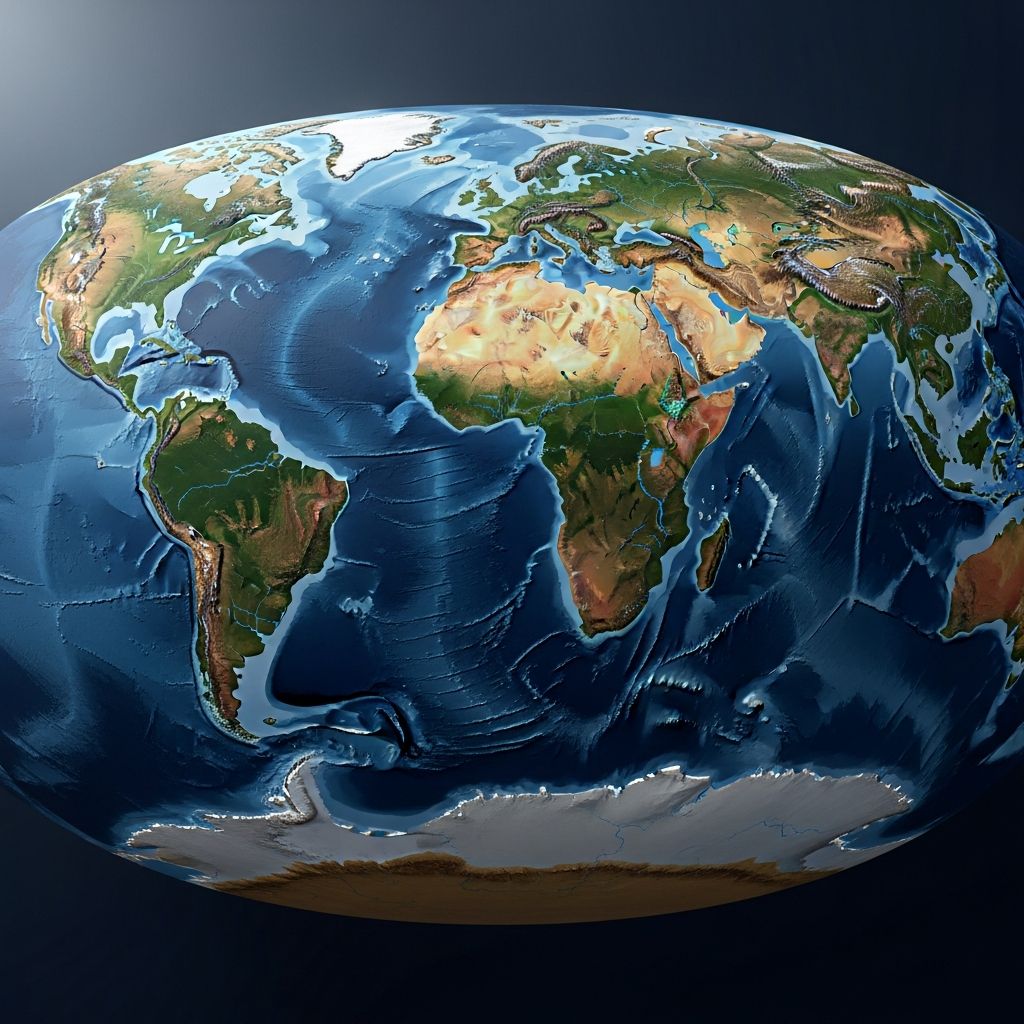
Approximately 320 to 200 million years ago, nearly all of Earth’s landmasses converged into a single colossal landmass known as Pangea, encircled by the vast Panthalassa Ocean. This supercontinent’s assembly and eventual fragmentation fundamentally shaped the planet’s geography, climate, and biosphere, laying the groundwork for the continental configurations we observe today.
The Tectonic Forces Behind Supercontinent Assembly
Supercontinents like Pangea emerge cyclically every 300 to 500 million years through the dynamic processes of plate tectonics. Earth’s lithosphere, the rigid outer shell, divides into tectonic plates that float atop the semi-fluid asthenosphere in the mantle. These plates interact at boundaries: they diverge where new crust forms, converge where one plate subducts beneath another, and slide past each other at transform faults.
The path to Pangea began in the Devonian Period (419–359 million years ago), when ancient cratons—stable continental cores—started merging. Laurentia (proto-North America) fused with Baltica (proto-Eastern Europe) and smaller fragments to create Euramerica. By the Permian Period (299–252 million years ago), Gondwana (comprising South America, Africa, Antarctica, India, and Australia) collided with Euramerica’s southern margin, while Siberia’s Angaran craton joined from the east, finalizing Pangea’s structure around 300 million years ago.
- Key Mergers: Laurentia + Baltica → Euramerica (Devonian).
- Gondwana + Euramerica (Permian).
- Siberia integration completes the puzzle.
This convergence closed ancient oceans and erected mountain ranges, such as the Appalachians from Laurentia-Gondwana collision remnants.
Pangea’s Unique Geography and Layout
Pangea adopted a C-shaped form, with its main body spanning from pole to pole and an expansive embayment—the Tethys Sea—along its eastern flank. This inland sea connected to Panthalassa, moderating some climates but not preventing extremes. The supercontinent lacked the moderating influence of surrounding oceans on most land, leading to vast interior deserts.
Modern continents fit like puzzle pieces into Pangea’s outline: North America and Europe bordered its northern arm, South America and Africa its core, while India, Antarctica, and Australia dangled from the south. The western edge faced Panthalassa directly.
| Region | Modern Continents | Notable Features |
|---|---|---|
| Northern Arm (Laurasia) | North America, Europe, Asia | Tethys Sea influence, early rifts |
| Central Mass | Africa, South America | Appalachian precursors |
| Southern Extension (Gondwana) | Antarctica, India, Australia | Deserts, Glossopteris flora |
Climatic Extremes Across Pangea
Pangea’s immense size created stark climatic contrasts. Coastal zones enjoyed marine breezes, but the interior suffered arid conditions due to rain shadows from peripheral mountains. Equatorial regions baked under intense heat, while poles froze in isolation.
Fossil evidence reveals equatorial coals from lush swamps and polar ice caps during the Permian. Vast deserts akin to the modern Sahara dominated central Pangea, with eolian dunes preserved in rock records. Monsoon-like patterns occasionally brought moisture from the Tethys, fostering seasonal rivers and lakes.
Life Forms Thriving on the Supercontinent
Pangea’s biota adapted to its challenges. The Glossopteris flora—a seed fern with tongue-shaped leaves—dominated Gondwana, its fossils confirming continental unity as they appear across now-separated lands. Therapsids, mammal-like reptiles, roamed widely, evolving toward true mammals.
- Flora: Glossopteris, conifers, lycopods in wetter zones.
- Fauna: Dimetrodon (sail-backed synapsids), early dinosaurs in Late Triassic.
- Extinctions: Permian-Triassic event (252 Ma) wiped out 90% of species, possibly exacerbated by Pangea’s volcanism and climate swings.
Initiation and Progression of Pangea’s Fragmentation
Around 200 million years ago, in the Early Jurassic (201–174 Ma), Pangea began rifting due to mantle upwelling and plate stresses. A three-pronged fissure pried apart North America, Africa, and South America, with magma intruding to form new oceanic crust.
The breakup unfolded in phases: First, Laurasia (northern half: North America, Eurasia) separated from Gondwana (southern: Africa, South America, etc.) as the Central Atlantic opened ~195–170 Ma. Gondwana then fractured ~150 Ma, with South America rifting from Africa (South Atlantic), India from Antarctica, and Madagascar detaching.
- Early Jurassic: North America-Africa split.
- Mid-Jurassic: Gondwana dispersal begins.
- Cretaceous (~140 Ma): South Atlantic opens.
- ~80–60 Ma: India-Madagascar, Australia-Antarctica, North America-Eurasia separations.
Today’s Atlantic widening exemplifies ongoing drift.
Global Repercussions of Continental Separation
Pangea’s dispersal reshaped oceans, climates, and life. New seaways like the Atlantic facilitated moisture transport, greening continents and boosting diversity. Mountain-building at collision zones, like the Himalayas from India-Asia crash ~50 Ma, altered atmospheric CO2 via erosion.
Ocean currents reconfigured, influencing global temperatures. The supercontinent cycle persists; scientists predict a future “Pangea Ultima” in 250 million years.
Alfred Wegener and the Dawn of Continental Drift Theory
In 1912, meteorologist Alfred Wegener proposed continents once fit together, citing matching coastlines, fossils (e.g., Mesosaurus in Brazil-Africa), and rock strata. Initially dismissed, his ideas evolved into plate tectonics by the 1960s with seafloor spreading evidence.
Wegener’s hypothesis bridged to modern geology, explaining Pangea’s role without mechanisms initially.
Visualizing Pangea Through Reconstructions
Paleogeographic maps reconstruct Pangea using fossil, magnetic, and structural data. Animations depict rifting from 200 Ma to present, showing steady plate motions averaging 2–5 cm/year.
Frequently Asked Questions About Pangea
Was Pangea the first supercontinent?
No, earlier ones like Rodinia (~1 billion years ago) preceded it, but Pangea is the most recent fully assembled.
How long did Pangea exist as a whole?
From ~320 Ma assembly to ~200 Ma breakup, roughly 120 million years.
Could Pangea reform?
Plate motions suggest a new supercontinent in 200–300 million years, possibly closing the Pacific.
What evidence proves Pangea existed?
Fossil correlations (Glossopteris, Lystrosaurus), paleomagnetic data, matching geology across oceans.
Did dinosaurs live on Pangea?
Yes, early dinosaurs appeared in Late Triassic as breakup initiated.
References
- The Breakup of Supercontinent Pangea — SHMuseum.hku.hk. Accessed 2026. https://shmuseum.hku.hk/education/earth-evolution/mesozoic/the-breakup-of-supercontinent-pangea
- Pangaea: Discover facts about Earth’s ancient supercontinent — Live Science. 2017-07-26. https://www.livescience.com/38218-facts-about-pangaea.html
- Pangea | Definition, Map, History, & Facts — Britannica. 2023-11-15. https://www.britannica.com/place/Pangea
- What was Pangea? — U.S. Geological Survey (USGS.gov). 2023-06-12. https://www.usgs.gov/faqs/what-was-pangea
Similar Articles







Read full bio of Sneha Tete