Preparing Sodium Citrate Buffer: Complete Guide
Master the preparation of sodium citrate buffer for lab use with detailed recipes, applications, and safety tips for pH 3-6.
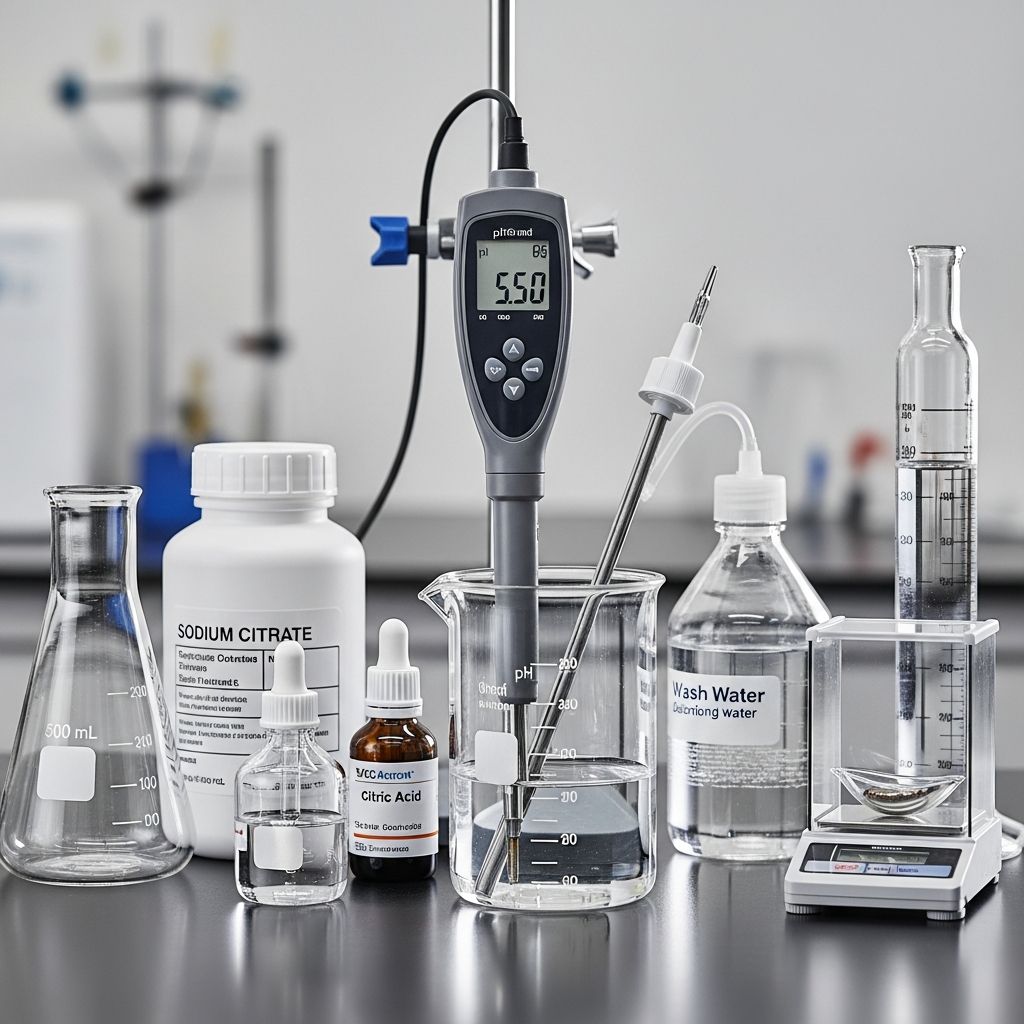
Sodium citrate buffer is a versatile solution widely used in laboratories to maintain stable pH levels between 3.0 and 6.2, making it essential for biological experiments, medical procedures, and analytical techniques.
Understanding Buffer Systems and Citrate’s Role
Buffers resist changes in pH when small amounts of acid or base are added, relying on the equilibrium between a weak acid and its conjugate base. Citric acid (C6H8O7), a triprotic weak acid with pKa values of 3.13, 4.76, and 6.40, pairs with sodium citrate to form effective buffers in the acidic to neutral range. This property stems from citrate’s ability to donate or accept protons, stabilizing reaction environments in sensitive assays.
In practice, the buffer’s pH is tuned by the ratio of citric acid to sodium citrate dihydrate, following the Henderson-Hasselbalch equation: pH = pKa + log([A-]/[HA]). For instance, equal molar concentrations near a pKa yield pH pKa.
Essential Components for Preparation
To create a standard 0.1 M citrate buffer, gather these high-purity reagents:
- Citric acid monohydrate (MW: 210.14 g/mol) the acidic component.
- Sodium citrate dihydrate (Na3C6H5O7 H2O, MW: 294.10 g/mol) provides the conjugate base.
- Distilled or deionized water to avoid ionic contaminants.
- 1 M HCl or 1 M NaOH for fine pH tuning.
- pH meter calibrated with standard buffers (pH 4.0, 7.0).
Alternative forms like trisodium citrate anhydrous (MW: 258.07 g/mol) can substitute, but adjust masses accordingly.
Step-by-Step Recipe for 1 L of 0.1 M Citrate Buffer (pH 3.0-6.2)
This scalable protocol yields a buffer stable for 3 months at room temperature.
- Measure 800 mL distilled water into a clean 2 L beaker.
- Add 25.703 g sodium citrate dihydrate (0.087 mol) while stirring with a magnetic stirrer.
- Incorporate 2.421 g citric acid (0.013 mol) slowly to prevent clumping.
- Stir until fully dissolved (10-15 minutes).
- Adjust pH to desired value (e.g., 6.0) using 1 M HCl (add dropwise) or NaOH. Monitor continuously as pH shifts rapidly near target.
- Top up to 1 L with distilled water.
- Filter sterilize through 0.22 m membrane if needed for sterile applications.
- Store in glass or polyethylene bottles at 4 C.
| pH Target | Citric Acid (g/L) | Sodium Citrate Dihydrate (g/L) |
|---|---|---|
| 3.0 | ~21.0 | ~2.5 |
| 4.0 | ~10.5 | ~14.8 |
| 5.0 | ~5.2 | ~21.0 |
| 6.0 | ~3.4 | ~24.3 |
| 6.2 | ~2.4 | ~25.7 |
Values approximate for 0.1 M total citrate; fine-tune empirically.
Specific Recipes for Common pH Values
pH 6.0 (0.1 M) Ideal for Antigen Retrieval
For 1 L: Dissolve 24.269 g sodium citrate dihydrate and 3.358 g citric acid in 800 mL water, adjust to pH 6.0 with 0.1 N HCl, then qs to 1 L. Commonly used with 0.05% Tween 20 for immunohistochemistry.
pH 4.74 (pKa2) Biochemical Assays
Prepare 100 mL: Weigh 2.94 g trisodium citrate dihydrate into 50 mL water, dissolve, titrate to pH 4.74 with 1 M HCl, transfer to volumetric flask, and dilute to 100 mL.
10 mM Sodium Citrate (pH 6.0) Low-Strength Variant
Dissolve 2.94 g trisodium citrate dihydrate in 1 L water, adjust pH with 1 M HCl. Stable 6 months at 4 C.
Applications in Research and Medicine
Citrate buffers excel in preventing RNA degradation by inhibiting RNase activity through base hydrolysis blockade. In immunohistochemistry, they retrieve antigens by reversing formalin-induced cross-links, enhancing antibody binding without background noise.
Clinically, citrate anticoagulation in dialysis leverages mild pH control to improve efficiency. It’s also key in immunofluorescence for optimal stain intensity and in pathology for tissue processing.
- RNA isolation and storage.
- Antigen unmasking in fixed tissues.
- Enzyme assays (e.g., pectinase at pH 4-5).
- Food science (chelation of metals).
Safety Protocols and Best Practices
Wear PPE: gloves, goggles, lab coat. Citric acid irritates skin/eyes; HCl is corrosive. Work in a fume hood for pH adjustments. Dispose as per lab hazardous waste guidelines.
Storage: Glass bottles at 4 C; verify pH before use as CO2 absorption can alter acidity. Shelf life: 3 months RT, 6 months refrigerated.
Troubleshooting Common Issues
| Problem | Cause | Solution |
|---|---|---|
| pH drifts during adjustment | CO2 contamination | Boil water, cool under vacuum; use fresh calibration |
| Precipitate forms | Temperature drop or impurity | Warm gently to 37 C; filter |
| Buffer capacity low | Incorrect ratio | Recalculate using Henderson-Hasselbalch; test with acid/base challenge |
| Microbial growth | Non-sterile | Autoclave or add 0.02% sodium azide |
Scaling and Customization
For smaller volumes, use the molarity slider principle: mass = (molarity volume in L MW). Software like Buffer Calculator apps aid precision. For high-throughput, prepare stock (1 M) and dilute.
Custom additives: 0.05% Tween 20 for permeabilization; 0.1% BSA for blocking.
Advanced Tips from Lab Experts
Calibrate pH meter daily with 3-point standards. Use analytical balance (0.0001 g precision). For pH <4, prefer glassware to avoid leaching. Test buffer capacity: add 0.1 mL 0.1 M HCl to 10 mL buffer; 9pH should be <0.1 unit.
Frequently Asked Questions (FAQs)
What is the shelf life of sodium citrate buffer?
Up to 3 months at room temperature or 6 months at 4 C if properly stored and sterile.
Can I use citric acid anhydrous instead?
Yes, adjust mass: 192.12 g/mol vs. 210.14 for monohydrate. Confirm purity >99%.
How do I adjust pH precisely?
Titrate slowly with micropipette; overshoot corrected with opposite base/acid.
Is this buffer autoclavable?
Yes, but recheck pH post-autoclaving as it may rise 0.2-0.5 units.
What’s the difference between citrate and phosphate buffers?
Citrate better for acidic pH and chelates metals; phosphate for neutral, but precipitates with divalent cations.
Conclusion
Mastering sodium citrate buffer preparation empowers reliable experiments across disciplines. Follow recipes diligently, prioritize safety, and validate performance for optimal results.
References
- Citrate Buffer (pH 3.0 to 6.2) Preparation and Recipe AAT Bioquest. Accessed 2026. https://www.aatbio.com/resources/buffer-preparations-and-recipes/citrate-buffer-ph-3-to-6-2
- Citrate Buffer (0.1 M, pH 6.0) Preparation and Recipe AAT Bioquest. Accessed 2026. https://www.aatbio.com/resources/buffer-preparations-and-recipes/citrate-buffer-ph-6
- Citrate Buffer (pH 3.0 to 6.2) Preparation and Recipe Novopro Labs. Accessed 2026. https://www.novoprolabs.com/tools/buffer-preparations-and-recipes/citrate-buffer-ph-3-0-to-6-2
- How to prepare 10 mM sodium citrate buffer? Bio-protocol. Accessed 2026. https://bio-protocol.org/exchange/questiondetail?number=491322506347544581
- Sodium Citrate Buffer The Open Lab Book. Accessed 2026. https://theolb.readthedocs.io/en/latest/buffers/sodium-citrate-buffer.html
- Preparing Sodium Citrate Buffer Solution YouTube (CHE 459 Biochemistry). Accessed 2026. https://www.youtube.com/watch?v=152uYiTg6Og
Similar Articles







Read full bio of Sneha Tete