The Foundations and Legacy of Racial Segregation in America
Exploring how systemic racial segregation shaped American society and its enduring consequences.
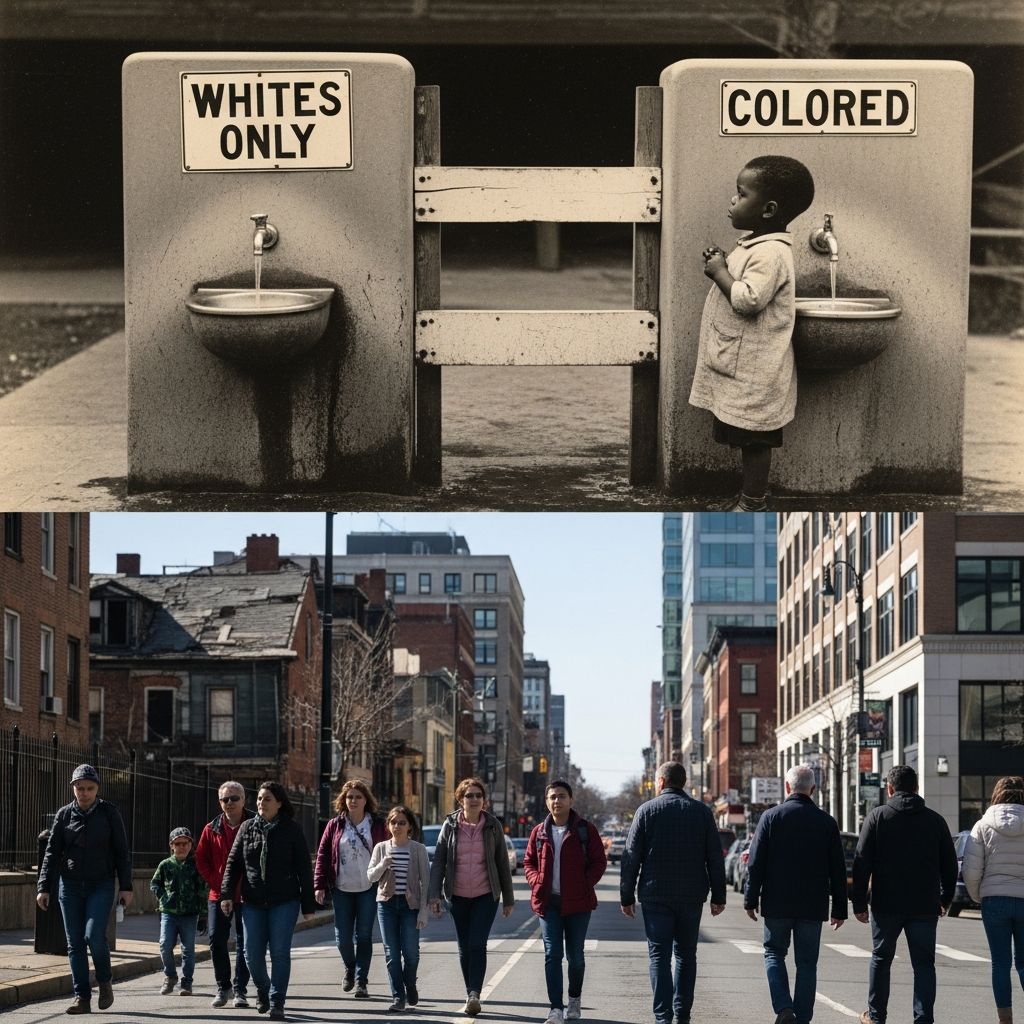
Understanding the Architecture of Racial Segregation in America
Racial segregation stands as one of the most consequential and damaging systems ever institutionalized within American society. Far from emerging naturally or through individual preferences, this separation of the races developed through deliberate governmental policies, corporate practices, and social mechanisms designed to subordinate African Americans while concentrating resources and opportunities within white communities. The evolution of segregation reveals how entire structures of inequality were built methodically, sustained legally, and only gradually dismantled through decades of resistance and reform.
The foundation of segregation rested on a fundamental premise: that African Americans were inherently inferior and therefore appropriately confined to separate, controlled spaces within the national geography and social hierarchy. This ideology, inherited from slavery and adapted for a supposedly free society, manifested across virtually every dimension of American life—from the neighborhoods where families could live to the schools where children received education, from transportation vehicles to hospitals and recreational facilities.
The Post-Civil War Genesis of Systemic Separation
The immediate aftermath of the Civil War and the abolition of slavery presented a critical juncture in American history. Rather than integrating formerly enslaved people as full participants in society, white lawmakers across the former Confederacy responded by creating new systems of legal restriction. Between the end of slavery and the Reconstruction era, states implemented Black Codes—statutes explicitly modeled on slavery law itself, which severely curtailed the freedoms that emancipation had supposedly granted.
These early restrictive measures targeted mobility and economic opportunity directly. Vagrancy laws criminalized unemployment or unemployment-like conditions, effectively recriminalizing poverty and converting poverty into a criminal offense. A particularly pernicious mechanism known as convict leasing allowed the state to arrest African American men on minor infractions, then lease their labor to private employers, creating what scholars have termed a system of re-enslavement. Through this apparatus, the South transformed its legal system into a tool for labor extraction and social control.
The Rise of Formal Jim Crow Legislation
The period from 1874 onward witnessed the proliferation of what became known as Jim Crow laws—a comprehensive body of statutes and local ordinances that persisted until 1975, establishing nearly a century of legally mandated racial separation. These laws did not emerge as spontaneous expressions of popular sentiment; rather, they represented organized governmental action to codify and enforce racial hierarchy.
The Jim Crow system operated on an ostensibly neutral principle: “separate but equal” facilities for the races. In practice, however, this doctrine masked profound inequality. The most essential services and spaces became subject to segregation mandates:
- Public education systems were divided entirely along racial lines, with Black schools receiving dramatically inferior funding and resources
- Public transportation—buses, trains, and waiting areas—maintained separate seating, with African Americans confined to rear sections and less desirable accommodations
- Municipal facilities including water fountains, restrooms, and swimming pools carried explicit “Colored Only” or “Whites Only” designations
- Restaurants and dining establishments segregated customers by race, often restricting African Americans to separate entrances or delivery windows
- Hotels, theaters, and recreational venues maintained exclusionary policies that prevented interracial gathering spaces
- Healthcare institutions operated segregated wards and facilities, extending racial separation even in moments of medical vulnerability
Religious institutions and cemeteries also became segregated, making racial separation a physical fact even in spaces devoted to spiritual community and final rest.
Legal Sanctioning and Constitutional Justification
A crucial turning point came in 1896 when the United States Supreme Court provided constitutional legitimacy to segregation. In Plessy v. Ferguson, the Court ruled that racial segregation did not violate the Fourteenth Amendment’s Equal Protection Clause, effectively blessing the “separate but equal” doctrine at the highest legal level. This decision transformed segregation from a regional custom into a constitutionally protected system, enabling its systematic expansion and entrenchment.
The Plessy decision proved consequential precisely because it offered federal judicial endorsement to what had previously been state and local practices. With Supreme Court approval, southern and border states intensified segregation legislation, while the decision’s logic was cited even in northern jurisdictions to justify segregated schools and public accommodations in states that had technically abolished slavery decades earlier.
Geographic Segregation and Housing Discrimination
While Jim Crow statutes governed public facilities, a parallel system of residential segregation was constructed through different mechanisms—mechanisms that proved exceptionally durable and consequential. Beginning in the early twentieth century, as millions of African Americans migrated from rural southern areas to industrial cities of the North and Midwest seeking economic opportunity, they encountered systematic barriers preventing them from accessing most residential neighborhoods.
Real estate and governmental actors deployed several interconnected tools to enforce residential segregation:
- Racially restrictive covenants were legal agreements embedded in property deeds prohibiting African Americans (and often other groups) from purchasing, leasing, or occupying homes in designated communities. These covenants remained enforceable in courts until the late 1940s and functioned as de jure segregation at the neighborhood level.
- Redlining practices by federal and private lenders systematically denied mortgages and capital to African American borrowers and to entire neighborhoods where Black families lived, starving these communities of investment while subsidizing suburban development for white residents.
- Zoning ordinances enacted by local governments restricted land use in ways that effectively excluded lower-income residents and people of color while protecting predominantly white areas from integrated development.
- Violence and intimidation by white property owners and organized groups made entry into white neighborhoods physically dangerous, enforcing segregation through threatened and actual harm.
These mechanisms worked synergistically to create what scholars call separate and unequal neighborhoods—racially distinct geographies with fundamentally different access to resources, services, and economic opportunity.
Educational Segregation and Its Profound Consequences
Among segregation’s most damaging manifestations was the deliberate creation of separate and vastly unequal educational systems for Black and white children. African American communities understood deeply that segregated schooling perpetuated inequality and limited their children’s futures. The educational disparity reflected broader patterns: schools serving Black students received minimal funding, outdated materials, less experienced teachers, and inferior physical facilities compared to white schools.
The Supreme Court’s reasoning in Plessy suggested that separate education could serve Black communities’ interests—a sophistry contradicted by the actual practices of segregated school systems. Resource allocation systematically privileged white schools, ensuring that the “separate but equal” promise remained entirely theoretical. This educational segregation had cascading effects throughout students’ lives, limiting academic achievement and restricting pathways to higher education and professional advancement.
The Mechanism of Disenfranchisement and Political Control
Complementing spatial and institutional segregation was the systematic removal of African Americans from political participation. After the Reconstruction era, southern states implemented voting restrictions that eliminated Black electoral power while maintaining the facade of democratic process. These mechanisms included:
- Poll taxes that required payment to vote, economically excluding most Black citizens living in poverty
- Literacy tests administered with deliberately discriminatory standards to disqualify Black voters while exempting white voters
- White primary systems that excluded Black voters from Democratic primary elections where real political decisions occurred
- Physical intimidation and electoral manipulation to discourage voting and invalidate Black votes
The combination of segregation, disenfranchisement, and violence created what one scholar termed a system of “official coercion and vigilante terror” lasting over fifty years. Without political power, African American communities could not challenge segregation through democratic means, entrench segregation through governance, or redirect public resources toward their own communities.
The Consequences of Segregation: Concentrated Disadvantage
Segregation produced not merely social separation but systematic economic disadvantage concentrated within particular geographies. Restrictive policies and discriminatory practices confined African Americans—for whom poverty rates already exceeded those of white populations—to specific urban neighborhoods, magnifying poverty concentration and creating areas of intense disadvantage.
When federal, state, and local governments responded to urban distress through urban renewal programs in the 1960s and 1970s, they frequently exacerbated these problems. Using eminent domain authority, cities demolished housing and businesses in predominantly Black neighborhoods, displacing families and communities. Residents relocated to newly constructed public housing often placed in isolated or undesirable areas, intensifying concentration of poverty and disadvantage rather than alleviating it.
The infrastructure investments of the federal government reinforced segregation. Transportation spending prioritized automobile access for predominantly white suburban residents while inner-city highway construction literally cut through established Black neighborhoods, creating physical barriers that separated communities from downtown employment centers and economic opportunities.
Resistance, Legal Challenge, and the Long Struggle for Equality
African American communities and their allies did not passively accept segregation. Beginning in 1909, the National Association for the Advancement of Colored People (NAACP) organized to challenge discrimination and segregation across multiple domains. The organization’s legal strategy initially focused on validating the “separate but equal” standard while documenting its systematic violation—proving that facilities for Black Americans were separate but manifestly unequal.
Under the leadership of Charles Hamilton Houston, a visionary attorney later known as the “man who killed Jim Crow,” the NAACP trained successive generations of lawyers, including Thurgood Marshall, to mount constitutional challenges to segregation in education, transportation, housing, and other domains. By mid-century, the organization’s efforts produced significant Supreme Court victories in 1950 that set the stage for a direct assault on Plessy itself.
These efforts culminated in legislative action during the civil rights movement. The Civil Rights Act of 1964 made segregation and discrimination in public accommodations illegal at the federal level, while the Voting Rights Act of 1965 restored electoral participation for African Americans through federal protection of voting rights and federal oversight of electoral practices in jurisdictions with histories of discrimination.
Legacies and Contemporary Continuities
Formal legal segregation ended during the 1960s, yet the architectural and economic consequences of segregation persist profoundly. Residential segregation that emerged from redlining, restrictive covenants, and discriminatory real estate practices continues to structure American metropolitan areas. The wealth disparities created through exclusion from homeownership in appreciating suburban neighborhoods perpetuate intergenerational inequality, as home equity remains the primary wealth-building mechanism for American families.
School segregation increased after the mid-1980s despite desegregation court orders, as residential segregation resegregated educational systems and court supervision ended. Neighborhoods that remain predominantly African American or Latino continue experiencing disproportionate poverty, inadequate municipal services, environmental degradation, and limited access to economic opportunity—consequences directly traceable to segregation-era policies.
FAQ Section
Q: What was the “separate but equal” doctrine, and why was it important?
A: The “separate but equal” doctrine emerged from the 1896 Supreme Court decision Plessy v. Ferguson, which ruled that racial segregation did not violate constitutional rights as long as facilities were theoretically equal. This doctrine provided constitutional legitimacy to segregation, though in practice segregated facilities for Black Americans were almost always inferior in quality, funding, and resources.
Q: How did residential segregation differ from Jim Crow laws?
A: Jim Crow laws were explicit statutes mandating segregation in public spaces. Residential segregation operated through private mechanisms (restrictive covenants, discriminatory lending), local zoning ordinances, and violence, creating geographically separated neighborhoods without always relying on explicit segregation statutes.
Q: What role did the federal government play in creating segregation?
A: Beyond Supreme Court decisions validating segregation, the federal government enforced redlining through the Home Owners’ Loan Corporation, invested transportation dollars in ways that reinforced segregation, and used urban renewal programs that displaced Black communities.
Q: When did segregation legally end?
A: Legal segregation was formally prohibited through the Civil Rights Act of 1964 and the Voting Rights Act of 1965. However, de facto segregation—segregation resulting from residential patterns and private discrimination—continues in many American communities.
Q: Why did segregation persist for so long?
A: Segregation persisted because it served the economic and political interests of white majorities by maintaining access to resources and opportunity while limiting Black competition. Legal, governmental, and private enforcement mechanisms worked together, and political disenfranchisement prevented Black communities from challenging segregation through democratic processes.
References
- Jim Crow Laws and Racial Segregation — Social Welfare History Project, Virginia Commonwealth University. Accessed April 2026. https://socialwelfare.library.vcu.edu/eras/civil-war-reconstruction/jim-crow-laws-andracial-segregation/
- Causes and Consequences of Separate and Unequal Neighborhoods — Urban Institute, Racial Equity Analytics Lab. https://www.urban.org/racial-equity-analytics-lab/structural-racism-explainer-collection/causes-and-consequences-separate-and-unequal-neighborhoods
- Segregation, Freedom’s Story, TeacherServe — National Humanities Center. https://nationalhumanitiescenter.org/tserve/freedom/1865-1917/essays/segregation.htm
- The Struggle Against Segregated Education — National Museum of African American History and Culture, Smithsonian Institution. https://nmaahc.si.edu/explore/stories/struggle-against-segregated-education
- A Century of Racial Segregation 1849–1950: Brown v. Board at Fifty — Library of Congress. https://www.loc.gov/exhibits/brown/brown-segregation.html
Similar Articles







Read full bio of medha deb