Understanding Regional Accreditation for Online Degree Programs
Learn what regional accreditation means and why it matters for your online education
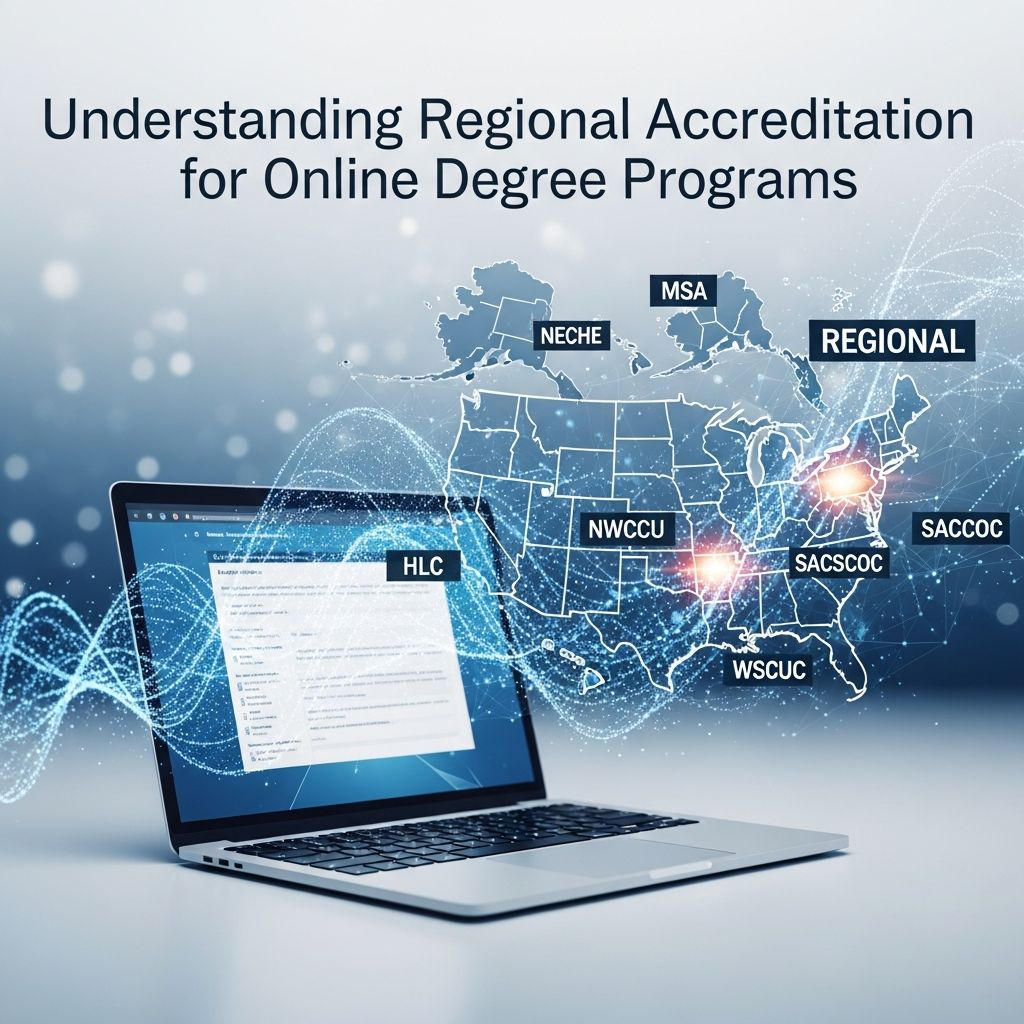
When evaluating online colleges, one of the most important factors to consider is accreditation status. Among the various forms of educational accreditation, regional accreditation stands out as a critical marker of institutional quality and credibility. This designation carries significant implications for students pursuing online degrees, affecting everything from eligibility for federal financial assistance to the transferability of earned credits and recognition by employers and graduate programs.
What Accreditation Means in Higher Education
Accreditation represents an evaluation process conducted by independent external organizations to verify that educational institutions meet established standards for academic quality and operational excellence. When a college or university undergoes accreditation review, authorized bodies assess multiple dimensions of institutional performance, including curriculum design, faculty qualifications, graduation rates, student retention, and overall institutional integrity. This rigorous evaluation process ensures that students receive education meeting recognized benchmarks for quality and rigor.
The accreditation system serves as a quality assurance mechanism, offering prospective students, employers, and policymakers confidence that an institution operates with academic integrity and delivers meaningful educational experiences. Without this external validation, it would be considerably more difficult for stakeholders to evaluate institutional quality objectively.
Defining Regional Accreditation
Regional accreditation represents the most widely respected form of institutional accreditation in the United States. This designation indicates that an entire institution—as opposed to individual programs—has met comprehensive quality standards established by a recognized regional accrediting body. Regional accreditors typically focus on evaluating schools at the institutional level rather than assessing specialized programs or departments.
Currently, the United States maintains seven regional accrediting agencies that are recognized by both the U.S. Department of Education and the Council for Higher Education Accreditation (CHEA). These agencies include:
- Accrediting Commission for Community and Junior Colleges (ACCJC)
- Higher Learning Commission (HLC)
- Middle States Commission on Higher Education (MSCHE)
- New England Commission of Higher Education (NECHE)
- Northwest Commission on Colleges and Universities (NWCCU)
- Southern Association of Colleges and Schools Commission on Colleges (SACSCOC)
- WASC Senior College and University Commission (WSCUC)
Each of these organizations oversees institutions within specific geographic regions, though recent policy changes have permitted some flexibility in regional accreditor jurisdiction. These agencies maintain directives available on their websites, allowing prospective students to verify institutional accreditation status and identify which schools operate under their authority.
Key Characteristics of Regionally Accredited Institutions
Regionally accredited schools typically exhibit several defining characteristics that distinguish them from other educational institutions. Most regionally accredited colleges and universities are nonprofit entities, including both public and private institutions. These organizations place primary emphasis on academic excellence and comprehensive educational experiences rather than vocational or specialized training alone.
Institutions holding regional accreditation must demonstrate commitment to continuous improvement, maintain high standards for faculty credentials, and show evidence of institutional integrity across administrative and academic operations. The accreditation process evaluates whether schools effectively fulfill their stated institutional missions and whether they possess the financial and operational capacity to sustain quality education.
The Regional Accreditation Process
Acquiring regional accreditation involves a structured, multi-phase process that typically extends over several years. Colleges begin by attending pre-applicant workshops conducted by their target regional accrediting body, during which institutional leaders learn about specific requirements and expectations. Following this preparation phase, the institution submits its formal application along with appropriate fees.
Once an application is submitted, the accrediting agency’s committee conducts a candidacy visit to evaluate whether the institution meets preliminary standards. The committee subsequently submits recommendations to the accrediting body’s board, which conducts additional reviews and votes on the accreditation decision. The entire process from application submission through accreditation approval can extend four years or longer.
After receiving initial accreditation, institutions must undergo subsequent on-site reviews within a 48-month window, with initial accreditation status remaining valid for five years. This cyclical review process ensures that accredited institutions maintain compliance with established standards on an ongoing basis.
Why Regional Accreditation Matters for Online Students
Regional accreditation carries substantial significance for students pursuing online degrees. The benefits extend across multiple dimensions of the educational experience and subsequent career development.
Federal Financial Aid Eligibility
One of the most consequential advantages of attending a regionally accredited institution is eligibility for federal financial aid programs. Students enrolled at regionally accredited colleges qualify for federal grants and student loans, providing access to funding sources unavailable to students at non-accredited or differently accredited institutions. This financial access can substantially reduce the burden of educational expenses and increase educational opportunity for students with limited personal resources.
Credit Transferability
Credits earned through regionally accredited institutions demonstrate significantly higher transferability when students change institutions or pursue advanced degrees. Other regionally accredited colleges typically accept transfer credits more readily from peer institutions, recognizing that they meet comparable quality standards. This transferability is particularly valuable for students who may transition between institutions during their educational journey or who later pursue graduate education.
In contrast, credits from nationally accredited or non-accredited institutions frequently encounter barriers to acceptance at regionally accredited schools, potentially forcing students to repeat coursework despite previous completion.
Employer and Graduate School Recognition
Employers and graduate programs generally accord greater recognition and respect to degrees from regionally accredited institutions. Many employers prefer or explicitly require degrees from regionally accredited colleges, particularly for positions requiring professional credentials or advanced qualifications. Similarly, graduate schools typically prioritize applicants holding degrees from regionally accredited undergraduate institutions, viewing them as meeting established educational quality standards.
Program Quality Assurance
Regional accreditation signifies that an institution provides education aligned with national quality standards. The rigorous evaluation process underlying accreditation designation confirms that the school maintains appropriate curriculum standards, employs qualified faculty, and implements effective student support services. For online students, this assurance is particularly important since they cannot rely on traditional campus observations to evaluate institutional quality.
Regional Accreditation Versus National Accreditation
While both regional and national accreditation represent legitimate forms of institutional recognition, they differ substantially in scope, standards, and implications for students. Understanding these distinctions helps prospective students make informed decisions about institutional choice.
| Dimension | Regional Accreditation | National Accreditation |
|---|---|---|
| Rigor Level | Considered more rigorous and comprehensive | May be less rigorous or more narrowly focused |
| Typical Institutions | Nonprofit, academically-focused colleges and universities | For-profit institutions, vocational and technical schools |
| Credit Transferability | Widely accepted among regionally accredited schools | May not transfer to regionally accredited institutions |
| Employer Recognition | Broadly accepted across industries and professions | May not be accepted by some employers or licensing boards |
| Graduate School Acceptance | Generally accepted by graduate programs | May face acceptance limitations |
Regional accreditors typically apply more comprehensive evaluation standards and focus on institutions’ overall academic quality and mission fulfillment. National accreditors, by contrast, frequently serve for-profit and career-focused institutions, with evaluation standards that may be more specialized or narrowly defined.
It is important to note that regulatory changes in 2019 modified accreditation rules to permit regional accreditors to serve institutions outside their traditional geographic boundaries, reducing the strict geographic demarcation that previously existed. However, this flexibility does not alter the fundamental distinction between the two accreditation types regarding standards rigor and widespread institutional recognition.
Online Program Accreditation Standards
Regional accreditors maintain specific requirements for institutions offering online programs. The Southern Association of Colleges and Schools Commission on Colleges (SACSCOC), for example, requires that institutions assure student achievement and satisfaction levels are equivalent between online and on-campus courses. The Accrediting Commission for Community and Junior Colleges (ACCJC) mandates that online programs be substantially equivalent to corresponding on-campus offerings.
These standards ensure that online students receive education quality comparable to traditional campus-based students, addressing legitimate concerns about whether online delivery might compromise educational rigor. By requiring equivalency between modalities, regional accreditors protect online students’ interests while supporting institutional flexibility in pedagogical delivery.
Verifying Regional Accreditation Status
Prospective students should independently verify an institution’s accreditation status rather than relying solely on institutional claims. Each regional accrediting agency maintains a directory of accredited institutions on its website, providing a reliable resource for verification. Additionally, the Accredited Institutions of Postsecondary Education (AIPE) publication, available through the American Council on Education, contains comprehensive accreditation information updated annually.
When researching online colleges, students should confirm not only that an institution holds accreditation, but also that it maintains accreditation from one of the seven recognized regional agencies rather than from a national accreditor. This distinction significantly impacts the educational and professional benefits the degree will provide.
Frequently Asked Questions
Can I transfer credits from a nationally accredited college to a regionally accredited university?
Credit transfer from nationally accredited to regionally accredited institutions is not guaranteed and frequently encounters acceptance barriers. Each regionally accredited institution makes independent decisions regarding transfer credit acceptance. However, credits from nationally accredited institutions are generally accepted less readily than credits from peer regionally accredited institutions. Students should consult directly with their target institution’s admissions office regarding specific transfer policies.
Are online degrees from regionally accredited colleges recognized by employers?
Degrees from regionally accredited institutions, whether earned through online or traditional on-campus formats, receive employer recognition. The format of delivery does not diminish the credential’s value when the institution holds proper regional accreditation. Employers recognize that regional accreditation signifies quality education standards regardless of instructional delivery method.
Do all online colleges hold regional accreditation?
No. Regionally accredited online colleges remain less common than traditional campus-based programs, though an increasing number of established institutions now offer primarily or entirely online degree options. Some online-exclusive institutions hold national accreditation rather than regional accreditation. Prospective students must verify individual institutional accreditation status rather than assuming online colleges are regionally accredited.
How long does the regional accreditation process take?
The timeline from initial application through accreditation approval typically spans four years or longer, depending on the specific regional accrediting body and institutional circumstances. After receiving accreditation, institutions undergo periodic reviews to maintain their status.
Conclusion: Making Informed Decisions About Regional Accreditation
Regional accreditation represents a crucial indicator of educational quality and institutional credibility that significantly impacts students’ educational experiences and professional opportunities. For online students, regional accreditation status determines access to federal financial aid, the ease of credit transfer, recognition by employers and graduate programs, and assurance of academic quality. By understanding what regional accreditation signifies and why it matters, prospective online students can make more informed choices about institutional selection, ultimately supporting their long-term educational and career success.
References
- Regional vs National Accreditation – Colleges — eLearners.com. Accessed 2026. https://www.elearners.com/colleges/regional-accreditation-vs-national-accreditation/
- Regionally Accredited Online Colleges: What You Need to Know — Tiffin University. Accessed 2026. https://go.tiffin.edu/blog/regionally-accredited-online-colleges-what-you-need-to-know/
- What Is Regional Accreditation? — Accredited Schools Online. Accessed 2026. https://www.accreditedschoolsonline.org/accreditation/regional/
- What Is College Accreditation? How Does It Work? — Best Colleges. Accessed 2026. https://www.bestcolleges.com/blog/accreditation/
- Accreditation Guide — Accredited Online Colleges. Accessed 2026. https://www.accreditedonlinecolleges.org/guide/
- What Does Regional Accreditation Mean — California Commission on Teacher Credentialing. Accessed 2026. https://www.ctc.ca.gov/credentials/what-does-regional-accreditation-mean
Similar Articles








Read full bio of Sneha Tete