Secrets of Intergalactic Space
Discover the hidden wonders, gases, dark matter, and rogue stars filling the vast voids between galaxies.
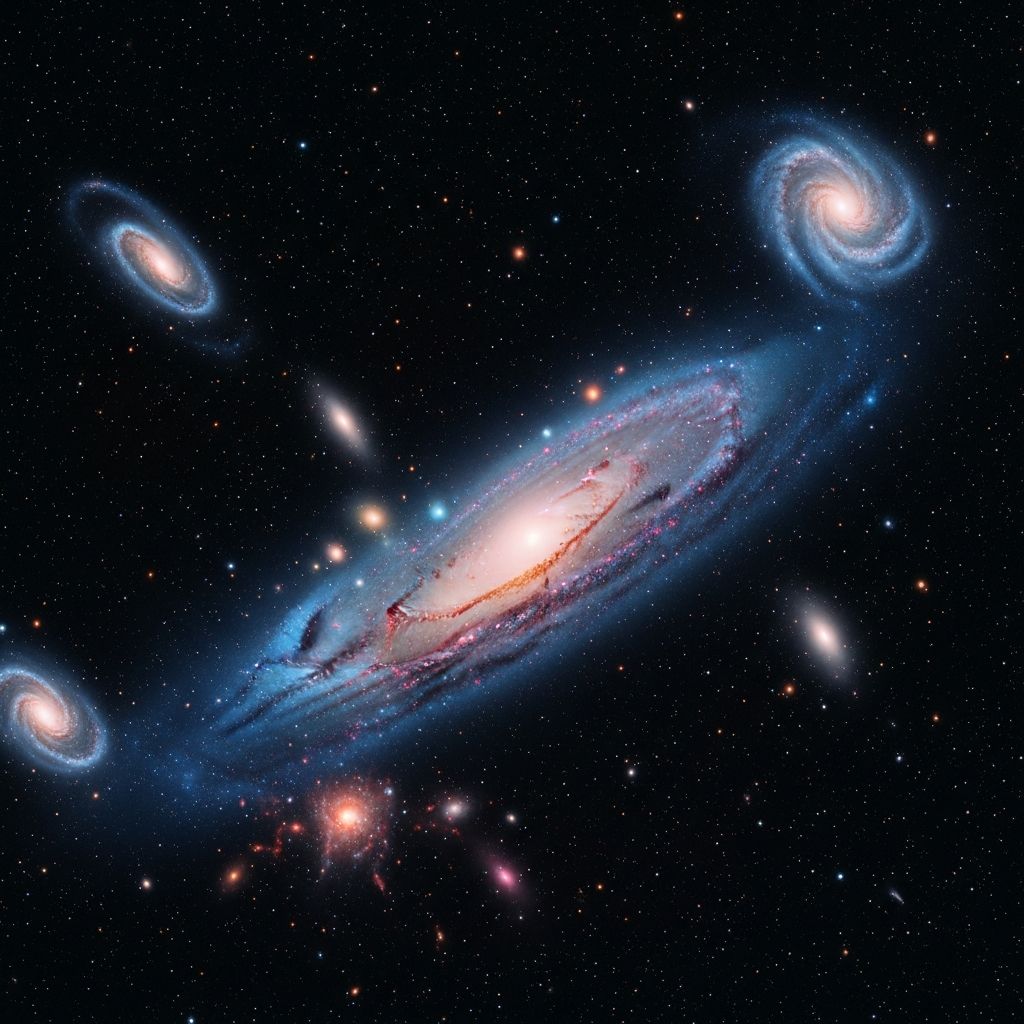
The universe extends far beyond the glowing clusters of stars we call galaxies. Between these cosmic islands lies intergalactic space, a realm that appears empty but teems with invisible forces and matter that dictate the cosmos’s architecture. Far from a barren void, this expanse holds the intergalactic medium, dark matter scaffolds, and even wayward celestial bodies.
Defining the Intergalactic Realm
Intergalactic space refers to the enormous regions separating galaxies, distinct from the denser interstellar spaces within them. For instance, the journey from the Milky Way to Andromeda spans 2.5 million light-years of this territory, filled not with nothingness but with diffuse plasma and structures. Densities here drop to less than one atom per cubic meter, yet across cosmic scales, this rarity accumulates to represent 50-80% of ordinary baryonic matter.
This medium, primarily ionized hydrogen with traces of helium and heavier elements like carbon and oxygen, originates from the Big Bang’s aftermath. Heated to millions of degrees by gravitational collapse and early universe events, it permeates the cosmos, influencing galaxy formation and evolution.
The Cosmic Web: Filaments Binding the Universe
Galaxies do not float in isolation; they align along a monumental network dubbed the cosmic web. This structure comprises vast filaments—tunnel-like formations of gas and dark matter—stretching hundreds of millions of light-years. Galaxies cluster at nodes where these threads intersect, resembling beads on invisible strings.
Observations of distant quasars reveal these filaments through absorption lines in their light spectra, where hydrogen atoms imprint signatures as light passes through. Simulations confirm galaxies connect via these gas-filled corridors, with voids—expansive empty zones—separating them. The Local Void, nearest to us, exemplifies these underdense regions.
- Filament Composition: Hot ionized gas, dark matter halos, magnetic fields.
- Scale: Largest known structures, dwarfing galaxy clusters.
- Detection Methods: Quasar absorption spectroscopy, X-ray emissions from heated gas.
This web emerged from primordial density fluctuations amplified by gravity post-Big Bang, channeling matter into denser regions while voids expanded.
Dark Matter: The Unseen Architect
Comprising about 27% of the universe’s mass-energy, dark matter forms the gravitational backbone of intergalactic space. Invisible to light, its effects manifest in galaxy rotation curves, gravitational lensing, and the clumping that forms the cosmic web.
Without dark matter’s pull, galaxies would disperse due to rotational speeds. It clusters along filaments, creating potential wells where baryonic matter condenses into stars and galaxies. Recent studies map its distribution via weak lensing, confirming halos extending far beyond visible disks.
| Component | Percentage of Universe | Role in Intergalactic Space |
|---|---|---|
| Dark Matter | 27% | Forms scaffolds for cosmic web, holds filaments together. |
| Baryonic Matter (IGM) | 5-10% | Fills filaments, precursor to galaxy formation. |
| Dark Energy | 68% | Drives void expansion. |
Unveiling the Intergalactic Medium
The IGM dominates ordinary matter between galaxies, existing as a plasma at temperatures exceeding 10^6 Kelvin. Its low density belies immense total mass, potentially harboring much of the ‘missing’ baryons unaccounted for in galaxies.
X-ray telescopes detect its glow from bremsstrahlung radiation, where electrons decelerate in ion collisions. Heavier elements, forged in stars and ejected via supernovae or active galactic nuclei, pollute this medium, altering its cooling and star formation potential.
Filaments within the IGM serve as fuel highways, feeding gas into galaxies and clusters. Feedback from supermassive black holes heats this gas, regulating star birth rates across cosmic history.
Wandering Stars and Rogue Bodies
Not all intergalactic denizens are diffuse; rogue stars, ejected from galaxies, roam freely. These intergalactic stars, also called intracluster or tidal dwarfs, arise from mergers where gravitational slingshots hurl them outward.
During collisions, supermassive black hole mergers or dense cluster interactions strip stars loose. A 2015 study linked intergalactic supernovae to such events in elliptical galaxy pairs. Rogue planets and star clusters may accompany them, drifting at high velocities through voids.
Though numbering perhaps quadrillions universe-wide—small relative to galaxy totals—they hint at dynamic histories. Simulations of mergers show stars flung at speeds exceeding escape velocities.
- Sources of Ejection: Galaxy collisions, black hole encounters, three-body interactions.
- Detection: Planetary nebulae surveys, supernova light curves in voids.
- Implications: Contribute to intergalactic light backgrounds, possible isolated stellar nurseries.
Observational Windows into the Void
Probing intergalactic space demands indirect methods. Lyman-alpha forest—absorption lines from neutral hydrogen along quasar sightlines—maps IGM structure. Chandra and XMM-Newton X-ray observatories image hot gas in filaments and clusters.
Gravitational lensing distorts background light, revealing dark matter distributions. Future telescopes like the James Webb Space Telescope and Extremely Large Telescope will peer deeper, potentially spotting rogue stars via their faint glows.
Cosmological Implications and Future Mysteries
Intergalactic space encodes the universe’s expansion history. Baryon acoustic oscillations in the IGM preserve sound wave imprints from the recombination era, aiding distance measurements. Dark matter’s role in structure formation underpins Lambda-CDM models.
Challenges persist: exact IGM metal enrichment, rogue population sizes, void dynamics. Upcoming missions like Euclid satellite will map billions of galaxies, refining cosmic web models.
Speculatively, isolated rogue systems could host exotic life, though isolation poses survival hurdles. These wanderers expand our view of stellar fates beyond galactic confines.
Frequently Asked Questions (FAQs)
How dense is intergalactic space?
Typically less than one atom per cubic meter, vastly emptier than interstellar space but totaling significant mass over volume.
What holds the cosmic web together?
Dark matter’s gravity along filaments, with baryonic gas providing visible tracers.
Are there stars outside galaxies?
Yes, rogue stars ejected by mergers populate intergalactic regions, detectable via specialized surveys.
How do we detect the IGM?
Through quasar absorption spectra, X-ray emissions, and lensing effects on background sources.
What fills cosmic voids?
Even lower-density IGM, minimal dark matter, and expanding space driven by dark energy.
References
- What Lies Between Galaxies? Unveiling the Mysteries of Intergalactic Space — Vocal Media. 2023. https://vocal.media/futurism/what-lies-between-galaxies-unveiling-the-mysteries-of-intergalactic-space
- This Is What’s Hiding Between Galaxies – Intergalactic Medium — YouTube (Anton Petrov). 2023-10-15. https://www.youtube.com/watch?v=9KIZAJYPYqY
- What is Intergalactic Space? — Universe Today. 2022-05-12. https://www.universetoday.com/articles/intergalactic-space
- What Happens in Intergalactic Space? — Live Science. 2018-11-20. https://www.livescience.com/65978-what-happens-in-intergalactic-space.html
- What Lies Between Galaxies? Ejected Stars, Rogue Planets — YouTube (John Michael Godier). 2022. https://www.youtube.com/watch?v=mgZqBiJtRZ4
- Are there stars in the space between galaxies? — Cloudy Nights Forum. 2013-03-24. https://www.cloudynights.com/topic/412202-are-there-stars-in-the-space-between-galaxies/
- Intergalactic star — Wikipedia (citing peer-reviewed sources). 2023-08-15. https://en.wikipedia.org/wiki/Intergalactic_star
Similar Articles








Read full bio of Sneha Tete