Three Centuries of Names: St. Petersburg’s Evolving Identity
Explore how geopolitics, revolution, and history shaped a city's identity through three distinct names across 300 years.
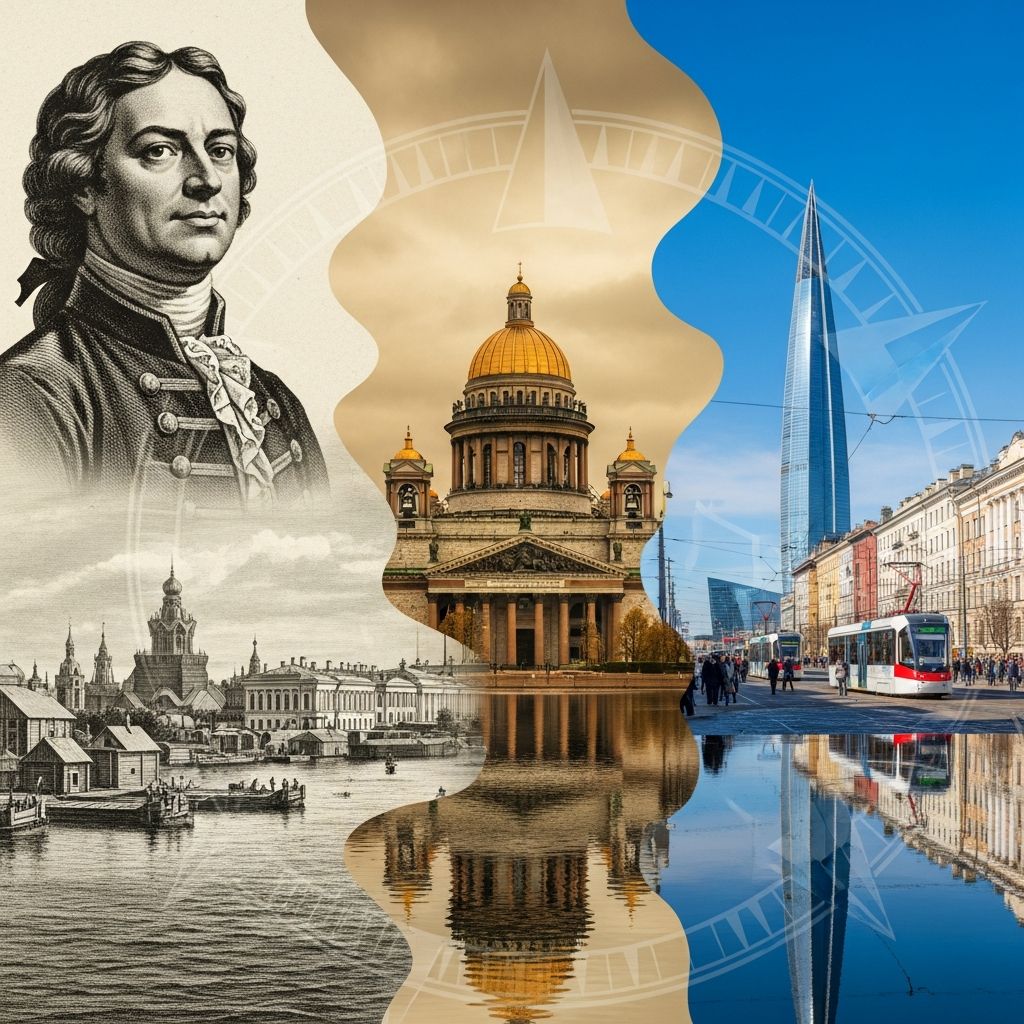
A City Born from Imperial Vision
Few cities in the world have undergone as many significant name changes as St. Petersburg, Russia’s most culturally sophisticated urban center. Founded in 1703 by Peter the Great on the banks of the Neva River, the city was christened with a name honoring Saint Peter, one of Jesus Christ’s twelve apostles. This Dutch-influenced name reflected Peter the Great’s European aspirations and his desire to transform Russia into a modern, Western-oriented power. For more than two centuries, the city retained this original designation, becoming one of Europe’s most magnificent capitals and the seat of the Russian imperial government.
During its formative years, St. Petersburg flourished as both a political and cultural hub. The royal family relocated from Moscow to this new city in 1710, cementing its status as the nation’s primary center of power. Throughout the 18th and 19th centuries, under the rule of subsequent tsars and tsarinas, particularly Catherine the Great, the city acquired its legendary architecture, including the Winter Palace, the Hermitage, and countless palaces and monuments. Poets and artists of the era bestowed upon it the romantic epithet “Northern Palmyra,” comparing its architectural splendor to the ancient Syrian city of Palmyra. This period solidified St. Petersburg’s reputation as a beacon of enlightenment, culture, and imperial grandeur.
Petrograd: When Nationalism Trumped Heritage
The onset of World War I catalyzed the first official transformation of the city’s identity. On August 18, 1914—merely weeks after Austria-Hungary declared war on Serbia and tensions escalated across Europe—Emperor Nicholas II issued a supreme decree that fundamentally altered how the world would know Russia’s greatest city. The decision to rename St. Petersburg to Petrograd reflected far more than mere administrative change; it represented a dramatic pivot in Russian national sentiment during wartime.
The impetus for this renaming emerged from the widespread anti-German fervor sweeping through Russian society as the conflict intensified. Many Russian citizens perceived the original name’s Dutch-Germanic roots as culturally incompatible with their nation’s interests during a war against the German Empire. The Czech community residing in St. Petersburg formally proposed the change through the newspaper Birzhevye Vedomosti on July 31, 1914, arguing that a more authentically Russian name would better reflect the city’s importance and the Russian people’s patriotic values. They invoked historical precedent, referencing 18th and 19th-century Russian intellectuals and leaders who had advocated for a less foreign-sounding designation for the nation’s capital.
Interestingly, initial official responses to the proposal were lukewarm. However, within three weeks, the tide had shifted dramatically. Emperor Nicholas II, responding to mounting patriotic pressure and recognizing the symbolic value of such a change during wartime, authorized the transformation. Government circles initially regarded this renaming as a temporary military measure, expecting the city to resume its historical name once peace was restored. This assumption would prove profoundly mistaken, as subsequent political upheavals would prevent any such restoration.
The popular response to the change was decidedly mixed. While newspapers from August 20 to September 4, 1914, published glowing articles celebrating the new designation and reporting enthusiastic reactions among residents, contemporary accounts acknowledge significant ambivalence, particularly among the educated classes who cherished the city’s historical continuity. The timing of the announcement, coinciding with Russia’s first major military defeats in East Prussia, may have dampened public enthusiasm. Nonetheless, the die was cast. Petrograd it would be for the next decade, and under this name the city would experience revolutionary upheaval that would fundamentally alter the course of world history.
Petrograd’s Revolutionary Crucible
The years immediately following the renaming witnessed extraordinary political turbulence that eclipsed any temporary wartime measure. Petrograd became the epicenter of revolutionary ferment in Russia. In 1917, the city was the birthplace of two seismic revolutions that toppled the tsarist regime and subsequently, within months, overthrew the provisional government that succeeded it. The February Revolution of 1917 marked the beginning of the end for imperial Russia, while the October Revolution of the same year inaugurated the Soviet era. Petrograd’s streets, squares, and palaces became the stage for these historic transformations, and the city’s name became inextricably linked with revolutionary struggle and communist ideology.
From 1918 onwards, Petrograd assumed a different role within the new Soviet state. Although Moscow reclaimed the status of capital, Petrograd remained a vital cultural and industrial center. During this period, the city witnessed significant institutional development: the establishment of Lenfilm, one of Russia’s most important film studios; the opening of Dom Knigi, a legendary bookstore; and the founding of Vsemirnaya Literatura, a prestigious publishing house. These institutions reflected Petrograd’s continuing importance to Soviet cultural production even as political power migrated to Moscow.
Leningrad: Honoring the Revolution’s Architect
The second major renaming occurred in 1924, when the city underwent another transformation that would define it for the next 67 years. Following Vladimir Lenin’s death on January 21, 1924, the Petrograd Soviet formally petitioned the II All-Union Congress of Soviets of the USSR to rename the city in honor of the deceased revolutionary leader. On January 26, 1924, merely five days after Lenin’s passing, the congress approved this request, and Petrograd officially became Leningrad. This change represented not merely a symbolic gesture of mourning but a deliberate attempt to eternalize Lenin’s legacy within the nation’s geography and collective consciousness.
Unlike the previous renaming, which many had expected to be temporary, the change to Leningrad proved permanent for nearly seven decades. The city adopted this designation at a pivotal moment in Soviet history, just as Stalin was consolidating power and the NEP (New Economic Policy) was yielding to rapid industrialization and collectivization. Leningrad, the city named for the revolution’s founder, became central to Soviet propaganda and national identity, representing the triumph of Bolshevism and the construction of socialism.
Leningrad Under Siege and Beyond
Leningrad’s darkest hour came during World War II, when Nazi Germany launched Operation Barbarossa in 1941. The city endured a catastrophic siege lasting 900 days—from September 1941 to January 1944—during which approximately one million residents perished, primarily from starvation. This devastating period, known as the Great Patriotic War in Russian historical terminology, forged Leningrad’s identity as a symbol of Soviet resilience and sacrifice. The city’s inhabitants demonstrated extraordinary courage in the face of inhuman suffering, and survivors carried immense pride in their city’s name and legacy. For many who lived through the blockade, Leningrad remained spiritually their city even after political circumstances changed.
The Cold War period further solidified Leningrad’s significance as the Soviet Union’s cultural and scientific capital. The city produced important scientific research, maintained vibrant artistic traditions, and served as a symbol of Soviet achievement and continuity with revolutionary ideals. Leningrad’s identity became inseparable from Soviet socialism itself.
The Restoration of Historical Identity
The collapse of the Soviet Union in 1991 created unprecedented conditions for reimagining Russian national identity and symbolism. As the USSR disintegrated and the Russian Federation emerged as its successor state, Leningrad’s residents faced a momentous question: should their city retain the name of Lenin, the Soviet system’s founder, or restore its pre-revolutionary designation? This question transcended mere nomenclature; it represented competing visions of Russia’s past, present, and future.
On June 12, 1991, the Leningrad City Council organized a referendum to permit residents to decide the city’s name directly. The ballot presented citizens with a clear choice regarding whether to restore the historical name Saint Petersburg. The question generated significant debate, as many long-time residents, particularly those who had survived the siege and the Soviet period, possessed deep emotional attachments to the name Leningrad. However, supporters of restoration emphasized historical continuity, cultural heritage, and the opportunity to reconnect with pre-revolutionary traditions as Russia itself underwent radical transformation.
The referendum produced a decisive result: 54 percent of voters supported renaming the city back to Saint Petersburg. This narrow but clear majority reflected the complex and sometimes contradictory impulses within Russian society at that transitional moment. On September 6, 1991, the Presidium of the Supreme Soviet of the RSFSR officially decreed that Leningrad would resume its original name, Saint Petersburg. The circle, as contemporary observers noted, had been completed: the city that had been Saint Petersburg, then Petrograd, then Leningrad, once again became Saint Petersburg.
Comparing the Three Names: A Historical Table
| Name | Period | Primary Reason for Change | Duration (Years) |
|---|---|---|---|
| Saint Petersburg | 1703-1914 | Original name honoring Saint Peter; reflects Peter the Great’s European vision | 211 |
| Petrograd | 1914-1924 | Anti-German sentiment during World War I; nationalist sentiment | 10 |
| Leningrad | 1924-1991 | Commemoration of Lenin following his death; Soviet ideological commitment | 67 |
| Saint Petersburg | 1991-Present | Soviet Union’s collapse; restoration of historical identity; popular referendum | 35+ |
The Broader Significance of Naming
The successive transformations of this city’s name illuminate profound truths about how political systems, nationalist ideologies, and historical circumstances shape urban identity. Each renaming was not arbitrary but rather reflected the dominant political and social forces of its era. The first renaming responded to wartime nationalism; the second embodied revolutionary transformation and the establishment of communist governance. The final restoration represented the end of an ideological system and the search for historical continuity in a dramatically altered geopolitical landscape.
Saint Petersburg today stands as one of Russia’s most important cultural, scientific, and economic centers, second only to Moscow in significance. The city’s history of name changes has become part of its distinctive identity, testimony to the tumultuous 20th-century Russian experience and the broader European history in which Russia has always been deeply embedded. Understanding these transformations provides insight not only into Russian history but into how cities, symbols, and names function within the larger narrative of national identity and political change.
Frequently Asked Questions
Q: Why was Saint Petersburg renamed to Petrograd in 1914?
A: The renaming occurred due to intense anti-German sentiment following the outbreak of World War I. The original name, derived from Dutch and potentially sounding Germanic, was perceived as inappropriate for Russia’s capital during wartime. Emperor Nicholas II issued the decree in August 1914 in response to public pressure and patriotic fervor.
Q: How long was the city called Petrograd?
A: Petrograd was the official name for exactly ten years, from August 1914 until January 1924. Despite being intended as a temporary wartime measure, the subsequent Bolshevik Revolution and the establishment of Soviet government prevented restoration of the historical name.
Q: What prompted the change from Petrograd to Leningrad in 1924?
A: Following Vladimir Lenin’s death on January 21, 1924, the Petrograd Soviet petitioned the II All-Union Congress of Soviets to rename the city in Lenin’s honor. The congress approved this request on January 26, 1924, reflecting the Soviet system’s desire to commemorate its revolutionary founder and integrate his legacy into the nation’s geography.
Q: Why did residents have mixed feelings about the original renaming to Petrograd?
A: Many educated and cultured Leningraders valued the city’s three-century historical continuity and its association with Peter the Great and imperial achievements. Additionally, the renaming coincided with Russia’s military defeats in World War I, which may have dampened enthusiasm for the change despite patriotic arguments supporting it.
Q: How did the 1991 referendum determine the city’s name?
A: On June 12, 1991, Leningrad residents voted on whether to restore the historical name Saint Petersburg. The referendum passed with 54 percent in favor of the change. The narrow majority reflected competing attachments: some citizens, particularly siege survivors, had deep emotional connections to the Leningrad name, while others emphasized historical continuity and cultural heritage.
Q: Is Saint Petersburg still sometimes called Leningrad by older residents?
A: Yes, many residents who lived through the Soviet period and survived the devastating 900-day siege during World War II retain strong emotional attachments to the name Leningrad. For these individuals, who endured extraordinary hardship under that name, Saint Petersburg may feel culturally or emotionally distant despite the official designation.
References
- St. Petersburg was renamed as Petrograd — Presidential Library of Russia. Accessed 2026. https://www.prlib.ru/en/history/1983280
- When was St Petersburg changed to Leningrad? — St. Pete Private Tours. 2024-12-04. https://www.stpeteprivatetours.com/blog/when-was-st-petersburg-changed-to-leningrad
- The Five Names of St. Petersburg — ITMO.news. Accessed 2026. https://news.itmo.ru/en/features/experience_saint_petersburg/news/12166/
- St. Petersburg Through The Ages — St. Petersburg Official History Portal. Accessed 2026. https://forumspb.com/en/o-sankt-peterburge/history/
Similar Articles








Read full bio of medha deb