The Long March: China’s Epic Retreat
Discover the harrowing 1934-1935 journey that saved the Chinese Communist Party and propelled Mao Zedong to power.
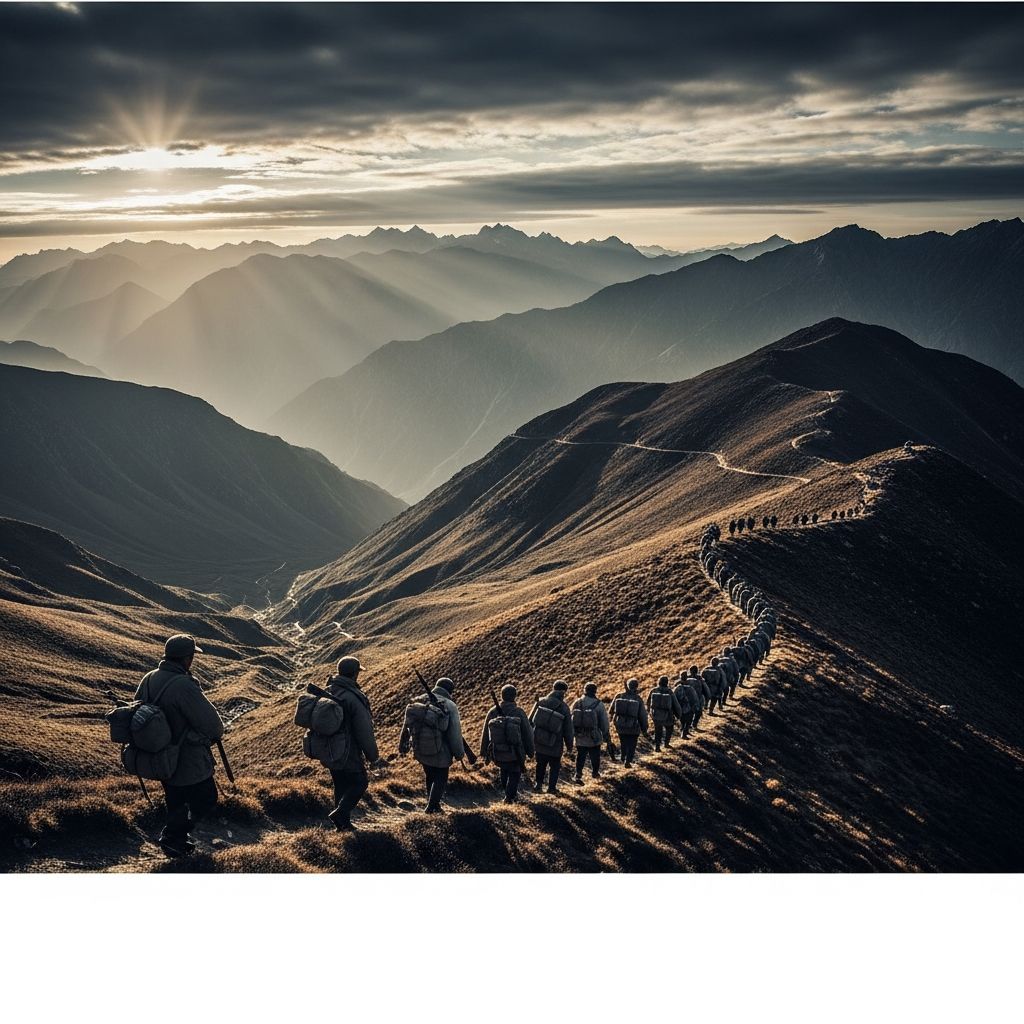
The Long March: China’s Epic Retreat and Revolutionary Turning Point
The Long March stands as one of the most extraordinary feats in modern military and revolutionary history. Between October 1934 and October 1935, the Chinese Red Army, under the banner of the Chinese Communist Party (CCP), undertook a desperate retreat from their besieged bases in southern China to the remote northwest. Facing relentless pursuit by Nationalist Kuomintang (KMT) forces, the march covered approximately 10,000 kilometers across 11 provinces, involving treacherous mountains, raging rivers, and constant combat. What began as a strategic withdrawal transformed into a legend that reshaped China’s political landscape, elevating Mao Zedong to supreme leadership and instilling unbreakable resolve in the survivors.
Origins of the Crisis: The Jiangxi Soviet Under Siege
In the early 1930s, the CCP had established the Jiangxi Soviet as a revolutionary base in southeastern China. This rural enclave served as a hub for land redistribution, peasant mobilization, and guerrilla warfare against the KMT government led by Chiang Kai-shek. By 1934, however, Nationalist encirclement campaigns had tightened around the Soviet. Five major blockades, supported by German advisors and modern weaponry, choked supply lines and decimated Communist forces. Internal leadership disputes exacerbated the peril: a troika of Bo Gu, Zhou Enlai, and Comintern advisor Otto Braun favored conventional positional warfare, which proved disastrous against the superior KMT army.
With over 700,000 Nationalist troops closing in, the CCP Politburo ordered a breakout. Around 86,000 to 100,000 soldiers, party cadres, and supporters—organized into four columns—evacuated the Jiangxi base on October 16, 1934. They carried minimal supplies, expecting a short maneuver. Reality quickly shattered this illusion as pursuits intensified, airstrikes hammered their positions, and defections mounted amid starvation and exhaustion.
The Harrowing Path: Terrain, Battles, and Survival Challenges
The route was a gauntlet of natural and human obstacles. Marchers traversed 18 mountain ranges, forded 24 major rivers, and navigated swamps and grasslands. Daily treks averaged 50 kilometers, often under sandals woven from grass. Every 72 hours brought combat against pursuing forces numbering in the hundreds of thousands.
- Snowy Mountains (Jiajin Range): At altitudes over 4,000 meters, freezing winds and thin air claimed countless lives. Soldiers discarded weapons to lighten loads, huddling together for warmth.
- Grasslands of Sichuan: Vast, waterlogged plains swallowed men and equipment; dehydration and disease ravaged the ranks.
- Tatu River Crossing: One of the march’s pivotal moments, where a small cadre scaled sheer cliffs to capture a suspension bridge, averting potential annihilation. Historical precedents, like the Taiping Rebellion’s defeat nearby, underscored the stakes.
Of the initial force, only about 8,000 reached the destination at Yan’an in Shaanxi province—a 90% attrition rate from battle, starvation, execution, and desertion. Women and children comprised a portion of the marchers, enduring equal hardships while contributing to logistics and morale.
Leadership Shift at Zunyi: Mao’s Ascendancy
A defining political event occurred at the Zunyi Conference in January 1935, midway through the march. Early disasters—such as the loss of 40,000 troops in failed engagements—vindicated Mao Zedong’s advocacy for mobile guerrilla tactics over rigid fronts. Previously sidelined since 1932, Mao critiqued the Comintern-influenced strategies during the conference.
Delegates elected him to the Standing Committee and de facto military command, with Zhou Enlai’s support. This pivot marked Mao’s irreversible rise, displacing Bo Gu and Braun. By journey’s end, Mao controlled the CCP and key army units, setting the stage for his dominance.
Building Mass Support: Discipline and Peasant Alliances
Beyond survival, the Long March was a masterclass in revolutionary mobilization. Adhering to the “Three Rules of Discipline and Eight Points for Attention”—codified in 1928—the Red Army contrasted sharply with KMT brutality. Rules emphasized respecting peasants: no unauthorized takings, return borrowed items, pay fairly, and speak politely.
| Three Rules of Discipline | Eight Points for Attention (Selected) |
|---|---|
| 1. Obey orders promptly | 1. Speak politely |
| 2. Do not take from the masses | 2. Pay fairly for purchases |
| 3. Turn over captured items | 3. Return borrowed items |
| 4. Pay for damages | |
| 5. Do not bathe in peasant wells |
These principles won hearts among peasants, ethnic minorities, youth, and women, transforming the retreat into a seeding of revolutionary fervor across provinces. The march “massified” the party, embedding it in China’s interior.
Strategic Outcomes: From Retreat to Revolution
Arrival in Yan’an provided respite. The isolated northwest base allowed recuperation, army rebuilding, and peasant goodwill cultivation. Psychologically, survivors embodied the “Yan’an spirit”: unyielding struggle, sacrifice, and optimism. Mao called it a “manifesto” and “seeding machine,” predicting future harvests of support.
Politically, it enabled the Second United Front against Japanese invasion (1937-1945), uniting nationalists and communists. The CCP’s reputation soared, aiding victory in the 1946-1949 civil war phase. Myths of the march became foundational to CCP lore, though some historians note embellishments in official narratives.
Enduring Legacy: Lessons for Revolution and Nation-Building
Ninety years on, the Long March symbolizes resilience. It galvanized CCP commitment, proving willpower could triumph over odds. For Mao, it birthed his cult, influencing policies until 1976. Globally, it inspires movements, echoing in anti-imperialist struggles.
In China, it’s mythologized as the “founding epic,” with sites like Zunyi and Luding Bridge as pilgrimages. Critically, it highlights guerrilla warfare’s efficacy and mass-line politics’ power. Casualties—20 million Chinese in the anti-Japanese war—underscore the broader context.
Frequently Asked Questions (FAQs)
What was the distance and duration of the Long March?
The march spanned about 10,000 km over one year, from October 1934 to October 1935, across diverse terrains.
How many survived the Long March?
From 86,000-100,000 starters, roughly 8,000 reached Yan’an.
Why is the Zunyi Conference significant?
It marked Mao Zedong’s rise to leadership, shifting to guerrilla strategies.
What role did peasants play?
Strict discipline won peasant support, enabling survival and expansion.
Did the Long March lead to Communist victory?
Yes, it preserved the CCP, built bases, and paved the way for 1949 triumph.
References
- The Long March: 90 years on and its lessons for our struggles today — Peoples Dispatch. 2024-10-28. https://peoplesdispatch.org/2024/10/28/the-long-march-90-years-on-and-its-lessons-for-our-struggles-today/
- The Significance of the Long March — History Made Easier. N/A. https://historymadeeasier.com/the-significance-of-the-long-march/
- Long March — Wikipedia. N/A. https://en.wikipedia.org/wiki/Long_March
- Mao’s Long March — EBSCO Research Starters. N/A. https://www.ebsco.com/research-starters/history/maos-long-march
- The Long March (1934-1936) — Asia for Educators, Columbia University. N/A. https://afe.easia.columbia.edu/special/china_1900_mao_march.htm
- INSIDE THE LONG MARCH, MODERN CHINA’S FOUNDING MYTH — History Guild. N/A. https://historyguild.org/the-25000-li-journey-inside-the-long-march-modern-chinas-founding-myth/
- The Long March — IU ScholarWorks. N/A. https://scholarworks.iu.edu/journals/index.php/iusburj/article/download/19910/25993/44148
Similar Articles







Read full bio of Sneha Tete