Exploring the Three Main Rock Types
Discover igneous, sedimentary, and metamorphic rocks: their formation, traits, examples, and roles in Earth's dynamic geology.
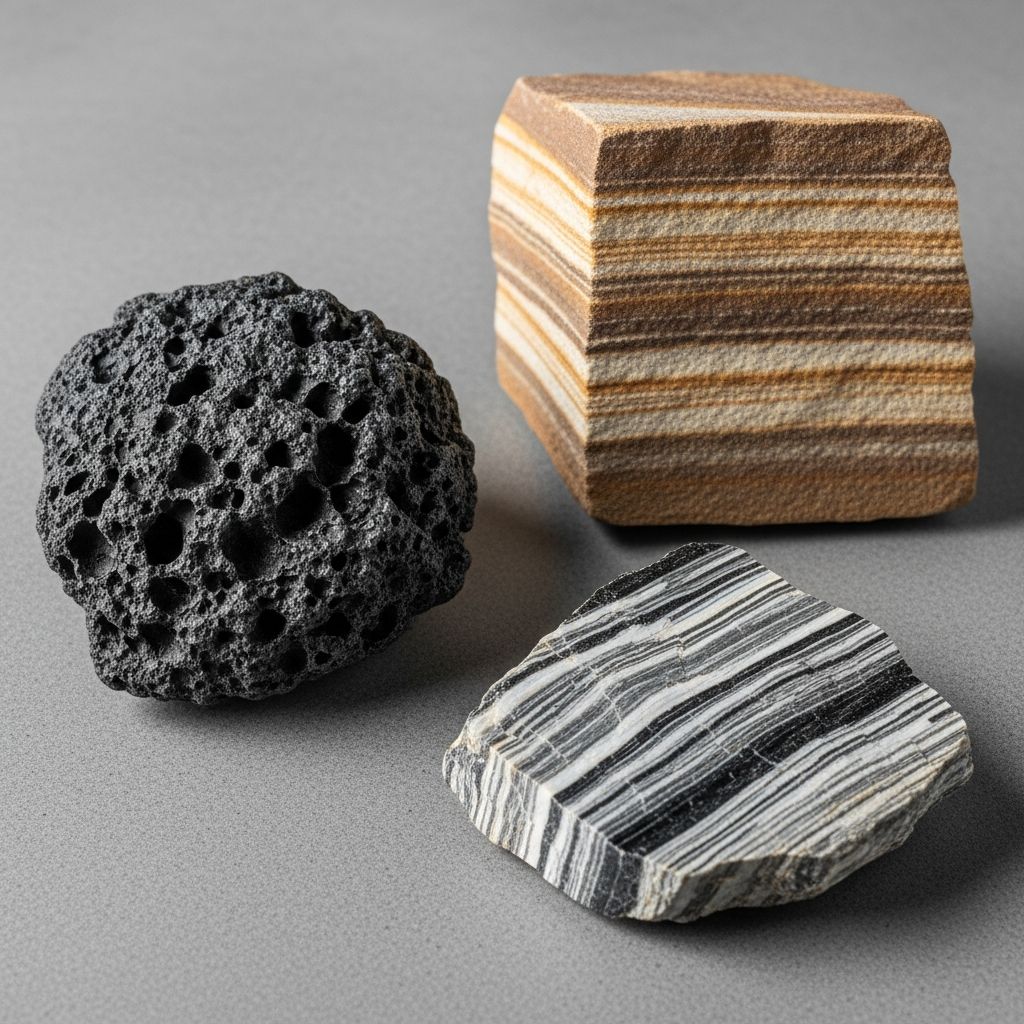
Rocks form the foundation of Earth’s crust, categorized into three primary groups based on their origin: igneous, sedimentary, and metamorphic. Each type arises through distinct geological processes involving heat, pressure, and material deposition.
Understanding Rock Formation Basics
A rock is a solid aggregate of minerals or mineral-like materials. Classification hinges on formation methods rather than mineral content alone. Igneous rocks crystallize from molten material, sedimentary rocks accumulate from eroded particles, and metamorphic rocks transform under intense conditions.
The
rock cycle
illustrates how these types interconvert. Igneous rocks erode into sediments that compact into sedimentary rocks, which can melt into magma or metamorphose. This continuous process shapes landscapes over millions of years.Igneous Rocks: Born from Fire
Igneous rocks originate from cooled and solidified magma or lava. Magma, molten rock beneath the surface, or lava, erupted material, cools to form crystals. Rapid cooling yields fine grains; slow cooling produces larger ones.
Key characteristics include interlocking crystals and absence of fossils. Color varies with composition: dark mafic rocks rich in iron and magnesium, light felsic rocks high in silica.
Extrusive Igneous Rocks
Extrusive rocks form when lava cools quickly on Earth’s surface. Fine-grained textures result from rapid solidification.
- Basalt: Dark, dense, mafic rock with low silica. Common in ocean floors and shield volcanoes.
- Andesite: Intermediate composition, lighter than basalt, contains quartz and feldspars.
- Rhyolite: Felsic, light-colored, high silica; fine-grained equivalent of granite.
- Obsidian: Glassy texture from ultra-rapid cooling, sharp-edged volcanic glass.
Intrusive Igneous Rocks
Intrusive rocks cool slowly underground, forming coarse crystals visible to the naked eye.
- Granite: Coarse-grained, felsic; quartz, feldspar dominant. Forms batholiths.
- Diorite: Intermediate, plagioclase, amphibole, pyroxene.
- Gabbro: Mafic counterpart to basalt, pyroxene, olivine, plagioclase.
Texture table for igneous rocks:
| Type | Cooling Rate | Grain Size | Examples |
|---|---|---|---|
| Extrusive | Fast | Fine/Aphanitic | Basalt, Rhyolite |
| Intrusive | Slow | Coarse/Phaneritic | Granite, Gabbro |
Sedimentary Rocks: Layers of History
Sedimentary rocks form from accumulated sediments—fragments of pre-existing rocks, minerals, or organic remains—compacted and cemented over time. They cover 75% of Earth’s surface despite comprising only 5% of crust volume.
Characteristics: Layered (stratified), often contain fossils, softer than igneous or metamorphic rocks. Form in water bodies, deserts, or glacial environments.
Clastic Sedimentary Rocks
Composed of rock fragments sorted by size: clay (<1/16 mm), sand (1/16-2 mm), gravel (>2 mm).
- Conglomerate: Rounded gravel cemented together.
- Sandstone: Sand grains, porous, used in construction.
- Shale: Clay-sized particles, splits into thin layers.
- Breccia: Angular fragments.
Chemical and Organic Sedimentary Rocks
Chemical rocks precipitate from solutions; organic from biological remains.
- Limestone: Calcium carbonate, often from shells; effervesces in acid.
- Evaporites: Halite, gypsum from evaporated water.
- Coal: Compressed plant matter.
Sedimentary environments table:
| Environment | Rock Type | Examples |
|---|---|---|
| Rivers/Beaches | Clastic | Sandstone, Conglomerate |
| Deep Ocean | Chemical/Organic | Chalk, Limestone |
| Evaporating Basins | Chemical | Rock Salt |
Metamorphic Rocks: Transformed by Pressure and Heat
Metamorphic rocks result from pre-existing rocks altered by heat, pressure, or fluids without melting. Changes affect texture, mineralogy, and structure.
Traits: Often harder, foliated (layered) or non-foliated. Foliation aligns minerals under directed pressure.
Foliated Metamorphic Rocks
- Slate: Fine-grained from shale; dense, brittle, used for roofing.
- Phyllite: Shiny sheen from slate; silky texture.
- Schist: Medium grains, mica flakes; splits along planes.
- Gneiss: Banded, high-grade; quartz/feldspar light bands, mafic dark.
Non-Foliated Metamorphic Rocks
- Marble: From limestone; recrystallized calcite, prized for sculpture.
- Quartzite: From sandstone; glassy, hard, resists erosion.
Metamorphic grade increases with temperature/pressure:
| Low Grade | Medium | High Grade |
|---|---|---|
| Slate | Schist | Gneiss |
Key Characteristics for Rock Identification
Identify rocks using: color (mineral influence), streak (powder color), luster (shine), hardness (Mohs scale), cleavage (fracture planes).
- Igneous: Crystalline, no layers/fossils.
- Sedimentary: Layered, fossils, softer.
- Metamorphic: Foliated/hardened, distorted fossils.
The Rock Cycle in Action
Earth’s rocks transform endlessly: weathering breaks them into sediment, burial compacts to sedimentary, heat/pressure metamorphoses, melting reforms igneous. Plate tectonics drives this via subduction, volcanism.
Practical Applications and Significance
Igneous: Building (granite), countertops. Sedimentary: Oil reservoirs (sandstone), limestone cement. Metamorphic: Marble flooring, slate tiles. Study reveals Earth’s history, resources.
Frequently Asked Questions (FAQs)
What are the three main types of rocks?
Igneous (from magma/lava), sedimentary (from sediments), metamorphic (altered by heat/pressure).
How do igneous rocks differ from others?
They cool from molten state, featuring interlocking crystals without fossils or layers.
Why are sedimentary rocks important for fossils?
Formed in low-energy environments preserving organisms.
What causes foliation in metamorphic rocks?
Directed pressure aligns minerals into bands.
Can rocks change types?
Yes, via the rock cycle through erosion, burial, melting.
References
- What Are The 5 Characteristics Of A Rock — Declan’s Mining Co. 2023-05-15. https://www.declansminingco.com/blogs/declans-blog/what-are-the-5-characteristics-of-a-rock
- Glad You Asked: Igneous, Sedimentary, & Metamorphic Rocks — Utah Geological Survey. 2024-01-10. https://geology.utah.gov/map-pub/survey-notes/glad-you-asked/igneous-sedimentary-metamorphic-rocks/
- Igneous Rocks – Geology — U.S. National Park Service. 2025-03-20. https://www.nps.gov/subjects/geology/igneous.htm
- 3 Types of Rock: Igneous, Sedimentary & Metamorphic — American Museum of Natural History. 2023-11-05. https://www.amnh.org/explore/ology/earth/if-rocks-could-talk2/three-types-of-rock
- Rocks and Their Types — Sternberg Museum of Natural History. 2024-02-14. https://sternberg.fhsu.edu/research-collections/geology/rock-page.html
- Rock | Definition, Characteristics, Formation, Cycle, Classification — Britannica. 2025-09-01. https://www.britannica.com/science/rock-geology
- Rocks and minerals — British Geological Survey. 2024-07-22. https://www.bgs.ac.uk/discovering-geology/rocks-and-minerals/
Similar Articles






Read full bio of medha deb