Trance Dance: Spiritual Healing Across Cultures
Discover how rhythmic movement bridges physical and spiritual realms for healing and transformation.
Understanding Trance Dance as a Transformative Practice
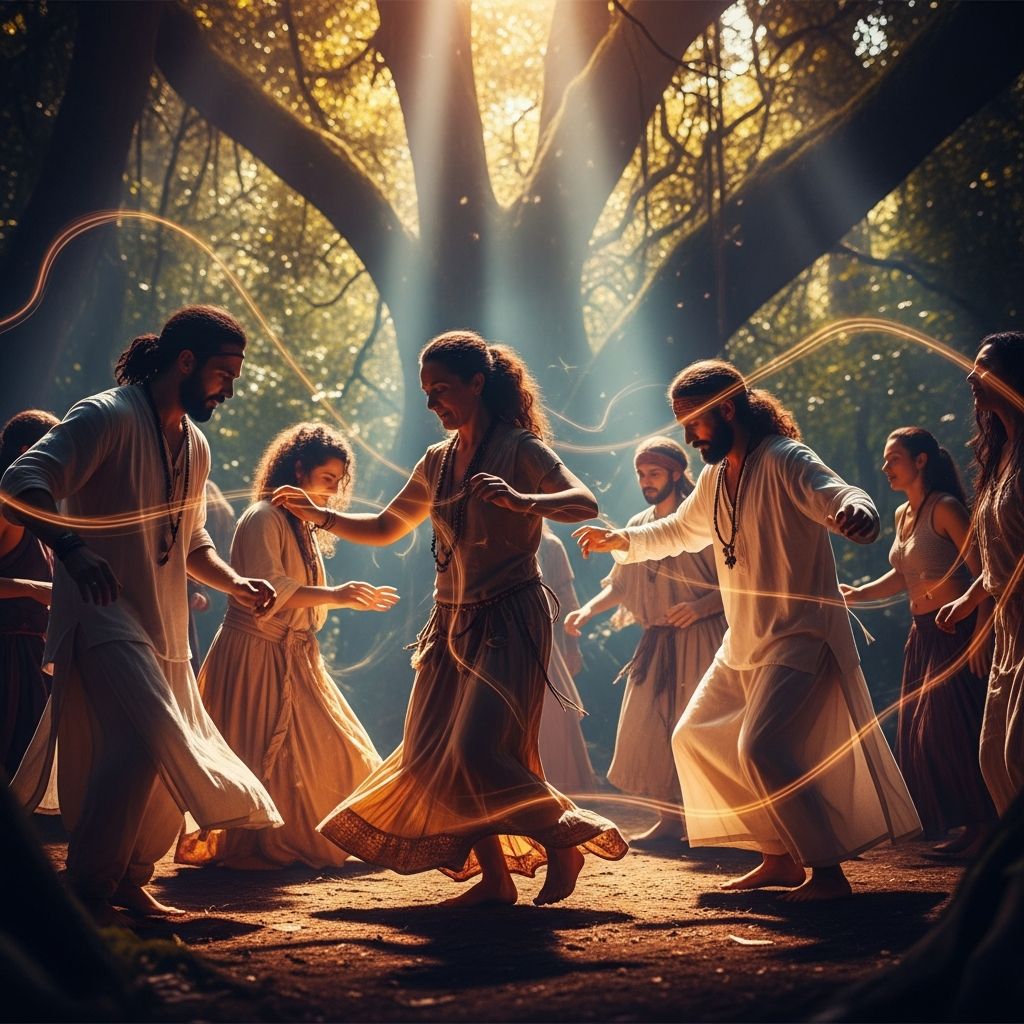
Throughout human history, movement has served as a powerful conduit for spiritual connection and healing. One of the most profound expressions of this phenomenon is trance dance, an ancient practice that transcends geographical boundaries and cultural distinctions. This ritualistic form of movement represents far more than physical activity—it embodies a comprehensive system of spiritual engagement that enables practitioners to access altered states of consciousness and facilitate personal transformation.
Trance dance fundamentally operates on the principle that rhythmic movement, combined with auditory stimulation and focused intention, can create gateways to non-ordinary consciousness. Participants engage in sustained, repetitive movement patterns that gradually lead to a state of deep absorption, often described as a merger between individual consciousness and collective spiritual energy. This process is neither random nor uncontrolled; rather, it represents a carefully calibrated approach to spiritual exploration that has been refined over millennia across diverse cultural contexts.
Global Origins and Historical Development
Archaeological and ethnographic evidence suggests that trance dance practices extend back at least 40,000 years, making them among humanity’s oldest documented spiritual technologies. Indigenous cultures worldwide independently developed similar approaches to accessing trance states, suggesting that these practices address fundamental aspects of human consciousness and spirituality that transcend cultural boundaries.
The San people of southern Africa represent one of the most extensively documented practitioners of trance dance traditions. Within San culture, the trance dance evolved as a central mechanism for maintaining spiritual equilibrium and community cohesion. Historical accounts describe these rituals as communal events where dancers would move throughout the night, guided by the rhythmic accompaniment of drums, singing, and hand clapping. The most experienced dancers—typically shamans or designated healers—would eventually enter profound trance states, facilitating communication with the spirit realm on behalf of the entire community.
Beyond Africa, trance dance emerged as a significant practice in numerous cultures across the globe. The Siberian shamans developed sophisticated trance dancing methodologies as part of their healing traditions, while indigenous North American peoples including the Navajo, Sioux, and Inuit incorporated trance dance into their spiritual ceremonies. The Sufi Dervishes of the Middle East became renowned for their whirling movements as a form of moving meditation, while Cuban Santería practitioners and Brazilian Umbanda traditions blended African, European, and indigenous American influences into their unique expressions of trance dance ritual.
Physiological and Psychological Mechanisms
The transition into trance states during dance involves specific physiological responses that have attracted increasing scientific attention. The repetitive, rhythmic movements characteristic of trance dancing stimulate the nervous system in particular ways, creating conditions for dissociation from ordinary conscious awareness. This dissociative state—sometimes described in psychological literature as a non-ordinary state of consciousness—allows practitioners to bypass habitual thought patterns and access deeper layers of awareness.
The process typically unfolds through progressive stages. Initial vigorous movement generates physiological arousal and increased cardiovascular activity. As the dancer continues moving to the beat, sustained muscular engagement combined with synchronized breathing patterns eventually induces a shift in neural activity. This shift facilitates the emergence of trance consciousness, characterized by diminished self-reflective awareness and heightened receptivity to intuitive and spiritual experiences.
Interestingly, participants report that this altered state does not represent a loss of control but rather a transition toward a different mode of consciousness. Dancers describe experiences of merging with protective spiritual entities, often called “Ayami” in shamanic traditions, through which suppressed emotions surface for processing and healing. This framework suggests that trance states provide access to psychological material that remains inaccessible during ordinary consciousness.
Multifaceted Purposes and Applications
While spiritual connection represents one primary function of trance dance, these practices serve numerous interconnected purposes within their communities of origin:
- Healing and Wellness: Shamans and healers utilize trance dance to address physical ailments, emotional wounds, and spiritual imbalances. The San tradition specifically employs trance dance as a healing modality for both individual practitioners and entire communities.
- Soul Retrieval: Many shamanic traditions understand trance dance as a mechanism for recovering fragmented aspects of consciousness that have become separated due to trauma or loss.
- Spiritual Communication: Trance dancing facilitates direct communication with ancestors, spirit guides, and divine forces, enabling practitioners to receive guidance, wisdom, and blessings for their communities.
- Environmental Stewardship: Certain traditions, particularly among the San, employed trance dance to petition for rain during drought periods, demonstrating the practice’s connection to ecological concerns.
- Social Cohesion: The communal nature of trance dancing strengthens group bonds, reinforces shared cultural values, and creates collective experiences that unify diverse individuals around common spiritual purposes.
- Rites of Passage: Many cultures incorporated trance dance into initiation ceremonies, using the altered states to facilitate psychological and spiritual maturation.
Ceremonial Structure and Ritual Components
Trance dance rituals typically follow established ceremonial frameworks that optimize conditions for deep spiritual work. In Northern Thai traditions, for example, practitioners organize elaborate preparatory ceremonies that may span multiple days. The initial phase, called the “Day of Preparation,” involves creating sacred space through construction of specially designed pavilions and preparation of ritual offerings.
The architectural elements themselves carry symbolic significance. Traditional Northern Thai pavilions incorporate specific numerical relationships—6 central posts representing the six senses, 32 posts symbolizing the 32 parts of the human body, and 24 posts honoring Buddhist spiritual history. This symbolic architecture creates a structured container within which practitioners can safely explore non-ordinary consciousness.
Musical accompaniment plays an equally crucial role in trance induction. Traditional instruments provide rhythmic patterns that gradually synchronize with the dancers’ heartbeats and breathing, creating a unified field of resonance. The San traditionally employed drums, hand clapping, and vocal patterns, while other cultures incorporated their indigenous instruments—gamelan orchestras in Southeast Asia, frame drums in Middle Eastern traditions, and various percussion instruments across African practices.
The progression from preparation through active dancing follows predictable stages. Initial movement tends to be relatively slow and deliberate, gradually accelerating as physiological arousal builds. Experienced practitioners recognize the threshold at which ordinary consciousness begins dissolving, allowing the deeper wisdom of trance consciousness to emerge.
Cultural Expressions and Regional Variations
While fundamental principles unite trance dance traditions globally, distinct cultural contexts have generated unique expressions and emphases:
| Cultural Tradition | Geographic Region | Key Characteristics | Primary Purpose |
|---|---|---|---|
| San Trance Dance | Southern Africa | Circle formation, fire-centered, nocturnal, rhythmic hand clapping and singing | Healing, spirit communication, environmental petition |
| Siberian Shamanism | Northern Asia | Drum-driven induction, costume and regalia, ecstatic movement | Soul retrieval, community healing, ancestor communication |
| Sufi Whirling | Middle East | Spinning rotation, meditative pace, formal movement patterns | Spiritual union, devotional practice, transcendence |
| Cuban Santería | Caribbean | Orisha-specific choreography, possession-based, polyrhythmic music | Divine communion, healing possession, ritual invocation |
| Brazilian Umbanda | South America | Catholic and African fusion, possession trance, communal participation | Healing through possession, spiritual integration |
| Northern Thai Ritual | Southeast Asia | Pavilion-centered, ancestor-focused, contract-based engagement | Ancestral veneration, community blessing, ceremonial obligation |
The Spiritual Framework Underlying Trance Practice
Across diverse cultural expressions, trance dance operates within a consistent spiritual cosmology. Practitioners understand reality as comprising multiple dimensions—a visible physical realm and an invisible spiritual realm—with shamans and trained dancers serving as intermediaries between these worlds.
This worldview understands consciousness not as confined to individual human minds but as a vast field of awareness distributed throughout existence. Trance dance provides a technology for expanding individual consciousness to encompass this larger field, facilitating direct experience of spiritual dimensions that ordinary perception cannot access.
The spiritual entities encountered during trance—variously described as spirit guides, ancestors, protective forces, or divine intelligences—are understood as real presences offering guidance, healing, and wisdom. Rather than dismissing these experiences as psychological projections, traditional practitioners engage them as authentic spiritual realities. The emotional intensity and healing impact of these encounters supports practitioners’ conviction that genuine spiritual contact occurs during trance states.
Contemporary Applications and Modern Adaptation
While trance dance originated in traditional shamanic contexts, contemporary practitioners have adapted these practices for modern spiritual seekers. Urban centers including Brussels and other European cities have developed trance dance communities that maintain the essential mechanisms of traditional practices while contextualizing them for contemporary participants who may lack connection to indigenous traditions.
Modern practitioners emphasize that trance dance remains accessible to anyone regardless of background or prior experience. Unlike many spiritual practices requiring years of training, trance dance operates on the principle that the individual’s inner wisdom and spiritual essence inherently knows how to move once ordinary consciousness relaxes its habitual constraints. This democratization has expanded trance dance’s reach while raising questions about maintaining the practice’s integrity when separated from its original cultural and spiritual contexts.
Physical and Psychological Healing Dimensions
Contemporary research and practitioner testimonies document multiple healing dimensions of trance dance engagement. At the emotional level, the altered state facilitates access to suppressed feelings and traumas that resist processing through ordinary consciousness. The intense physical movement provides a healthy outlet for emotional release while the altered state enables psychological integration of previously overwhelming experiences.
At the physical level, sustained rhythmic movement generates cardiovascular benefits, muscular engagement, and improved proprioceptive awareness. The stress-reducing aspects of deep trance states promote parasympathetic nervous system activation, facilitating relaxation responses that support overall physiological health.
Spiritually and mentally, practitioners report expanded perspectives, enhanced intuitive capacity, and profound insights into personal and collective dimensions of existence. The experience of transcending ordinary consciousness often catalyzes reevaluation of life priorities and deepened engagement with spiritual dimensions of human experience.
Frequently Asked Questions
Q: Is trance dance safe for beginners?
A: Yes, trance dance is generally considered safe when practiced in supportive, structured environments with experienced facilitators. Practitioners should maintain awareness of physical limitations and ensure adequate hydration. The practice typically proceeds at each individual’s natural pace.
Q: How is trance dance different from regular dancing?
A: Regular dance typically follows predetermined choreography with external focus on entertainment or aesthetic expression, while trance dance emphasizes internal experience, altered consciousness, and spiritual connection. There are no “correct” movements in trance dance; the body moves intuitively in response to rhythmic music and inner guidance.
Q: Can trance dance address specific health conditions?
A: Trance dance complements conventional medical treatment by facilitating emotional release, stress reduction, and psychological integration. However, it should not replace professional medical care for specific health conditions. Many practitioners use it as part of comprehensive wellness approaches.
Q: How long does it take to enter a trance state?
A: The time varies considerably among individuals. Some experienced practitioners enter trance within 15-20 minutes, while others may require 45 minutes to an hour. Factors including comfort level, musical accompaniment quality, and group energy all influence the induction timeline.
Q: Is trance dance connected to any specific religion?
A: Trance dance appears across numerous religious and spiritual traditions worldwide, suggesting it addresses universal dimensions of human consciousness rather than belonging exclusively to any single religion. Practitioners from various faiths incorporate trance dance into their spiritual practices.
References
- The History and Purpose of the Trance Dance — Neurotrance. Retrieved April 5, 2026. https://www.neurotrance.org/blog/the-history-and-purpose-of-the-trance-dance/
- Trance and Transformation in the San Great Dance — Google Arts & Culture. Retrieved April 5, 2026. https://artsandculture.google.com/story/trance-and-transformation-in-the-san-great-dance-origins-centre/
- How Trance Dance Heals: Brussels’ Hidden Spiritual Practice — Inner Spark Life. Retrieved April 5, 2026. https://innersparklife.com/how-trance-dance-heals-brussels-spiritual-practice/
- What is Trance Dance? — Trance-Dance.net. Retrieved April 5, 2026. https://trance-dance.net/what-is-trance-dance/
- Trance dancing and spirit possession in Northern Thailand — Sanuk Sanuk. 2010. https://sanuksanuk.wordpress.com/2010/11/19/trance-dancing-and-spirit-possession-in-northern-thailand/
- Shamanism – Trance Dance — Trance Dance EU. Retrieved April 5, 2026. https://www.trancedance.eu/what-is-trance-dance
Similar Articles








Read full bio of Sneha Tete