Understanding Experiments in Science
Discover the foundational role of experiments in scientific discovery, from design to analysis and real-world applications.
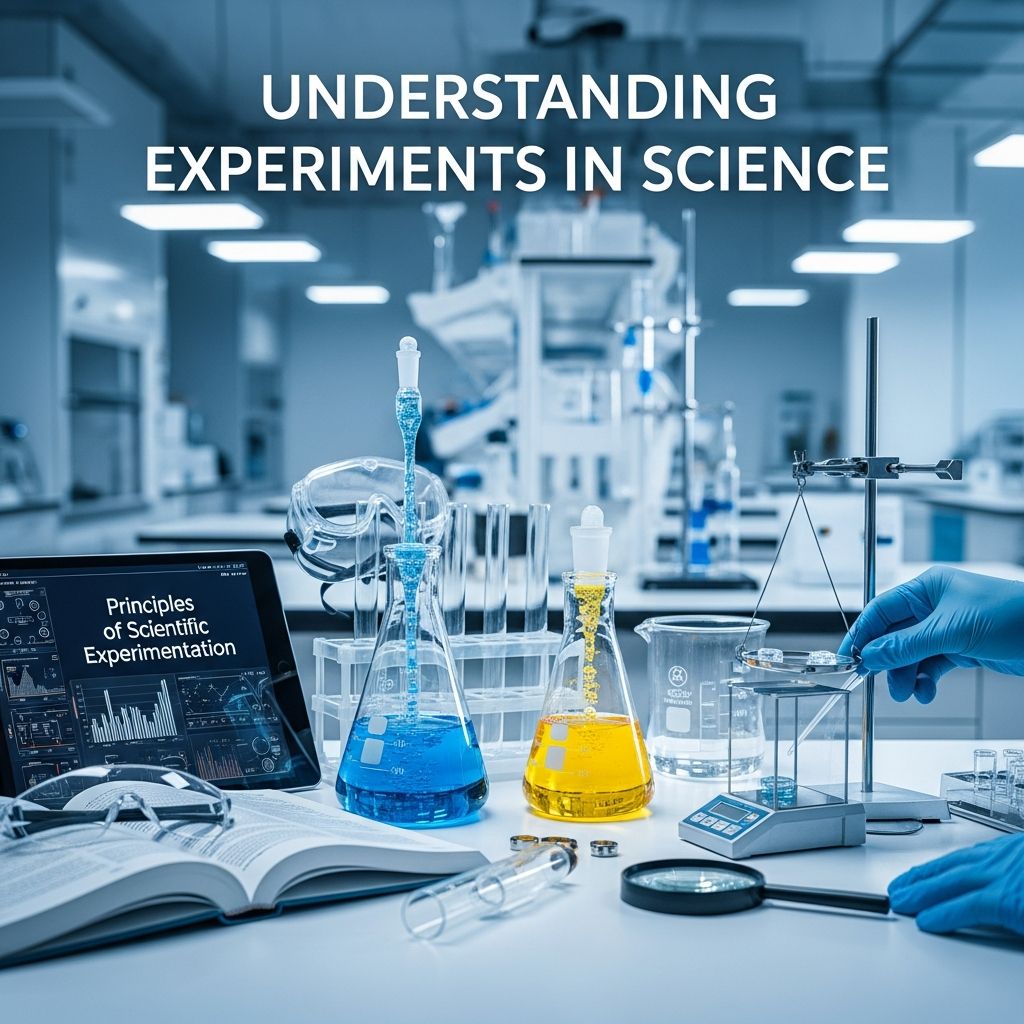
Experiments form the cornerstone of scientific inquiry, enabling researchers to test ideas systematically and uncover truths about the natural world. By manipulating variables under controlled conditions, scientists can establish cause-and-effect relationships, validate theories, and drive innovation across disciplines.
The Core Purpose and Definition of Scientific Experiments
A scientific experiment is a methodical procedure designed to test a hypothesis or explore an unknown phenomenon by observing outcomes under specific conditions. Unlike casual observations, experiments involve deliberate intervention to isolate variables and ensure reliable results. This approach distinguishes experiments from other research methods, as they directly address causality—determining if changes in one factor reliably produce changes in another.
At its heart, an experiment answers questions like “What happens if…?” or evaluates predictions derived from theories. For instance, dropping objects of varying weights tests the hypothesis that mass does not affect fall speed in a vacuum, confirming gravitational principles. Dictionaries reinforce this: Merriam-Webster defines it as “a procedure carried out under controlled conditions to discover an unknown effect, test a hypothesis, or illustrate a known law.”
Key Components Every Experiment Must Include
Effective experiments rely on several interdependent elements to produce valid, reproducible findings. Understanding these builds a strong foundation for anyone engaging in research.
- Hypothesis: A testable prediction, often phrased as “If [independent variable changes], then [dependent variable will change].” It guides the entire process.
- Variables:
- Independent Variable (IV): The factor manipulated by the researcher, such as dosage in a drug trial.
- Dependent Variable (DV): The outcome measured, like patient recovery rate.
- Controlled Variables: Factors kept constant to prevent confounding influences, e.g., same room temperature.
- Control Group: A baseline setup identical to the experimental group except for the IV, allowing fair comparisons.
- Trials/Replications: Multiple runs to account for variability and enhance reliability.
These components ensure experiments minimize bias and maximize objectivity. For example, in plant growth studies, sunlight exposure might be the IV, height the DV, and soil type a control.
Types of Experiments: From Lab to Field
Experiments adapt to contexts, ranging from tightly controlled lab settings to real-world applications. Here’s a breakdown:
| Type | Description | Examples | Strengths | Limitations |
|---|---|---|---|---|
| Laboratory Experiments | Conducted in controlled environments to isolate variables. | Physics demos like pendulum swings. | High precision, replicability. | May lack real-world applicability. |
| Field Experiments | Performed in natural settings for ecological validity. | Agricultural trials on farms. | Realistic outcomes. | Harder to control variables. |
| Natural Experiments | Observes naturally occurring events mimicking manipulation. | Studying volcano effects on climate. | Ethical for unmanipulable scenarios. | Limited causality inference. |
| Quasi-Experiments | Uses existing groups without random assignment. | Educational program evaluations. | Practical for social sciences. | Potential selection bias. |
Laboratory setups excel in precision but can oversimplify reality, while field variants prioritize applicability despite external interferences.
Step-by-Step Guide to Designing a Robust Experiment
Crafting a sound experiment follows the scientific method’s iterative cycle. Here’s a practical roadmap:
- Formulate a Question: Start with curiosity, e.g., “Does caffeine improve reaction time?”
- Conduct Background Research: Review prior studies to refine the question and avoid redundancy.
- Develop Hypothesis: Make it falsifiable and specific.
- Plan Procedure: Detail materials, steps, measurements, and safety protocols. Include sample size calculations for statistical power.
- Implement Controls: Randomize assignments, blind testers to reduce bias.
- Collect and Analyze Data: Use stats like t-tests to interpret results.
- Draw Conclusions: Support, refute, or refine the hypothesis; suggest future work.
- Report Findings: Share methods transparently for replication.
This sequence, rooted in empirical tradition, traces back to pre-scientific tech trials and evolved into modern rigor.
Common Pitfalls and How to Avoid Them
Even seasoned researchers encounter errors that undermine validity. Key traps include:
- Confounding Variables: Uncontrolled factors skewing results—solution: exhaustive lists and monitoring.
- Sampling Bias: Non-representative groups—use random selection.
- Confirmation Bias: Cherry-picking supportive data—employ double-blinding.
- Inadequate Sample Size: Leads to false negatives—power analysis beforehand.
- P-hacking: Manipulating stats for significance—pre-register protocols.
Avoiding these ensures ethical, trustworthy science. Peer review and replication further validate claims.
Historical Milestones: Experiments That Shaped Knowledge
Iconic experiments illustrate experimentation’s power. Galileo’s Pisa tower test debunked heavier objects fall faster myth. Pasteur’s swan-neck flask refuted spontaneous generation, proving microbes airborne. Modern examples include the Large Hadron Collider smashing particles to hunt Higgs boson, confirming Standard Model predictions.
In psychology, Milgram’s obedience studies revealed authority’s influence, sparking ethics debates. These cases highlight experiments’ dual role: discovery and societal impact.
Experiments Beyond Natural Sciences: Applications in Social Fields
While synonymous with physics or biology, experiments thrive in social sciences too. Economists run field trials like randomized cash transfers assessing poverty alleviation. Psychologists use lab paradigms for cognition, e.g., Stroop test on attention.
Quasi-experiments dominate where ethics bar manipulation, like policy impacts post-natural disasters. These adapt core principles—variables, controls—to human complexities.
The Future of Experimentation: Innovations and Challenges
Technology revolutionizes experiments: AI optimizes designs, CRISPR enables precise genetic manipulations, virtual simulations cut costs. Big data analytics handle massive trials, as in genomics.
Challenges persist: reproducibility crisis (only ~50% replicate), ethical dilemmas (animal testing, human trials), resource demands. Solutions include open science, preregistration, international collaborations.
Experiments remain indispensable, evolving with tech while upholding methodological purity.
Frequently Asked Questions (FAQs)
What is the main difference between an experiment and an observation?
Experiments actively manipulate variables to test causality, while observations passively record events without intervention.
Why are control groups essential?
They provide a baseline, isolating the independent variable’s effect and ruling out external influences.
Can experiments prove a hypothesis absolutely?
No; they support or refute, but certainty requires repeated, varied confirmations across studies.
How many trials are needed for reliable results?
Depends on variability; statistical power analysis determines sufficient sample size, often 30+ per group.
Are ethical guidelines required for all experiments?
Yes, especially involving humans/animals—IRBs ensure informed consent, minimal harm.
References
- Experiment – Wikipedia — Wikimedia Foundation. 2023-10-01. https://en.wikipedia.org/wiki/Experiment
- Experiment | Science | Research Starters — EBSCO. 2023. https://www.ebsco.com/research-starters/science/experiment
- Experiments: Why and How? — PubMed (Synthese Journal). 2015-03-01. https://pubmed.ncbi.nlm.nih.gov/25721443/
- EXPERIMENT Definition & Meaning — Merriam-Webster. 2023. https://www.merriam-webster.com/dictionary/experiment
- EXPERIMENT | definition in the Cambridge English Dictionary — Cambridge University Press. 2023. https://dictionary.cambridge.org/us/dictionary/english/experiment
- WHAT IS AN EXPERIMENT? The Experimental Method in Psychology — YouTube (Psychology University). 2023. https://www.youtube.com/watch?v=TxND6_oECdg
Similar Articles








Read full bio of Sneha Tete