Understanding Isolines in Cartography and Geography
Master the visualization of spatial data through isolines and their applications in modern mapping.
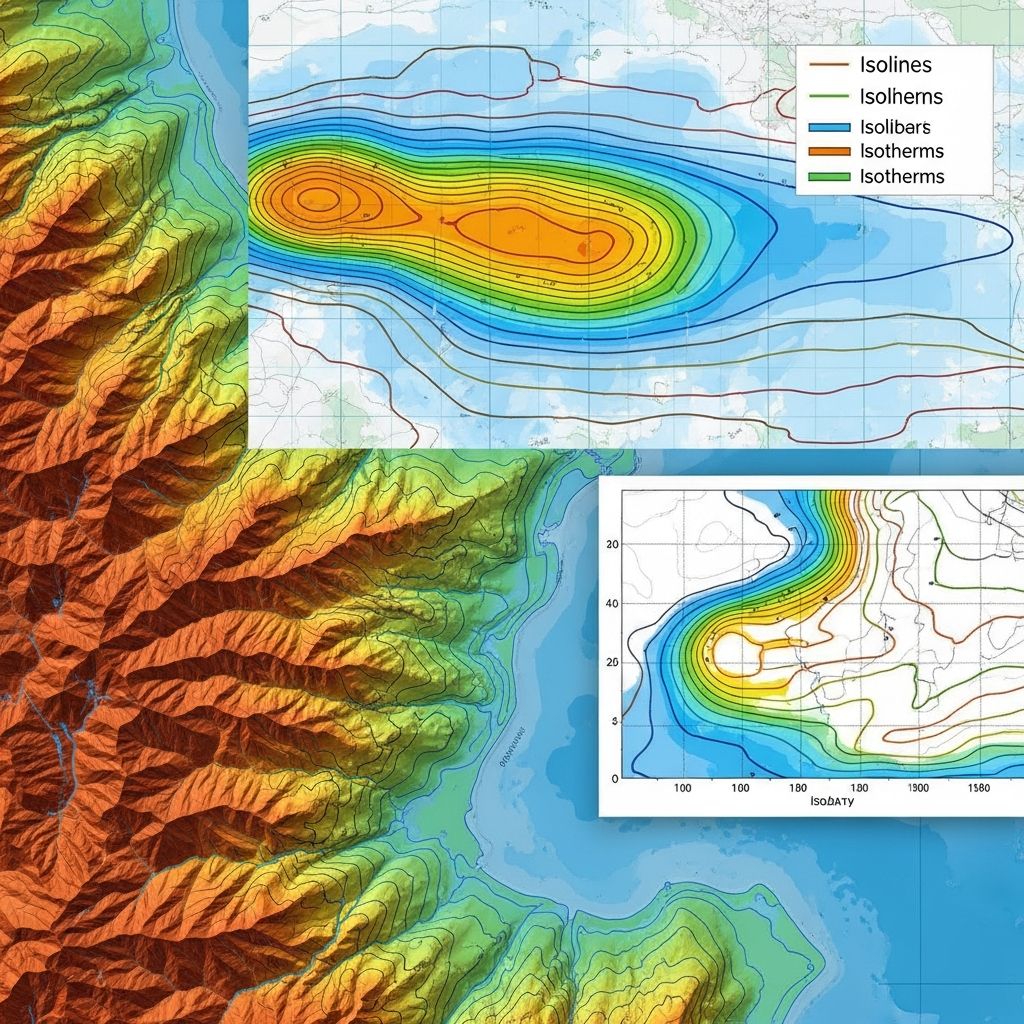
Fundamentals of Isolines: Bridging Data and Visual Representation
Isolines represent one of the most powerful tools in modern cartography and geographic information science, serving as a bridge between complex numerical datasets and intuitive visual patterns. At their core, isolines are lines drawn on maps that connect all points sharing an identical numerical value for a particular measured variable. This simple yet elegant concept enables cartographers, geographers, meteorologists, and urban planners to transform raw numerical data into meaningful spatial visualizations that reveal hidden patterns and trends across landscapes and regions.
The term “isoline” derives from two Greek-origin components: “iso,” meaning equal, and “line,” referring to the visual connection of points. Together, these components create a system for representing scalar fields—quantities that possess a magnitude at each location across a geographic area. By visually connecting locations where values remain constant, isolines allow viewers to quickly grasp how variables change across space without needing to interpret thousands of individual data points.
The Core Principle: Connecting Points of Equal Value
Understanding isolines requires grasping their fundamental principle: they connect geographic locations where a specific measurement or attribute holds the same numerical value. Whether examining elevation patterns on a topographic map, temperature variations across a continent, or atmospheric pressure systems during weather forecasting, isolines provide a consistent methodological approach to spatial representation.
Consider a practical scenario where meteorologists collect temperature readings from weather stations scattered across a region. Each station records a specific temperature value, creating a seemingly random collection of numbers. By connecting all locations where the temperature equals exactly 15 degrees Celsius, then 16 degrees Celsius, and so forth, meteorologists create isotherms—a specific type of isoline—that reveal temperature gradients and patterns invisible in the raw data.
This approach transforms three-dimensional spatial phenomena into two-dimensional map representations, making complex environmental patterns accessible and interpretable. The power of isolines lies in their ability to synthesize distributed observations into coherent visual narratives about how geographic variables change across space.
Primary Classifications: Understanding Isoline Categories
Isolines fall into two fundamental categories based on the nature of the values they represent and where those values actually exist in geographic space. Understanding this distinction is crucial for correctly interpreting and constructing isoline maps.
Isarithms: Point-Specific Values
Isarithms represent isolines where the measured values genuinely exist at specific points or locations. Temperature readings recorded at weather stations exemplify isarithmic data—the temperature value actually exists at that particular geographic coordinate. Elevation values on topographic maps represent another clear example of isarithmic data, as the height above sea level genuinely exists at every point being measured.
When constructing isarithmic maps, cartographers work with actual measured values collected at discrete locations, then interpolate to estimate values between measurement points. This interpolation process assumes that values change gradually across space, allowing mapmakers to draw isolines connecting estimated points of equal value with confidence.
Isopleths: Area-Based Ratios
Isopleths represent isolines for data that exists as ratios or densities distributed across areas rather than at specific points. Population density per square kilometer exemplifies isopleth data—no single location contains a discrete “population density” value; rather, the density represents an average across an entire administrative area.
Crop yield per acre, rainfall per month averaged across a region, and disease incidence per population all represent isopleth data. These values are inherently areal quantities that cannot be precisely located at single points. Constructing isopleth maps requires careful consideration of how area-based data are interpolated and represented as continuous lines across maps.
Specialized Isoline Types and Their Geographic Applications
Different academic disciplines and professional fields have developed specialized isoline terminology to describe lines representing specific types of geographic variables. This specialized vocabulary reflects the particular contexts where isolines prove most useful.
Contour Lines: Mapping Earth’s Surface Elevation
Contour lines represent the most widely recognized and utilized form of isolines in geographic education and professional cartography. These brown or tan lines on topographic maps connect all points sharing identical elevations above sea level. Hikers, surveyors, urban planners, and environmental scientists rely on contour lines to understand terrain characteristics, plan construction projects, and assess watershed boundaries.
Contour line spacing carries significant meaning: closely spaced contour lines indicate steep terrain where elevation changes dramatically over short distances, while widely spaced lines suggest gentle slopes and gradual elevation transitions. This visual encoding allows trained readers to instantly grasp topographic complexity.
Isobars: Visualizing Atmospheric Pressure Systems
Meteorologists employ isobars to connect points of equal atmospheric pressure recorded across regions. Weather maps displaying high-pressure and low-pressure systems utilize isobars to show pressure gradients driving wind patterns and weather systems. Pressure differences represented by isobar spacing directly influence wind speed—closely spaced isobars indicate strong pressure gradients and intense winds, while widely spaced isobars suggest gentler pressure transitions and lighter winds.
Isotherms: Temperature Distribution Patterns
Isotherms connect points experiencing identical temperatures, making them invaluable tools for climatologists, meteorologists, and geographers studying thermal characteristics across regions. January and July isotherm maps reveal continental climate patterns, showing how temperature varies with latitude, elevation, proximity to oceans, and other geographic factors.
Isohyets: Precipitation Mapping
Isohyets connect locations receiving equal amounts of precipitation over specified time periods. Annual isohyet maps reveal how rainfall distribution varies across continents, highlighting desert regions, tropical wet zones, and areas receiving seasonal precipitation patterns. Agricultural planners and water resource managers rely heavily on isohyet maps for strategic planning.
Isophenes: Biological Timing Isolines
Isophenes represent a more specialized isoline category connecting locations where biological events occur simultaneously. Spring bloom times for specific plant species, migration timing for animal populations, or the start of growing seasons all generate isophene patterns revealing how biological processes shift across geographic space.
Fundamental Rules Governing Isoline Construction and Interpretation
Cartographers and geographers adhere to specific principles when constructing isolines, ensuring consistency, accuracy, and interpretability across different maps and contexts.
Consistent Intervals Between Lines
Each map employs a fixed interval—called the isoline interval—between consecutive isolines. A topographic map might use 10-meter intervals between contour lines, while a pressure map might employ 5-millibar intervals between isobars. This consistency enables readers to quantify changes between lines and assess the magnitude of gradients represented.
Isolines Never Cross
A fundamental principle of isoline construction prohibits isolines representing different values from crossing each other. If two isolines crossed, this would suggest that two different values exist simultaneously at the same geographic location—an impossibility. Any crossing indicates either mapping errors or inappropriate data interpolation requiring correction before map publication.
Enclosed Regions Indicate Extrema
When isolines form closed loops or rings completely encircling a region, the enclosed area contains either maximum or minimum values compared to surrounding areas. A closed contour line encircling a mountaintop indicates an elevation maximum, while closed isobars around a low-pressure system indicate a pressure minimum. This visual pattern instantly communicates where extreme values occur spatially.
Practical Applications Across Professional Disciplines
Isolines have become indispensable across diverse fields requiring spatial data visualization and analysis. Their versatility explains their continued prominence in an era of advanced digital mapping technologies.
Urban Planning and Land Development
Urban planners utilize contour lines to understand terrain constraints affecting infrastructure development. Building placement, road routing, and drainage system design all depend on understanding elevation patterns revealed through contour mapping. Slope analysis derived from contour line spacing helps planners identify suitable development areas and hazardous terrain.
Environmental Resource Management
Water resource managers employ watershed maps utilizing contour lines to understand how precipitation flows across landscapes. Groundwater professionals use isoline maps showing water table depth to guide drilling operations and predict contamination spread. Foresters employ elevation-based isolines to understand vegetation distribution patterns.
Climate and Weather Analysis
Meteorological agencies produce daily weather maps with isobars showing pressure systems driving weather patterns. Climate scientists construct maps with isotherms and isohyets revealing long-term temperature and precipitation patterns across regions. These maps communicate weather forecasts and climate information to both professional audiences and the general public.
Agricultural and Biological Sciences
Agricultural specialists employ isoline maps showing temperature, rainfall, and soil characteristics to guide crop selection and planting strategies. Ecologists use isolines representing species habitat characteristics to model animal and plant distributions. Phenological maps showing isophenes track how biological processes shift in response to climate variations.
From Raw Data to Visual Intelligence: The Interpolation Process
Constructing isolines from real-world measurements involves making assumptions about values between measurement points. Cartographers employ various interpolation techniques to estimate where isolines should appear between actual data collection sites.
Linear interpolation assumes values change uniformly between measurement points, representing the simplest approach suitable for many applications. More sophisticated techniques like kriging, which employs statistical modeling, can produce more accurate interpolation when data distributions are irregular or influenced by underlying geographic features.
The choice of interpolation method significantly affects final map appearance and the patterns isolines reveal. Experienced cartographers select methods matching both their data characteristics and the intended map audience.
Advantages of Isolines Over Alternative Representation Methods
While various methods exist for representing spatial data, isolines offer distinctive advantages that explain their enduring popularity:
- **Intuitive Pattern Recognition:** Viewers can instantly grasp spatial gradients and extreme values without numerical data interpretation
- **Continuous Surface Representation:** Isolines depict phenomena as continuous surfaces rather than discrete points, matching how many geographic processes actually function
- **Efficient Data Synthesis:** Complex datasets containing thousands of observations become interpretable when synthesized into isoline patterns
- **Professional Standards:** Isolines represent established conventions in cartography, ensuring consistency and familiarity across maps and disciplines
- **Scale Flexibility:** Isoline maps effectively represent data at scales ranging from local neighborhoods to global phenomena
Modern Digital Isolines and Technological Advances
Contemporary geographic information systems (GIS) and digital mapping platforms automate much of the isoline construction process, allowing cartographers to generate isolines from datasets with unprecedented speed and sophistication. Digital tools enable dynamic exploration where users adjust isoline intervals, visualization methods, and data sources interactively.
However, automation introduces new considerations: algorithms making interpolation decisions previously requiring cartographic expertise now operate invisibly. Understanding underlying methodologies remains crucial for producing accurate, meaningful isoline maps despite technological convenience.
Frequently Asked Questions About Isolines
Q: Can isolines represent multiple variables simultaneously on a single map?
A: While technically possible, representing multiple variables with different isoline types on one map typically creates visual confusion. Separate maps for each variable usually provide clearer communication, though some specialized applications use different line styles or colors to distinguish variable types.
Q: How do cartographers choose appropriate isoline intervals?
A: Interval selection depends on data range, measurement precision, and intended audience. Smaller intervals reveal more detail but risk cluttering maps, while larger intervals simplify visualization but omit nuance. Professional conventions guide interval selection for standard map types.
Q: What happens when data is irregularly distributed across space?
A: Irregular data distributions require careful interpolation methodology selection. Cartographers may employ weighted averaging, statistical modeling, or expert interpretation to estimate values between measurement points while minimizing distortion from data clustering or sparse coverage areas.
Q: Do isolines always represent linear relationships between values?
A: No; isoline spacing reflects actual gradient patterns, which vary across space. Some regions may show gradual value transitions while others display rapid changes, producing variable spacing patterns that communicate underlying spatial complexity.
Q: How do digital isoline visualizations differ from traditional printed maps?
A: Digital tools enable interactive exploration, dynamic interval adjustment, and real-time updates from new data. However, fundamental isoline principles remain unchanged; digital and printed isolines employ identical geographic conventions and represent data through identical methodological approaches.
References
- Isoline Definition — Esri Support GIS Dictionary. 2024. https://support.esri.com/en-us/gis-dictionary/isoline
- Isolines: Definitions & FAQs — Atlas. 2024. https://atlas.co/glossary/isolines/
- Isolines — The Physical Environment. 2024. https://www.thephysicalenvironment.com/Book/essentials/isolines.html
- What is an Isoline Map? — Geoapify. 2024. https://www.geoapify.com/what-is-an-isoline-map/
- Contour line — Wikipedia. 2024. https://en.wikipedia.org/wiki/Contour_line
- A Guide to Isoline Maps — Royal Geographic Society. 2024. https://www.rgs.org/media/ewedan5h/iaguidetoisolinemaps.pdf
Similar Articles








Read full bio of medha deb