Understanding Mass Nouns in English Grammar
Master mass nouns: Explore uncountable nouns, their rules, examples, and how they differ from count nouns in English.
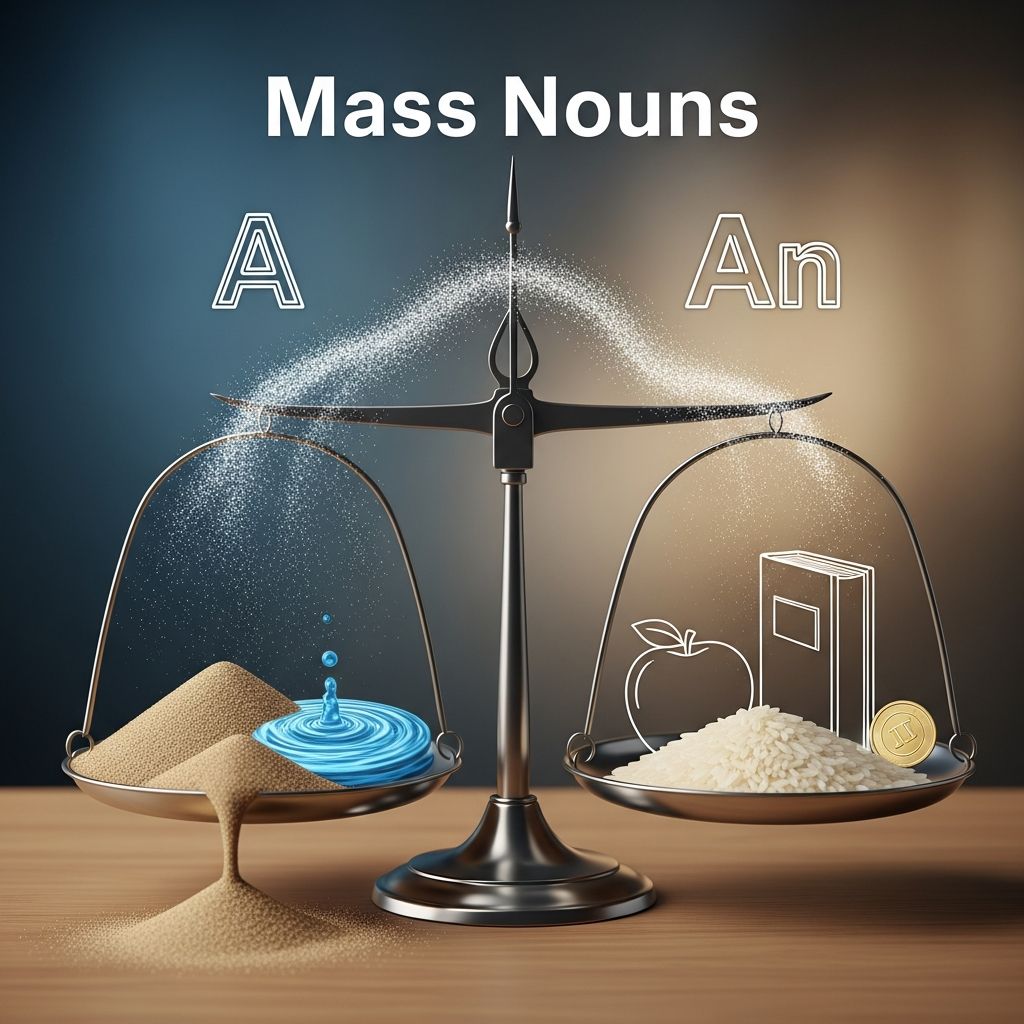
Mass nouns, often referred to as uncountable or noncount nouns, form a fundamental part of English grammar by describing substances, concepts, or qualities that resist individual counting. Unlike countable items like apples or books, mass nouns such as water or happiness treat their referents as continuous wholes without discrete units. This article explores their characteristics, categories, grammatical rules, and practical applications to enhance your language skills.
Defining Mass Nouns: The Basics
A mass noun denotes something homogeneous or indivisible into countable parts without additional specification. For instance, you cannot say “three airs” because air functions as a singular, undifferentiated entity. These nouns lack plural forms and pair with singular verbs, distinguishing them from plural-capable count nouns.
Key traits include:
- No plural inflection: “information” remains unchanged, not “informations.”
- Incompatibility with numbers directly: Avoid “two rices”; use “two grains of rice” instead.
- Pairing with quantifiers like “much,” “some,” or “a lot of” rather than “many.”
- Singular verb agreement: “The furniture is new,” not “are.”
This structure ensures precision in expressing quantities of intangible or bulk substances.
Categories of Mass Nouns
Mass nouns span diverse groups, from physical substances to abstract ideas. Understanding these helps in recognition and usage.
Physical Substances and Materials
Liquids like milk, gases such as oxygen, and granular materials including sand exemplify mass nouns. These are perceived as uniform masses rather than separate items. Metals (gold), foods (bread), and fabrics (cotton) follow suit.
| Category | Examples | Usage Note |
|---|---|---|
| Liquids | water, oil, wine | “Pour some water into the glass.” |
| Gases | air, smoke | “Fresh air is essential for health.” |
| Granular | rice, sugar, flour | “Add a cup of flour to the mix.” |
| Materials | wood, plastic | “The table is made of wood.” |
Abstract Concepts
Intangibles like intelligence, happiness, or advice cannot be quantified discretely. Academic fields (mathematics) and emotions (anger) also qualify. These nouns convey qualities or states without boundaries.
- Emotions: love, fear
- Qualities: beauty, courage
- Activities: music, swimming (as gerunds)
Other Groups
Languages (English), weather phenomena (rain), and collective terms like furniture or luggage round out common mass nouns. Gerunds, such as running or reading, often behave similarly when denoting the activity itself.
Mass Nouns Versus Count Nouns: Key Differences
Count nouns, like chair or dog, can be pluralized (chairs, dogs) and modified by numerals or articles (a chair, three dogs). Mass nouns demand different handling.
| Feature | Mass Noun | Count Noun |
|---|---|---|
| Plural Form | No (water) | Yes (books) |
| Direct Numerals | No (not “two waters”) | Yes (two books) |
| Quantifiers | much, little, some | many, few, several |
| Articles | No “a/an” (not “a water”) | a/an, the |
This contrast affects sentence construction profoundly.
Quantifying Mass Nouns Effectively
To discuss amounts, employ quantifiers or partitives. “Much” suits questions and negatives (“How much sugar? Not much.”), while “some/any” fits affirmatives and questions.
- Partitives: a piece of advice, a drop of water, a sheet of paper
- Measurements: a liter of milk, a kilo of rice
- General: a lot of/little time
Examples:
– Correct: “I need some advice.”
– Incorrect: “I need an advice.”
– Correct: “There is too much traffic.”
Dual Nature: When Mass Becomes Count
Some nouns shift roles contextually. “Beer” as mass noun: “I like beer.” As count: “I drank three beers” (glasses). Similarly, “cake” (mass: general substance) vs. “cakes” (types or pieces).
This flexibility arises when referring to varieties, containers, or portions, allowing plurals for specificity.
Common Errors and How to Fix Them
Learners often pluralize mass nouns or misuse articles. Pitfalls include:
- Error: “The news are good.” → Fix: “The news is good.”
- Error: “I have three furnitures.” → Fix: “I have three pieces of furniture.”
- Error: “Give me an information.” → Fix: “Give me some information.”
Test by adding numbers: If “five Xs” sounds wrong, it’s mass.
Advanced Usage in Sentences
Mass nouns enrich descriptive language. In literature: “The silence was deafening.” In science: “Oxygen supports combustion.” Professional writing benefits from precise quantification: “A scarcity of resources hampers growth.”
Consider verb agreement: “Mathematics requires logic.” This singular treatment unifies expression.
Practical Exercises for Mastery
Practice identifying:
- Classify: homework, scissors, luggage. (homework: mass; scissors/luggage: count in plural sense but often mass-like)
- Correct: “She bought two breads.” → “two loaves of bread.”
- Quantify: “_____ sand is in the desert.” → “A lot of/ much sand”
These build intuition over time.
Frequently Asked Questions (FAQs)
What is the main difference between mass and count nouns?
Mass nouns cannot be pluralized or counted directly, while count nouns can take plurals and numbers.
Can mass nouns ever be plural?
Yes, when denoting types or units, e.g., “various wines” for kinds of wine.
How do I quantify mass nouns?
Use “much/many,” partitives like “a bit of,” or measurements: “a cup of sugar.”
Is “data” a mass noun?
Traditionally yes (“data is”), though sometimes treated as count in tech contexts (“datasets”).
Why can’t I say “a furniture”?
Furniture is mass; use “a piece of furniture.”
References
- What Is a Mass (Uncountable) Noun? — Grammarly. 2023. https://www.grammarly.com/blog/parts-of-speech/mass-noun/
- Mass Noun Definition & Meaning — Merriam-Webster. 2023-10-15. https://www.merriam-webster.com/dictionary/mass%20noun
- Mass Noun — Wikipedia. 2023. https://en.wikipedia.org/wiki/Mass_noun
- What are Mass Nouns in English? — Mango Languages. 2023. https://mangolanguages.com/resources/learn/grammar/english/what-are-mass-nouns-in-english
- What Are Mass Nouns? — Proofed Writing Tips. 2023. https://proofed.com/writing-tips/what-are-mass-nouns/
- Why Isn’t This Plural? Mass Nouns — University of Nevada, Reno Writing Center. 2023. https://www.unr.edu/writing-speaking-center/writing-speaking-resources/mass-nouns
Similar Articles







Read full bio of medha deb