Understanding the Coriolis Effect
Discover how Earth's rotation creates the Coriolis effect, shaping winds, ocean currents, and global weather patterns.
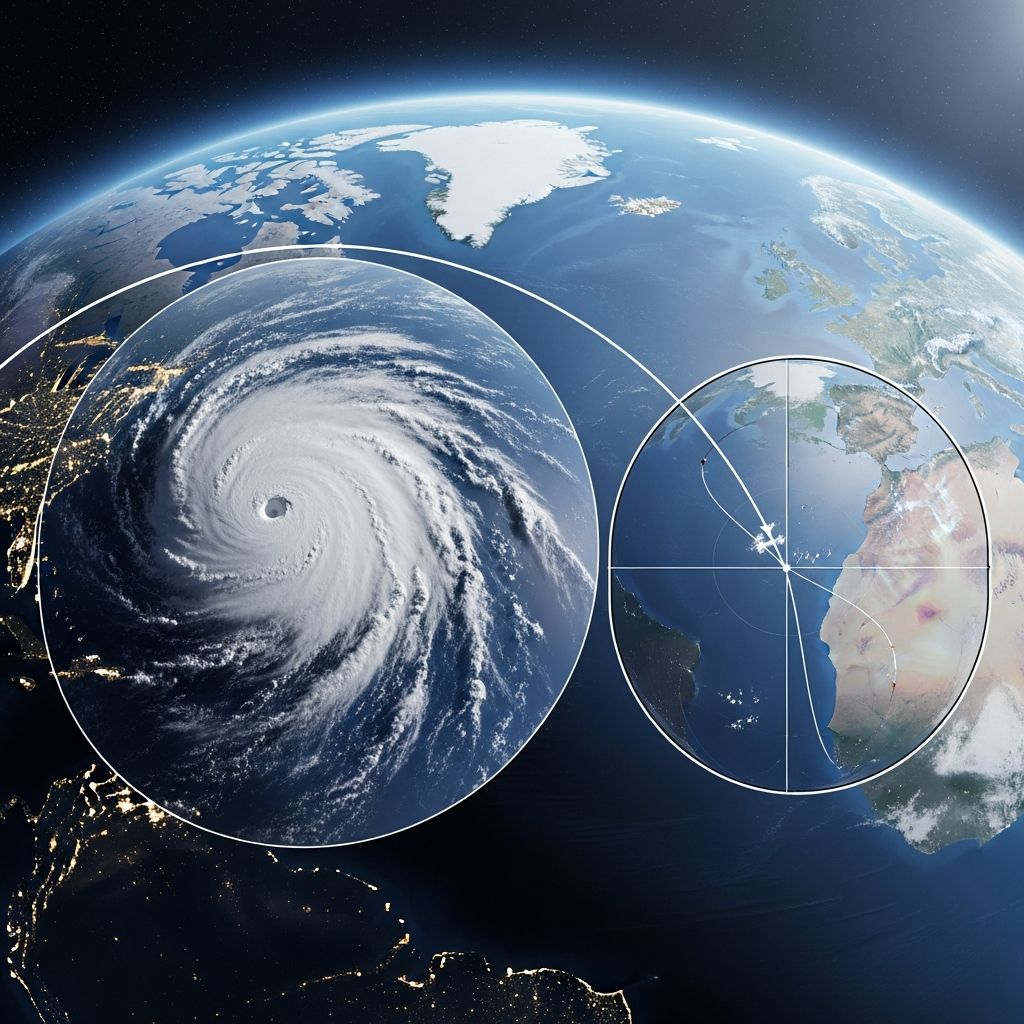
The Coriolis effect is an apparent deflection of moving objects caused by the rotation of the Earth, profoundly influencing large-scale movements in the atmosphere and oceans.
Fundamentals of Earth’s Rotation and Motion
Earth completes one full rotation on its axis every 24 hours, creating different linear speeds at various latitudes. At the equator, points on the surface move at about 1670 kilometers per hour eastward, while near the poles, this speed approaches zero. This variation is central to the Coriolis effect.
From an inertial frame outside Earth, objects move in straight lines per Newton’s first law. However, observers on the rotating Earth perceive these paths as curved due to the changing reference frame.
Defining the Coriolis Force
The Coriolis force is a fictitious force arising in rotating reference frames. It acts perpendicular to the velocity of an object, deflecting it to the right in the Northern Hemisphere and to the left in the Southern Hemisphere.
Mathematically, the Coriolis acceleration is given by a_c = -2 Ω × v, where Ω is Earth’s angular velocity vector and v is the object’s velocity vector. This effect is negligible for small-scale motions but dominates over long distances and durations.
Mechanisms Behind the Deflection
Consider an object launched northward from the equator. It retains the high eastward speed of its origin, while the ground beneath slows eastward at higher latitudes. Thus, the object appears to veer right relative to the surface.
- Northern Hemisphere: Deflection to the right of motion.
- Southern Hemisphere: Deflection to the left of motion.
- Equator: No deflection, as rotation speed matches.
This principle applies to air masses, ocean currents, and even long-range projectiles.
Influence on Atmospheric Circulation
The Coriolis effect shapes global wind patterns by balancing with pressure gradient forces in geostrophic flow. It drives the formation of trade winds, westerlies, and polar easterlies.
High-pressure systems (anticyclones) rotate clockwise in the north and counterclockwise in the south, while low-pressure systems (cyclones) do the opposite. Jet streams, fast airflow at high altitudes, follow wavy paths influenced by this balance.
Role in Ocean Dynamics
Ocean currents, driven by winds, exhibit gyres—large rotating systems. The Coriolis effect causes these to circulate clockwise in the Northern Hemisphere and counterclockwise in the Southern.
Key examples include the Gulf Stream (part of the North Atlantic Gyre) and the Kuroshio Current. Ekman transport, where surface waters move 90 degrees right of wind direction due to Coriolis, contributes to upwelling and nutrient distribution.
| Gyres | Hemisphere | Rotation Direction | Major Currents |
|---|---|---|---|
| North Atlantic | Northern | Clockwise | Gulf Stream, Canary Current |
| South Pacific | Southern | Counterclockwise | East Australian Current |
| North Pacific | Northern | Clockwise | Kuroshio, California Current |
Formation and Spin of Tropical Storms
Hurricanes and typhoons require the Coriolis effect for rotation. Air rushing into low-pressure storm centers deflects, creating inward spiral motion.
- Northern Hemisphere: Counterclockwise rotation.
- Southern Hemisphere: Clockwise rotation.
Near the equator, where Coriolis is weak, storms rarely form (within 5 degrees latitude). Stronger deflection at higher latitudes intensifies spin, enabling hurricane development.
Everyday and Engineering Applications
While imperceptible in daily life, the effect matters for long-range navigation. Artillery shells, missiles, and aircraft adjust trajectories for Coriolis deflection.
For instance, eastward-firing projectiles from high-speed trains experience reduced effective weight due to added rotational speed. Snipers and bombardiers account for several centimeters to kilometers of deviation over distance.
Debunking Common Myths
A persistent myth claims the Coriolis effect dictates drain swirl direction in sinks or toilets. In reality, basin shape, water entry, and residual motion dominate; Coriolis acceleration is tiny (~10^-7 g).
Laboratory demos use large tanks (e.g., 3-meter diameter), precise conditions, and 15-20 hour waits to observe subtle counterclockwise rotation in the Northern Hemisphere.
Experimental Evidence and Demonstrations
Foucault’s pendulum (1851) visually proves Earth’s rotation via precession, with plane of swing rotating 360 degrees in 32-36 hours at mid-latitudes. Modern setups confirm Coriolis predictions.
High-speed turntables replicate the effect: mercury pools show counterclockwise vortices in the north. These underscore the need for large scales and long times.
Global Implications for Climate and Weather
The Coriolis effect sustains trade wind belts, influencing monsoon patterns and El Niño/La Niña cycles via altered ocean currents. Rossby waves, planetary-scale undulations, propagate weather systems across hemispheres.
In Sverdrup balance, interior ocean flow matches wind curl modulated by Coriolis, explaining basin-wide circulation. Climate models incorporate this for accurate predictions.
Advanced Concepts: Waves and Balances
Kelvin and Rossby waves rely on Coriolis for propagation. In geostrophic balance, Coriolis opposes pressure gradients, stabilizing flows like jet streams.
Ekman spirals describe vertical current shear: surface 90 degrees right of wind, decreasing below. These dynamics underpin ocean productivity and carbon cycling.
Frequently Asked Questions (FAQs)
Does the Coriolis effect determine toilet flush direction?
No, local factors like basin design override the minuscule Coriolis influence.
Why don’t hurricanes form at the equator?
Coriolis force vanishes there, preventing rotational organization of storm inflows.
How does Coriolis affect airplane flights?
Pilots adjust for curved great-circle paths and deflection on long-haul routes.
Is the Coriolis effect a real force?
It’s fictitious—apparent in rotating frames—but essential for describing motion on Earth.
Can you see the Coriolis effect in a backyard pool?
Not reliably; requires controlled, large-scale setups over extended periods.
References
- Coriolis force — Wikipedia. 2023-10-01. https://en.wikipedia.org/wiki/Coriolis_force
- What Is the Coriolis Effect? — NESDIS/NOAA. 2023-05-15. https://www.nesdis.noaa.gov/about/k-12-education/atmosphere/what-the-coriolis-effect
- The Coriolis Effect: A (Fairly) Simple Explanation — SSEC Wisconsin. 2022-08-20. https://stratus.ssec.wisc.edu/courses/gg101/coriolis/coriolis.html
- The Coriolis Effect Explained — Veritasium (YouTube). 2019-11-12. https://www.youtube.com/watch?v=w0Rr6UJGhS4
- The Coriolis Effect — minutephysics (YouTube). 2018-06-25. https://www.youtube.com/watch?v=6L5UD240mCQ
Similar Articles







Read full bio of medha deb