Understanding the Middle East: Geography and Beyond
Explore the Middle East's diverse geography, rich history, cultures, and geopolitical significance in this comprehensive guide.
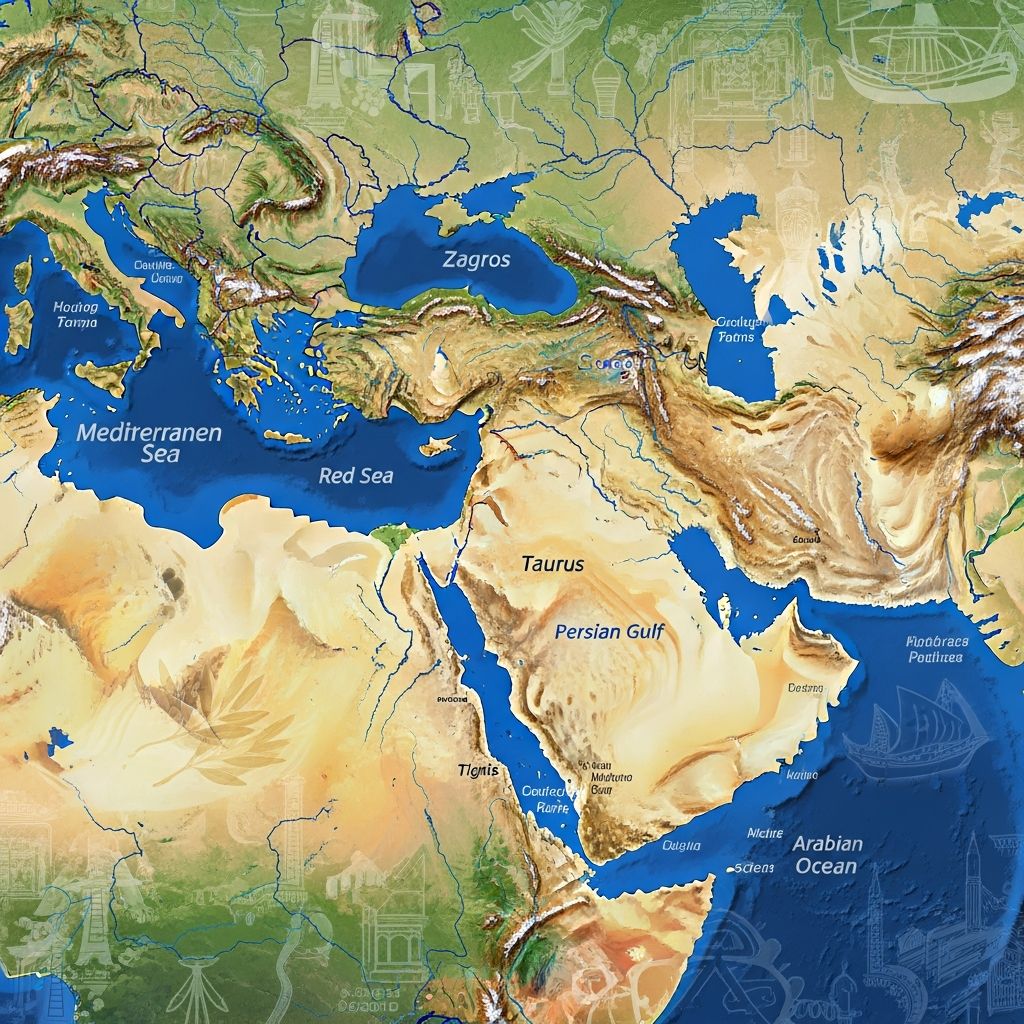
The Middle East stands as a pivotal region bridging continents, cradling ancient civilizations, and shaping global events. This area, often called Southwest Asia by geographers, encompasses a mosaic of nations with shared yet distinct identities.
Defining the Boundaries: A Fluid Concept
Geographical definitions of the Middle East vary, reflecting its Eurocentric origins from 19th-century British naval strategies distinguishing it from the ‘Far East.’ Commonly, it includes the Arabian Peninsula, Levant, Mesopotamia, Anatolia, and Iran, extending sometimes to North Africa and Central Asia.
Core nations typically feature in all definitions: Saudi Arabia, UAE, Qatar, Bahrain, Kuwait, Oman, Yemen (Arabian Peninsula); Syria, Lebanon, Jordan, Israel, Palestine (Levant); Iraq; plus Turkey, Iran, and Egypt. Broader interpretations add Algeria, Libya, Tunisia, Morocco, Sudan from North Africa, or Afghanistan and Pakistan.
- Core Consensus: Arabian Peninsula states, Levant countries, Iraq, Iran, Turkey, Egypt.
- Extended Areas: North African nations (Maghreb), Cyprus, Azerbaijan, Somalia.
- Debated Inclusions: Afghanistan, Pakistan, Greece, Sudan.
This ambiguity arises because the term prioritizes cultural, historical, and political ties over strict geography.
Geographical Diversity and Natural Features
Spanning roughly 2.5 million square miles, the Middle East features deserts, mountains, fertile valleys, and coastlines. Saudi Arabia dominates landmass, followed by Iran, Turkey, and Yemen, comprising over 80% of the area; tiny Bahrain spans just 225 square miles.
| Country | Land Area (sq mi) | Key Features |
|---|---|---|
| Saudi Arabia | 830,000 | Rub’ al-Khali Desert |
| Iran | 636,000 | Zagros Mountains |
| Turkey | 302,000 | Anatolian Plateau |
| Egypt | 386,000 | Nile Valley |
| Bahrain | 225 | Island archipelago |
Western borders touch the Mediterranean and Red Seas; eastern edges meet the Persian Gulf and Caspian Sea. Climates range from arid deserts to Mediterranean coasts and highland plateaus.
Demographics: Population and Ethnic Tapestry
Home to about 335 million in 2015 (with growth since), nearly half reside in Iran and Turkey. Arabs form the largest group, followed by Turks, Persians, Kurds, Jews, Assyrians. Languages include Arabic (dominant), Persian (Farsi), Turkish, Kurdish, Berber.
- Arabic: Lingua franca across 13 Arab League states.
- Persian: Iran’s official tongue.
- Turkish: Spoken by Turkey’s majority.
- Minorities: Hebrew (Israel), Kurdish (transnational).
Religions blend Islam (Sunni-Shia divide), Christianity, Judaism—birthplace of Abrahamic faiths.
Historical Foundations: From Cradles to Empires
The Middle East birthed humanity’s earliest cities in Mesopotamia (modern Iraq), innovations in writing, astronomy, mathematics. Ancient powers: Sumerians, Akkadians, Babylonians, Assyrians, Persians under Cyrus the Great.
Islam’s rise post-632 CE unified the region under caliphates: Umayyad (Damascus), Abbasid (Baghdad), Ottoman (1517-1918). European colonialism redrew maps post-WWI, birthing modern states via Sykes-Picot and mandates.
Key Historical Milestones
- ~3500 BCE: Sumerian cuneiform in Uruk.
- 539 BCE: Persian Empire conquers Babylon.
- 632 CE: Prophet Muhammad’s death; Rashidun Caliphate begins.
- 1916: Sykes-Picot Agreement divides Ottoman lands.
- 1948: Israel founded; Arab-Israeli conflicts ensue.
Cultural Richness and Societal Pillars
Islamic heritage shapes art, architecture (mosques like Mecca’s Kaaba), literature (One Thousand and One Nights). Hospitality, family centrality define social norms.
Diverse traditions: Bedouin nomadism, Levantine cuisine (hummus, falafel), Persian poetry (Rumi, Hafez). Modern influences blend tradition with globalization.
Economic Engines: Oil, Trade, and Diversification
World’s largest oil reserves propel GCC economies (Saudi Arabia holds 17% global). Suez Canal vital for trade; emerging sectors: tourism (Egypt pyramids), tech (Israel ‘Startup Nation’), finance (Dubai).
Challenges: Oil dependency, water scarcity, youth unemployment spur diversification (Saudi Vision 2030).
Geopolitical Hotspot: Conflicts and Diplomacy
Strategic location fuels rivalries: Arab-Israeli wars, Iran-Iraq War, Gulf Wars, Arab Spring (2011). Issues: Palestinian statehood, Syrian civil war, Yemen conflict, Iran nuclear tensions.
External powers (US, Russia, China) vie for influence amid sectarian divides (Sunni Saudi vs. Shia Iran).
Modern Transformations and Future Prospects
Urbanization booms (Dubai skyscrapers); renewable energy rises (solar in deserts). Youth-driven reforms challenge autocracies.
Climate change exacerbates water woes; tech hubs foster innovation.
Frequently Asked Questions (FAQs)
What countries make up the Middle East?
Core: Bahrain, Egypt, Iran, Iraq, Israel, Jordan, Kuwait, Lebanon, Oman, Qatar, Saudi Arabia, Syria, Turkey, UAE, Yemen, Palestine. Extensions vary.
Why is the Middle East called that?
Term coined by Europeans as ‘middle’ between Europe and India/China.
Is the Middle East always in conflict?
No; conflicts stem from resources, borders, ideologies—not inherent.
What languages are spoken?
Primarily Arabic, Persian, Turkish; others: Kurdish, Hebrew, Berber.
Role of oil in the economy?
Dominant in Gulf states; diversification ongoing.
References
- Where Is the Middle East? — UNC Center for Middle East & Islamic Studies. 2023. https://mideast.unc.edu/where/
- History of the Middle East — Deewan Institute. 2023. https://deewaninstitute.com/history-of-the-middle-east/
- Middle East | Map, Countries, West Asia, History, Conflict, & Facts — Encyclopædia Britannica. 2024-04-01. https://www.britannica.com/place/Middle-East
- Middle East — Wikipedia. 2026. https://en.wikipedia.org/wiki/Middle_East
- Middle East (region) — EBSCO Research Starters. 2023. https://www.ebsco.com/research-starters/social-sciences-and-humanities/middle-east-region
- Middle East Facts — Idaho State University. 2023. https://www.isu.edu/history/student-opportunities/projects/middle-east-facts/
- Modern History and U.S. Foreign Policy: Middle East and North Africa — Council on Foreign Relations. 2024. https://education.cfr.org/learn/reading/middle-east-timeline
Similar Articles





Read full bio of medha deb