Unraveling the Term Punic: From Phoenician Roots to Roman Legacy
Discover the origins, evolution, and cultural significance of 'Punic' from ancient Carthage to its lasting impact on history and language.
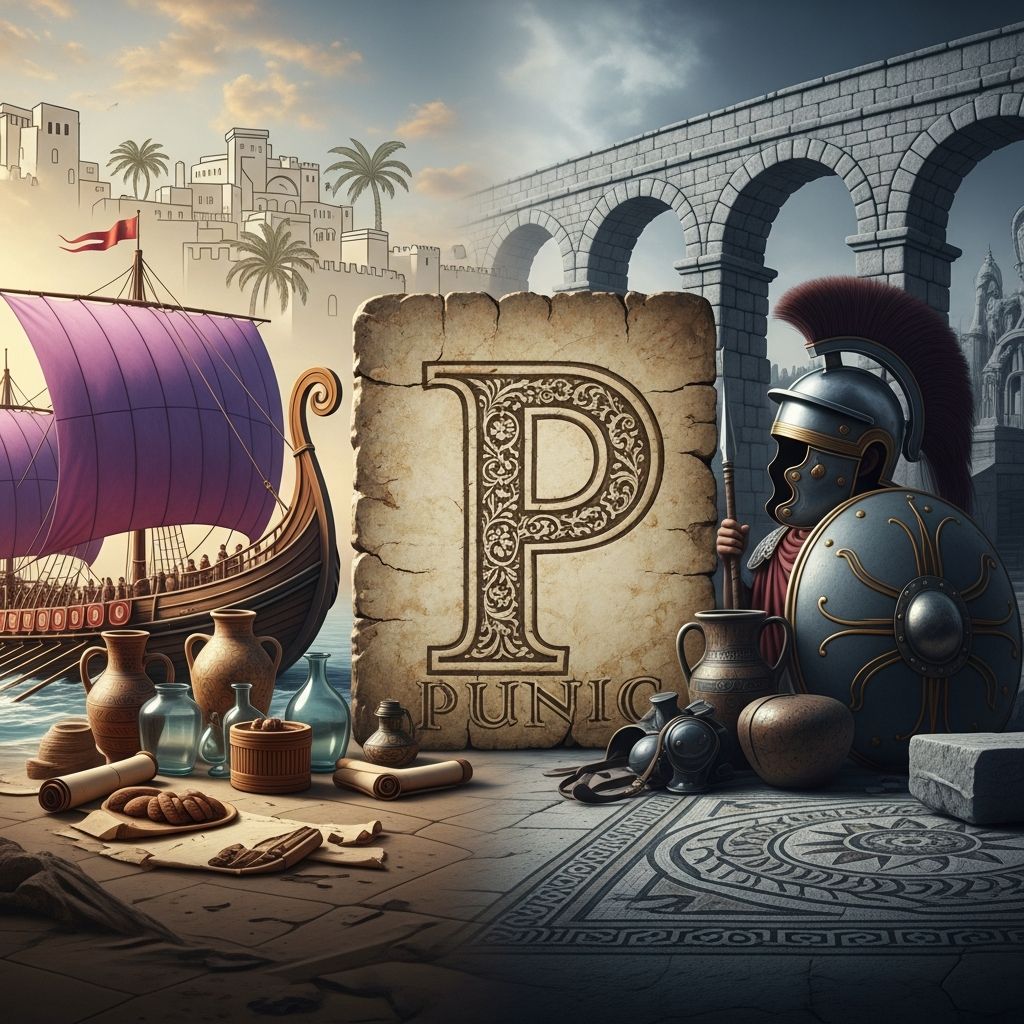
The word Punic evokes images of ancient naval battles, a mighty North African empire, and bitter rivalries that shaped the Mediterranean world. Far more than a mere label, it encapsulates the story of Carthage, its Phoenician forebears, and the Roman propaganda that turned it into a synonym for deceit. This article traces the linguistic journey of ‘Punic,’ examines its cultural distinctions, and explores its enduring legacy through historical conflicts and scholarly debates.
Etymological Foundations: Linking Phoenicians to Punics
At its core, the term ‘Punic’ derives from Latin punicus, a variant of poenicus, referring to Carthaginians or inhabitants of Carthage. This Latin form stems from Poenus, which itself traces back to Greek Phoinix, meaning ‘Phoenician.’ The connection is direct: Carthage was founded around 814 BCE as a Phoenician colony by settlers from Tyre, in modern-day Lebanon.
Phoenicians, renowned seafarers and traders, established outposts across the Mediterranean, from Spain to Sicily. Their language, a Semitic tongue closely related to Hebrew, persisted in these colonies, evolving into what scholars call Punic. By the 1670s in English, ‘Punic’ specifically denoted this Carthaginian dialect. Mycenaean Greek influences, seen in terms like po-ni-ki-jo, further underscore the term’s ancient roots, possibly linked to Egyptian words for Semites or the crimson hue of Tyrian purple dye.
- Key Linguistic Path: Egyptian fnḫw (Asiatics) → Greek Phoinix → Latin Poenus → Punicus.
- Earliest English use as adjective: 1530s, describing Carthaginian traits.
- Noun form: Carthaginian language by 1670s.
This etymology highlights how geography and migration reshaped identities. While ‘Phoenician’ applied to Levantine homeland cities like Tyre and Sidon, ‘Punic’ emerged for western outposts, reflecting adaptation to new environments.
Distinguishing Phoenician Heartlands from Punic Colonies
Scholars debate whether ‘Punic’ denotes a distinct culture or merely a geographic variant of Phoenician identity. Core Phoenician cities in the eastern Mediterranean maintained direct ties to their origins, fostering a unified ‘Phoenicity.’ In contrast, western colonies like Carthage developed unique traits through interactions with Berbers, Iberians, and Sicilians.
Carthage rose to hegemony, subsuming other settlements such as Utica and Hadrumetum in North Africa. This led to a ‘Punic’ synthesis: Phoenician religion (gods like Baal and Tanit), alphabet, and trade practices blended with local elements. Archaeologists note pottery styles, burial customs, and architecture evolving distinctly in these areas.
| Aspect | Phoenician (Eastern) | Punic (Western) |
|---|---|---|
| Geography | Lebanon, Syria coast | North Africa, Iberia, Sicily |
| Cultural Influence | Direct homeland ties | Local integrations (e.g., Berber) |
| Key Sites | Tyre, Sidon, Byblos | Carthage, Utica, Motya |
| Language Evolution | Standard Phoenician | Late Punic dialects |
Figures like historian Moscati argued that while unified by language and beliefs, Punic culture incorporated indigenous features absent in the east. Roman authors, post-64 BCE annexation of Syria, distinguished phoenix (eastern Phoenicians) from poenus (westerners), possibly due to firsthand observations. The mantra holds: All Punics were Phoenicians, but not vice versa.
Carthage: The Epicenter of Punic Power
Founded by Princess Dido (per legend), Carthage became the Mediterranean’s commercial powerhouse by the 3rd century BCE. Its triple-walled harbors, tophet sanctuaries, and mercenary armies symbolized Punic ingenuity. The language, attested in inscriptions like the Nora Stone, persisted even after Rome’s conquest, evolving into Neo-Punic until the 5th century CE.
Punic society thrived on maritime trade: purple dye, ivory, metals. Religion featured child sacrifice debates (tophet stelae), though modern views question ritual extent. Politically, a suffete-led republic balanced aristocratic families like the Barcids, who expanded into Spain.
Carthage’s fall in 146 BCE during the Third Punic War marked the term’s pivot. Romans razed the city, salting the earth in legend, annexing its territories. Yet, Punic speakers lingered in rural Tunisia, influencing Augustine of Hippo, who knew the tongue.
The Punic Wars: Forging a Term of Treachery
The three Punic Wars (264–146 BCE) defined ‘Punic’ in Roman memory. These cataclysmic clashes arose from Sicily rivalries, escalating to total war.
- First (264–241 BCE): Rome’s naval debut against Carthaginian fleets; ended with Sicily’s seizure.
- Second (218–201 BCE): Hannibal’s Alps crossing with elephants; Cannae massacre, yet Roman resilience led to Zama defeat.
- Third (149–146 BCE): Cato’s ‘Carthago delenda est’; total destruction.
Roman propaganda painted Carthaginians as perfidi (faithless). Hasdrubal’s oath-breaking and Hannibal’s cunning fueled this. By the late Republic, punicus meant treacherous, as in Pliny’s accounts. English adopted this slur: ‘Punic faith’ for betrayal.
“Carthaginians were proverbial among Romans as treacherous and perfidious.”
Recent analyses, like climate data from the era, note favorable conditions aiding Rome’s rise during these wars.
Linguistic Legacy: Punic Language and Inscriptions
Punic, a Phoenician dialect, used the 22-letter alphabet. Texts range from treaties (e.g., 507 BCE with Rome) to tariffs and curses. Neo-Punic, latinized script, extended its life post-conquest.
- Major Finds: Marseille tariffs, Lepcis stelae.
- Influence: Berber languages borrowed terms; Latin via Punic words like mapalia (huts).
Today, Punic aids deciphering Phoenician scripts, revealing trade networks.
Modern Scholarship: Debates on Identity
Contemporary historians like Bondì and Docter argue ‘Punic’ best captures post-colonial evolutions, rejecting simplistic Phoenician labels. Archaeology—from Kerkouane’s houses to Ibiza’s necropoleis—shows hybridity. Greek texts uniformly called them Phoenicians, but Romans’ punicus (1st c. BCE) formalized separation.
Punic identity lacked self-designation; outsiders imposed terms. Still, shared Semitic roots unified them against Greek and Roman worlds.
Frequently Asked Questions (FAQs)
Was Punic a separate language from Phoenician?
No, Punic was a dialect of Phoenician, with minor evolutions due to geography and time.
Why did Romans view Punics as treacherous?
Propaganda from Punic Wars amplified Hannibal’s tactics and diplomatic maneuvers into a stereotype of perfidy.
Did Carthage have a distinct religion?
It blended Phoenician deities with local ones, like Tanit supplanting Astarte.
How long did Punic culture survive Rome?
Elements persisted into Roman Africa, influencing Vandals and Byzantines.
Are there Punic descendants today?
Modern Tunisians and Maltese have genetic traces, but culturally assimilated.
References
- Online Etymology Dictionary: Punic — Etymonline. Accessed 2026. https://www.etymonline.com/word/Punic
- Phoenicians or Punics? — Sebastián Panatt, SP Historian (Substack). 2023. https://sebastianpanatt.substack.com/p/phoenicians-or-punics
- Punic – Wiktionary — Wiktionary. Accessed 2026. https://en.wiktionary.org/wiki/Punic
- Punic Definition & Meaning — Merriam-Webster. Accessed 2026. https://www.merriam-webster.com/dictionary/Punic
- Defining Punic Carthage — Telmini et al. (referenced in ). 2015. https://sebastianpanatt.substack.com/p/phoenicians-or-punics
Similar Articles








Read full bio of medha deb