Why Youth Are Turning Away from Traditional News
Unpacking the reasons behind declining news interest among young people and paths to re-engagement.
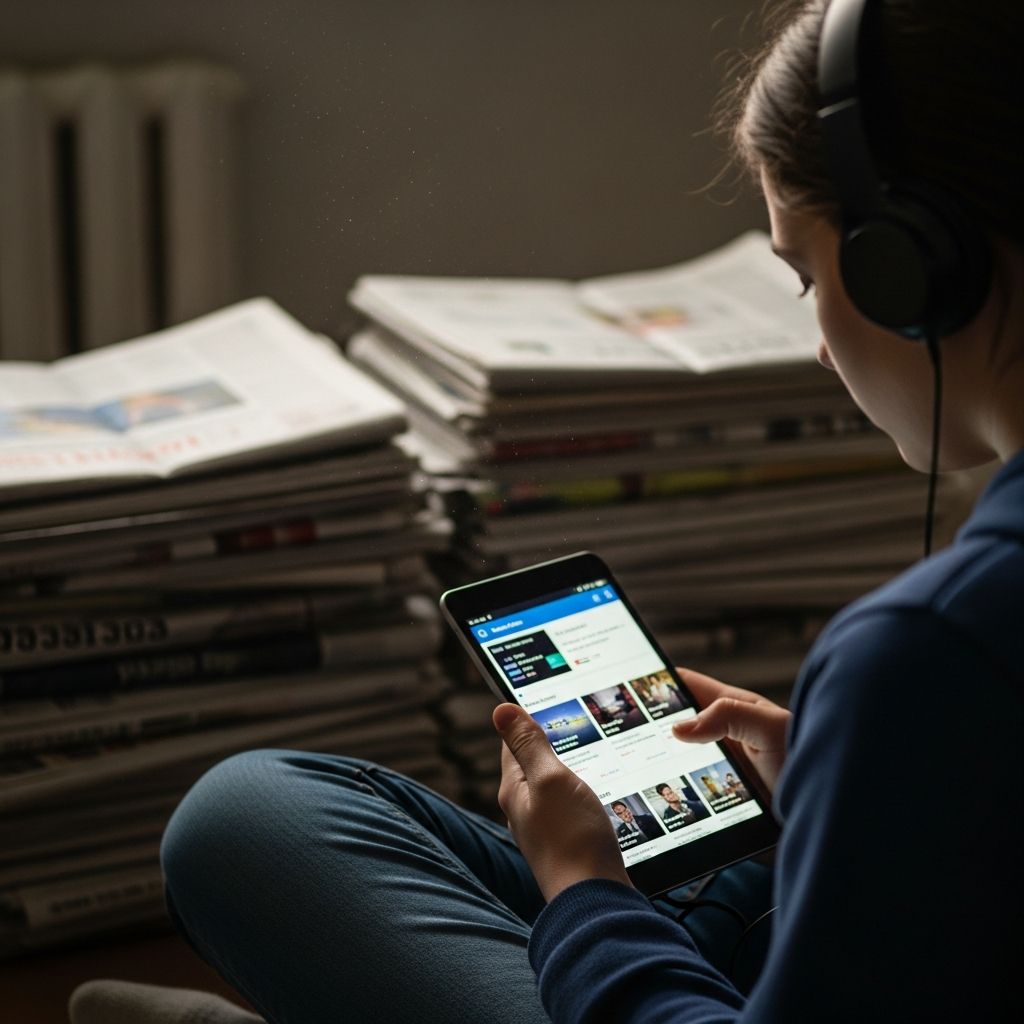
Young people today interact with information in profoundly different ways compared to previous generations, leading to a noticeable decline in engagement with conventional news outlets. While passive data reveals substantial exposure to news content, self-reported habits paint a picture of deliberate avoidance, influenced by distrust, emotional strain, and evolving media landscapes.
The Gap Between Actual and Perceived News Consumption
Recent research highlights a stark discrepancy in how young individuals engage with news. Surveys often show low intentional readership, yet comprehensive tracking of online behaviors tells a different story. For instance, among 15- to 29-year-olds, passive analysis of digital clickstreams indicated that 72% interacted with premium news brands, far exceeding the 16% who self-reported doing so. This underreporting stems from a cultural myth that news is irrelevant to youth, reinforced by peers and media narratives.
News ranks highly in overall digital reach for this demographic, placing third behind essential online activities like email and social messaging, with 88% audience penetration. Even younger subsets, such as 15- to 19-year-olds, demonstrate interest through diverse touchpoints, including social shares and incidental discoveries. These findings challenge assumptions, showing news as a fundamental, if understated, part of young lives.
Widespread Distrust in News Media
A primary barrier is profound skepticism toward journalistic integrity. An overwhelming 84% of teens aged 13-18 hold negative views of news media, associating it with terms like “fake,” “false,” and “lies.” This sentiment persists even when asked about positive aspects, with one-third citing unethical practices such as fabricating details or favoring advertisers.
Teens perceive reporters as more adept at deception than accurate reporting, believing common malpractices include paying sources (51%), contextual manipulation of media (60%), and inventing quotes (50%). Such misperceptions, often fueled by pop culture portrayals and viral misinformation, leave youth vulnerable to propaganda and conspiracy theories, undermining civic participation.
| Perception | Teen Belief (%) | Impact |
|---|---|---|
| Give advertisers special treatment | 49% | Undermines objectivity |
| Make up details/quotes | 50% | Erodes fact-checking trust |
| Pay/favor sources | 51% | Questions source reliability |
| Take media out of context | 60% | Fuels misinformation spread |
This table summarizes key unethical behaviors teens attribute to journalists, based on 2025 News Literacy Project data.
Emotional Fatigue from News Exposure
Beyond distrust, the psychological impact of news consumption deters youth. Young adults under 30 are less likely to follow news closely, with 33% frequently feeling scared or confused by it. Many actively avoid it to protect mental health, citing phrases like “for my sanity” or mood disruption from negativity.
- Scared often/extremely often: 33% of young adults
- Confused often/extremely often: 33% of young adults
- Incidental exposure dominant: 70% encounter political news passively vs. seeking it
This emotional toll is amplified across ages but hits youth harder, correlating with weaker community attachments that might otherwise motivate habitual news intake. In a rapid-change media environment, the depressing tone exacerbates avoidance.
Shift to Digital and Incidental News Pathways
Traditional news delivery struggles against digital natives’ preferences. While 45% of 18-29-year-olds prefer reading news over watching (31%), this aligns with broader text-based, scrollable content habits on social platforms. Gen Z dedicates 58% of video time to social media, favoring short-form over long broadcasts.
Intentional news-seeking is low; instead, 70% of young adults stumble upon political content incidentally, especially on social media used for non-news purposes. This passive consumption ranks news highly in reach but lacks depth, as youth cross-check across platforms (90% do so for decisions).
Implications for Democracy and Personal Decision-Making
Low trust and engagement threaten democratic health. Distrust heightens vulnerability to AI-amplified misinformation, hindering informed choices on health, politics, and civics. Without reliable information filters, youth risk manipulation by extremists or propagandists.
Community disconnection may both cause and result from disengagement, creating a feedback loop. As news brands prove influential despite perceptions—trusted for combating fake news—opportunities exist to rebuild bridges.
Strategies to Reinvigorate Youth News Habits
Addressing these challenges requires multifaceted approaches. News literacy education emerges as critical: teens receiving such lessons show higher media trust. Mandating it in K-12 curricula could bridge perception gaps, teaching bias detection and source evaluation.
- Integrate news literacy nationwide to distinguish news from opinion.
- Highlight quality journalism examples in schools and homes.
- Leverage entertainment to portray accurate press depictions.
- Adapt content for digital preferences: short, engaging formats.
Publishers must innovate, emphasizing trusted, premium content amid fake news eras. Parents and educators can model balanced consumption, discussing stories critically. Research underscores youth value news personally (67%), despite peer skepticism (51%), signaling receptivity.
Comparative News Consumption by Age
| Age Group | Seek News Intentionally (%) | Incidental Exposure (%) | Primary Emotion from News |
|---|---|---|---|
| Under 30 | 30 | 70 | Scared/Confused (33%) |
| 65+ | High (reverse of youth) | 30 | Less negative |
Data from Pew Research illustrates generational divides in news habits.
Frequently Asked Questions (FAQs)
What percentage of teens distrust news media?
84% of 13-18-year-olds express negative views, often calling it “fake” or deceptive.
Do young people actually consume news?
Yes, 72% of 15-29-year-olds engage with premium brands per passive data, though self-reports are lower at 16%.
Why do youth avoid news emotionally?
33% feel scared or confused frequently, leading to avoidance for mental health.
How can news literacy help?
It boosts trust and equips youth to spot bias, reducing misinformation vulnerability.
Do young adults prefer reading or watching news?
45% prefer reading vs. 31% watching, fitting digital scrolling habits.
Looking Ahead: Building Trust in a Fragmented Media World
As digital ecosystems evolve, reclaiming youth attention demands transparency, relevance, and education. By confronting misperceptions head-on and tailoring delivery, news can regain its role as a trusted guide. Premium brands’ hidden influence offers hope, provided stakeholders act decisively on evidence.
References
- Young people don’t read news? Research from Newsworks suggests otherwise — The Media Leader UK. 2023-11 (approx.). https://uk.themedialeader.com/young-people-dont-read-news-research-from-newsworks-suggests-otherwise/
- 84% of Teens Distrust the News. Why That Matters for Schools — Education Week. 2025-11-06. https://www.edweek.org/teaching-learning/84-of-teens-distrust-the-news-why-that-matters-for-schools/2025/11
- Young Adults and the Future of News — Pew Research Center. 2025-12-03. https://www.pewresearch.org/journalism/2025/12/03/young-adults-and-the-future-of-news/
- New study suggests misperceptions drive distrust of news media among Gen Z and Gen Alpha — News Literacy Project. 2025 (approx.). https://newslit.org/news-and-research/new-study-suggests-misperceptions-drive-distrust-of-news-media-among-gen-z-and-gen-alpha/
- Young adults are choosing to read news, not watch it — eMarketer. 2025-08 (approx.). https://www.emarketer.com/content/young-adults-choosing-read-news–not-watch
- Understanding young news audiences at a time of rapid change — Reuters Institute, University of Oxford. N/A (recent). http://reutersinstitute.politics.ox.ac.uk/understanding-young-news-audiences-time-rapid-change
Similar Articles








Read full bio of medha deb